What happened
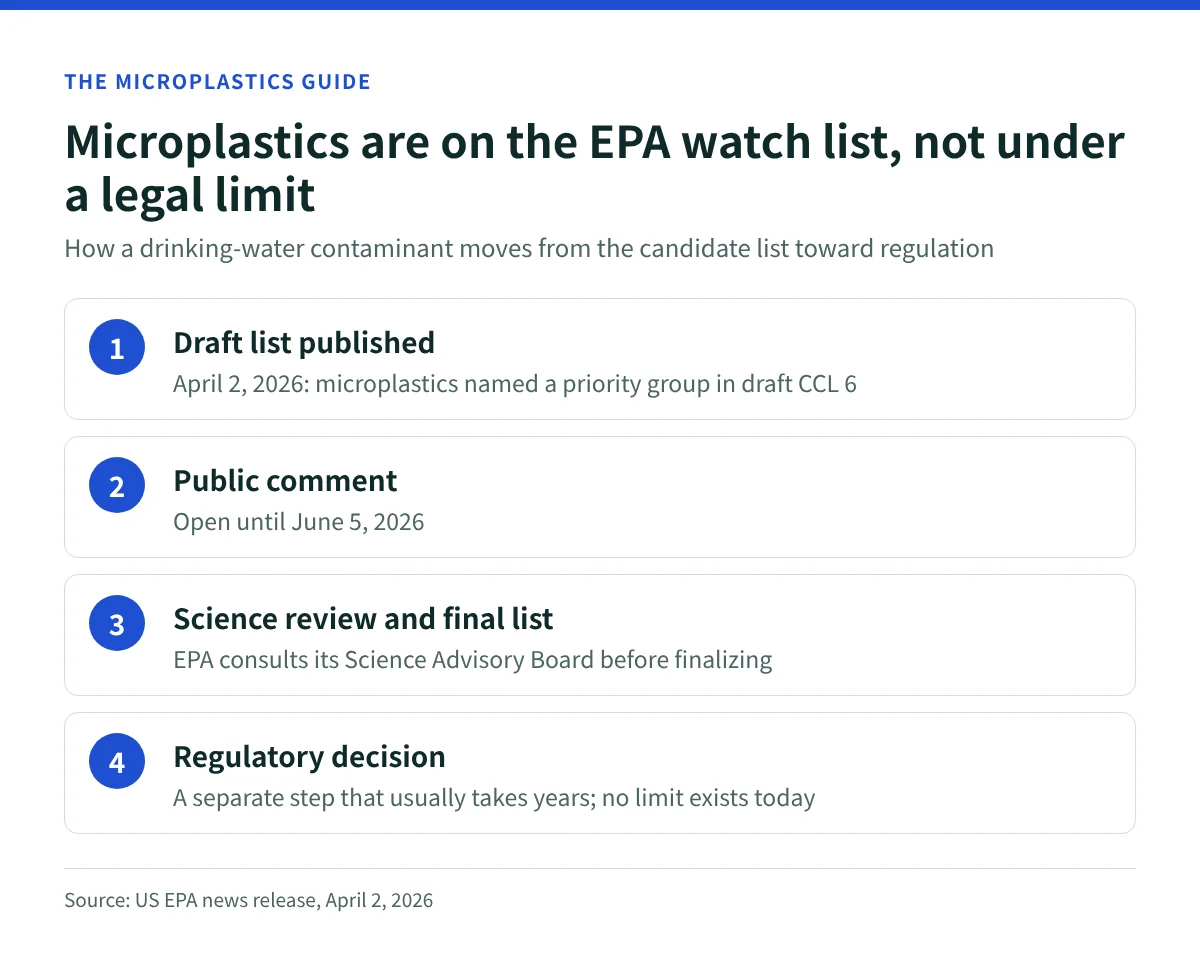
On April 2, 2026, the US Environmental Protection Agency announced a draft of its sixth Contaminant Candidate List (CCL 6) under the Safe Drinking Water Act. For the first time, it named microplastics, along with pharmaceuticals, as priority contaminant groups. The announcement was made jointly with the Department of Health and Human Services.
EPA opened public comment on the draft until June 5, 2026, and said it would consult its Science Advisory Board before finalizing the list later in the year.
What the Contaminant Candidate List does
The list is a research and priority-setting tool. Contaminants on it are not regulated yet. Being listed means EPA considers the contaminant may be present in public water systems and needs more study, and it can lead to a formal decision on whether to set a legal limit. That process typically takes years.
So, today, there is no federal legal limit on microplastics in US tap water. Apart from the 2015 ban on microbeads in rinse-off cosmetics, no federal law directly regulates microplastics.
The research program
HHS also launched Systematic Targeting Of MicroPlastics (STOMP), a $144 million program run by the Advanced Research Projects Agency for Health (ARPA-H). Its goals are to build reliable tests for measuring plastic particles in the human body, map where they collect, and develop ways to remove them.
Better measurement is badly needed. In early 2026, scientists publicly challenged several high-profile studies of microplastics in human organs for possible contamination and false positives. Standard methods would make future findings much easier to trust.
Reaction
Public health researchers welcomed the move but warned that focusing on drinking water and on removing plastic from the body is too narrow. Other major routes include synthetic textile fibers in indoor air and particles from food processing and packaging. Industry lawyers noted that the announcement signals a policy shift that could shape future regulation and litigation, even though no rules have been proposed.
What you can do now
You do not need to wait for regulation to lower your exposure from water:
- Drink tap instead of bottled. Bottled water averaged about 240,000 particles per liter in a 2024 study, far more than typical tap water.
- Use a certified filter if you want extra protection. Look for a microplastics reduction claim under NSF/ANSI 401, or a certified reverse osmosis system. See our filter guide.
- Boil water in steel or glass, not a plastic kettle.
Frequently asked questions
Is US tap water regulated for microplastics?
Not yet. The EPA's 2026 proposal adds microplastics to a list of contaminants under study. It does not set a legal limit.
When could limits on microplastics in water come into force?
No timeline has been announced. Moving from the candidate list to an enforceable standard usually takes several years and requires agreed measurement methods.
Does any state test tap water for microplastics?
California adopted a definition of microplastics in drinking water in 2020 and started a testing program for large water systems. Other states have not adopted comparable requirements.