Many tampons and most disposable pads contain plastic. A 2022 lab study found synthetic polymers in 12 of 24 tampons tested, and some released plastic fibers in simulated use. Whether that matters for health is not known yet, and no study has shown harm in people. For the wider picture of plastics in bathroom products, see our cosmetics and personal care guide.
Do tampons contain plastic?
Some do. The US Food and Drug Administration says tampons are typically made of cotton, rayon or a blend of the two. Cotton and rayon are not plastics. But some tampons also contain synthetic fibers, and many come with plastic applicators.
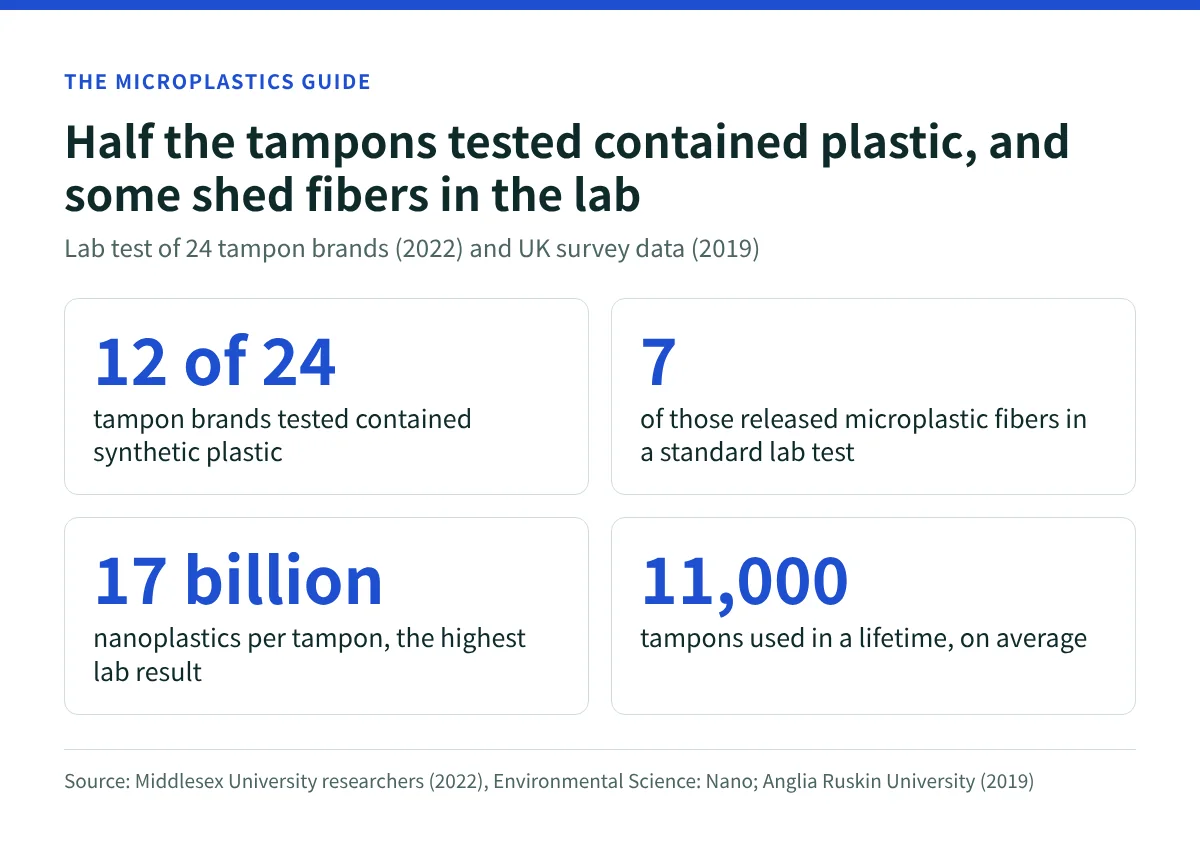
Researchers at Middlesex University in London tested 24 tampon brands in a study published in Environmental Science: Nano. They found synthetic plastics in 12 and fiber release in seven of those 12, using a standard lab test.
Do pads and panty liners contain plastic?
Yes, most disposable pads do. One major brand's published ingredient list, reviewed by EU Fact Check in 2019, shows plastic in each layer:
| Pad layer | Typical material |
|---|---|
| Top sheet | Polypropylene, or a polypropylene, polyethylene and polyester blend |
| Second layer | Polyester fibers |
| Absorbent core | Superabsorbent polyacrylate |
| Backing | Polyethylene film |
You may have seen the claim that pads are "90% plastic." The same fact check rated it uncheckable: the figure is likely, but no maker or agency has published the data to confirm it.
How much plastic can a tampon shed?
The Middlesex team also tested how tampon fibers break down in conditions meant to mimic vaginal fluid. Some products released up to 17 billion nanoplastics per tampon in that lab test.
The average was about 9.4 billion per tampon, according to the university. The authors noted that even cotton fibers could matter at such numbers, since some fibers may stay in the body for a long time.
Use adds up over time. Researchers at Anglia Ruskin University reported in 2019 that women use about 11,000 tampons over a lifetime, on average.
Are microplastics in period products harmful?
Here is how the main claims stand today:
- Strong: most disposable pads and many tampons or applicators contain plastic. Ingredient lists show it, and EU law requires a warning mark.
- Emerging: tampons can shed micro- and nanoplastic fibers. This comes from one lab study, not from measurements in people. The authors called it a preliminary assessment and said health effects in the body are unknown.
- Emerging: possible risks. The authors listed the particles themselves, pollutants stuck to them and additives leaching out. None of these has been tested in users.
Tampons have also drawn attention for metals. In a July 2026 update, the FDA said trace metals are present in tampons, but the amount released during use is too small to cause harm.
Research on plastic in reproductive tissue is young and often disputed. Our explainer on microplastics in the placenta shows why measurements in human tissue are hard. The debate over plastic in the brain follows the same pattern. There is no proven way to remove microplastics from the body.
How are period products regulated in the US and EU?
In the US, the FDA says all menstrual products are regulated as medical devices. Tampons need FDA authorization before sale. In October 2025, the FDA issued draft guidance that recommends testing for contaminants and clearer ingredient information.
In the EU, a 2020 rule under the Single-Use Plastics Directive requires a "PLASTIC IN PRODUCT" marking on packs of pads, tampons and tampon applicators. It has applied since July 3, 2021.
Clear labels matter to shoppers. In a 2019 UK survey of 300 people, 78% felt packaging information was not enough to make an informed choice.
How can you choose period products with less plastic?
Comfort, safety and access come first. If you want less plastic, compare product types:
- Check the pack. In the EU, look for the "Plastic in product" mark. Elsewhere, read the ingredient list for polypropylene, polyethylene, polyester or polyacrylate.
- Organic cotton tampons and pads. The 2019 Anglia Ruskin study notes that organic tampons do not contain plastic. Cardboard applicators or none avoid plastic applicators.
- Menstrual cups and discs. The FDA says cups are generally made from silicone or rubber and may stay in for up to 12 hours. We found no published study measuring particle release from cups.
- Reusable cloth pads and period underwear. Check the fabric label. Synthetic fabrics shed fibers like other clothing, as our clothing and laundry guide explains.
- Never flush tampons or pads. In the Anglia Ruskin survey, 20% thought flushing was acceptable, which sends plastic toward rivers and seas.
Whatever you use, follow the directions. The FDA says to change tampons every four to eight hours and never wear one for more than eight hours, to lower the risk of toxic shock syndrome. Our product guide explains how to read material claims.
Frequently asked questions
Do tampons contain plastic?
Some do. The FDA says authorized tampons are made of cotton, rayon or a blend of the two, which are not plastics. But a 2022 lab study found synthetic plastic in 12 of 24 tampons, and many applicators are plastic.
Do pads contain plastic?
Yes, most disposable pads do. Published ingredient lists show polypropylene or polyethylene top sheets, polyester layers, a superabsorbent polyacrylate core and a polyethylene backing. EU packs must carry a "Plastic in product" mark.
Do Tampax tampons contain plastic?
According to the maker's published ingredient list for Tampax Pearl, the absorbent fibers are rayon and cotton. The same list names polypropylene and polyethylene fibers and a polyester thread, and says Pearl applicators are plastic made without BPA. Check the pack of the product you use, since materials vary by line.
Do modern tampons contain superabsorbent polymers?
The FDA describes authorized tampons as made of cotton, rayon or a blend and does not list superabsorbent polymers. In period products, the superabsorbent polyacrylate gel is found in pad cores. Tampon ingredient lists can still include other synthetic fibers, so read the label.
Are organic tampons free of microplastics?
Organic cotton tampons are made without plastic fibers, so they avoid that source. They can still come in plastic wrappers or with plastic applicators, so check the pack. No product can promise zero contact with plastic, because tiny particles are found almost everywhere.
Do menstrual cups shed microplastics?
Most cups are made of silicone or rubber, which are not the plastics found in pads. We found no published study that measured particle release from menstrual cups. Wash and store a cup as its instructions say.
Should I stop using tampons because of microplastics?
There is no evidence that tampons cause harm through microplastics, and the research so far is a single lab study. If you want less plastic, organic cotton tampons, cups or reusable pads are options. Talk to a doctor if you have symptoms or health concerns.
Keep reading
Sources
- Middlesex University researchers (2022), Release of microplastic fibres and fragmentation to billions of nanoplastics from period products: preliminary assessment of potential health implications, Environmental Science: Nano
- Middlesex University (January 2022): Nanoplastic fibres in the billions released from tampons
- Peberdy, Jones and Green (2019), A Study into Public Awareness of the Environmental Impact of Menstrual Products and Product Choice, Sustainability 11(2):473
- Anglia Ruskin University (January 2019): Awareness is barrier to "plastic-free" periods
- EU Fact Check (February 2019): Conventional menstrual pads are made up of 90% plastic materials: uncheckable
- US FDA (September 2026): The Facts on Tampons and Tampon Safety
- Tampax (2026): What tampons are made of, Tampax Pearl ingredient list
- US FDA (2026): Tampons
- US FDA (2026): Menstrual Product Options, Facts, and Safe Use
- US FDA (2026): Menstrual Cups
- Commission Implementing Regulation (EU) 2020/2151 on harmonised marking specifications for single-use plastic products