
Yes, microplastics in the placenta have been reported repeatedly since 2020. The largest measurement study so far, published in 2024, found plastic in all 62 placentas tested, at an average of about 127 micrograms per gram of tissue. What that means for babies is not yet known, and some of the measurements are now disputed.
This article sums up the main studies. For the wider picture on pregnancy, bottles and children, see our babies and kids guide. After birth, small stool studies suggest babies may take in more microplastics than adults.
What did the first placenta study find?
The first report, nicknamed "Plasticenta", appeared as a preprint in 2020 and was later published in Environment International. Researchers examined placentas from 6 women and found 12 pigmented particles in 4 of them. The particles were about 5 to 10 micrometers wide, much thinner than a human hair. They sat on the side facing the mother, the side facing the baby, and in the membranes.
The study was small and identified particles mainly by their dyes. It showed that plastic particles can reach the placenta, but it could not say how much.
How much plastic was found in the placenta?
In February 2024, a University of New Mexico team reported in Toxicological Sciences that every one of 62 placentas contained plastic. Levels ranged from 6.5 to 685 micrograms per gram of tissue, with a mean of 126.8. The team heated the samples and analyzed the gases released, a method called pyrolysis gas chromatography mass spectrometry.
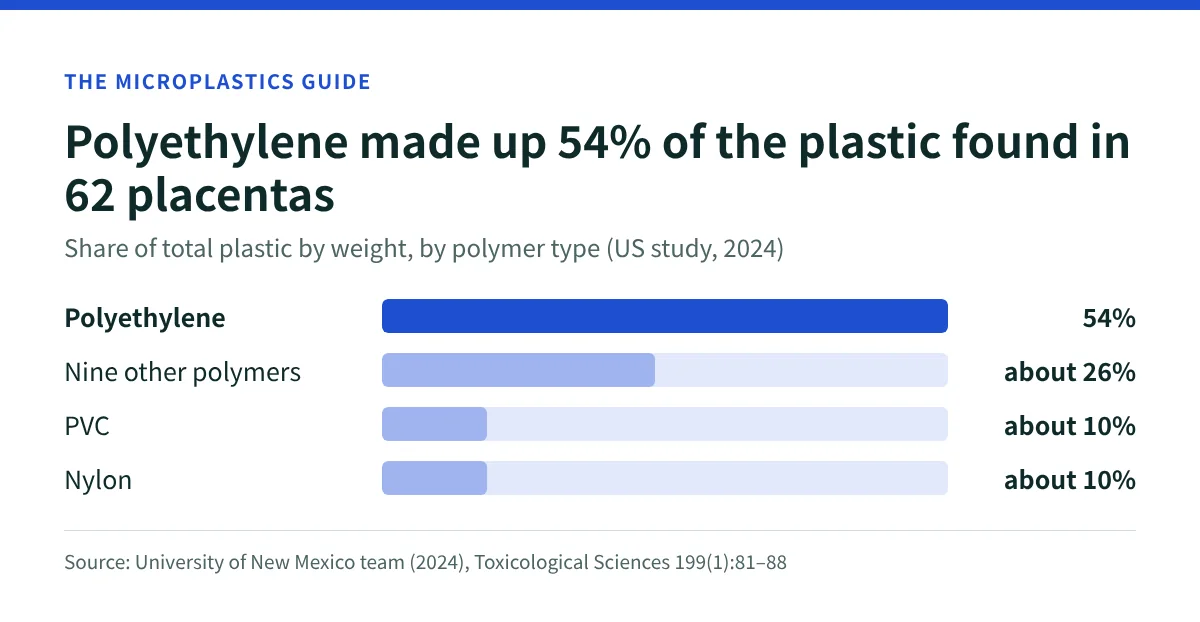
According to the university, polyethylene made up 54% of the plastic by weight. Polyethylene is used in plastic bags and many bottles. PVC and nylon each made up about 10%.
| Study (year) | Placentas | Main finding |
|---|---|---|
| "Plasticenta" (2020 preprint) | 6 | 12 particles in 4 placentas |
| University of New Mexico (2024) | 62 | Plastic in all 62; mean 126.8 µg/g |
| Baylor and Texas Children's (2025 abstract) | 175 | Higher levels in preterm than term births |
| eBioMedicine study (2025) | Not stated in report | Higher levels linked to early miscarriage |
Are microplastics in the placenta linked to preterm birth or miscarriage?
Emerging. In January 2025, researchers from Baylor College of Medicine and Texas Children's Hospital presented an abstract on 175 placentas, 100 from full-term births and 75 from preterm births. Preterm placentas held significantly more plastic. The authors said this only "hints at the possibility" of a link. It was a conference abstract, not a full peer-reviewed paper.
In October 2025, a study in eBioMedicine linked higher placental plastic levels with a higher risk of miscarriage in the first trimester. PVC made up more than half of the plastic detected. Drinking bottled water and eating seafood often were associated with higher levels.
Both findings are associations. They do not show that plastic causes preterm birth or miscarriage.
How strong is the evidence?
Contested for the exact amounts. In January 2026, The Guardian reported that scientists had published challenges to seven high-profile studies of plastic in human organs, including the placenta. A separate analysis listed 18 studies that did not account for a key problem: some human tissue gives signals easily confused with common plastics. Lab contamination is another risk, because plastic is everywhere, including in labs.
This does not mean the placenta is plastic-free. It means the true amounts are uncertain, and the same debate surrounds reports of plastic in the brain. Our health effects guide tracks how each finding holds up. For another reproductive-health question, see what lab tests found about microplastics in tampons and pads.
What can you do during pregnancy?
There is no proven way to remove microplastics from the body, and no test or "detox" is recommended for them. Reasonable steps reduce everyday exposure without stress:
- Do not heat food or drinks in plastic. Use glass, ceramic or stainless steel in the microwave and for hot liquids.
- Drink tap water, filtered if you like, instead of relying on bottled water. Learn more in our drinking water guide and our explainer on the EPA drinking water watch list.
- Vacuum with a HEPA filter and dust with a damp cloth to keep household dust down.
- Keep eating a varied, healthy diet. Fish and seafood still offer nutrients that matter in pregnancy, so talk to your doctor before cutting foods out.
Frequently asked questions
Can microplastics pass from the mother to the baby?
Particles have been found on the side of the placenta that faces the baby, which suggests some can cross. How much reaches the baby, and whether it causes harm, is not known.
Should I get my placenta tested for microplastics?
No clinical test exists for this. The measurements in studies use specialized research methods that are still being standardized, and results from one person could not guide care.
Does bottled water cause more microplastics in the placenta?
One 2025 study linked frequent bottled water drinking with higher placental levels. That is an association from a single study, not proof, but choosing tap water is a simple step that also saves money.
Keep reading
Sources
- "Plasticenta: Microplastics in Human Placenta" (2020 preprint), bioRxiv
- Plasticenta: First evidence of microplastics in human placenta, Environment International
- Quantitation and identification of microplastics accumulation in human placental specimens using pyrolysis gas chromatography mass spectrometry (2024), Toxicological Sciences 199(1):81–88
- UNM Health Sciences (February 2024): Microplastics in every human placenta
- Society for Maternal-Fetal Medicine (January 2025): High concentrations of plastics in the placentae of infants born prematurely
- Environmental Health News (October 2025): Microplastics in the placenta linked to increased risk of miscarriage
- The Guardian via SEJ (January 2026): Doubt cast on discovery of microplastics throughout human body