Where the "spoon" came from
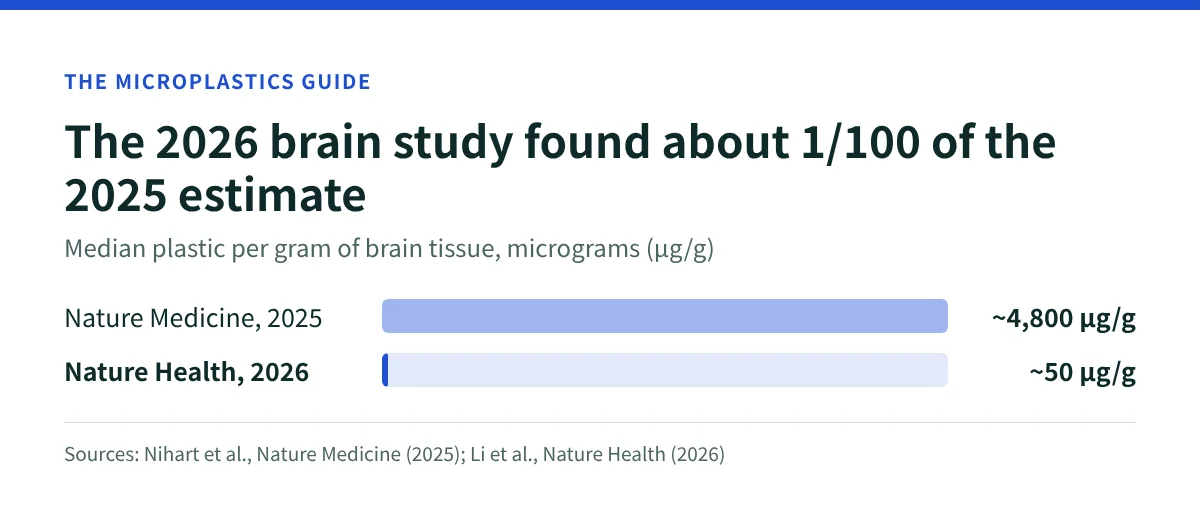
In February 2025, researchers at the University of New Mexico published a study in Nature Medicine analyzing liver, kidney and brain tissue from autopsies. They reported a median of roughly 4,800 micrograms of plastic per gram of brain tissue in 2024 samples, about 50% higher than in 2016 samples. Multiplied by the weight of an average brain, that comes to about 7 grams, close to the weight of a plastic spoon.
The comparison spread worldwide and was repeated by public officials, including in the April 2026 federal microplastics announcement.
Why scientists pushed back
Contested. Later in 2025, a group of chemists published a formal challenge in the journal. Their main points:
- The method heats tissue and measures the gases released. Fats can produce signals similar to polyethylene, and the brain is about 60% fat.
- The brain samples had more undigested tissue left after preparation than the liver and kidney samples.
- Key checks for contamination and false positives were missing.
The reported levels were higher than those measured in wastewater, which several experts found implausible. Germany's Federal Institute for Risk Assessment also reviewed the work and discussed its limits. The lead author has said the field is in an early stage and lacks standard methods.
The bigger 2026 study
In April 2026, a team publishing in Nature Health analyzed 191 brain samples from China using two independent techniques. They found plastic in all of the healthy brains tested and almost all diseased ones, at a median of about 50 micrograms per gram, roughly a hundredth of the 2025 figure.
Some independent experts praised the use of two methods as more robust. Others raised the same concerns about false positives from fats and proteins and about lab contamination. The study also found more plastic near fast-growing brain tumors, but neuro-oncologists point out that tumors damage the blood-brain barrier, so plastic may collect there as a result rather than a cause.
What we can say with confidence
- Very small plastic particles can probably cross into the brain. Animal studies support this.
- Nobody knows how much is there. Estimates differ a hundredfold, and measurement methods are still being standardized.
- There is no evidence that microplastics cause dementia or other brain disease in people. Links in the research so far are associations.
This is a good reason to reduce exposure sensibly, not a reason for alarm. See our ranked list of changes.
Frequently asked questions
Do microplastics cause dementia?
There is no evidence that they do. The 2025 study found higher levels in people who had dementia, but dementia damages the brain's barriers, which could let more particles in. The finding cannot show cause.
Can microplastics cross the blood-brain barrier?
Animal studies suggest the smallest particles can. How much crosses in people, and what happens afterward, is not known.
Keep reading
Sources
- Nihart et al. (2025), Bioaccumulation of microplastics in decedent human brains, Nature Medicine
- Li et al. (2026), Nature Health
- German Federal Institute for Risk Assessment (BfR): Microplastics in the brain
- R&D World: Does your brain really have enough plastic in it to make a spoon?
- Health Policy Watch (April 2026): new brain study and expert reaction