
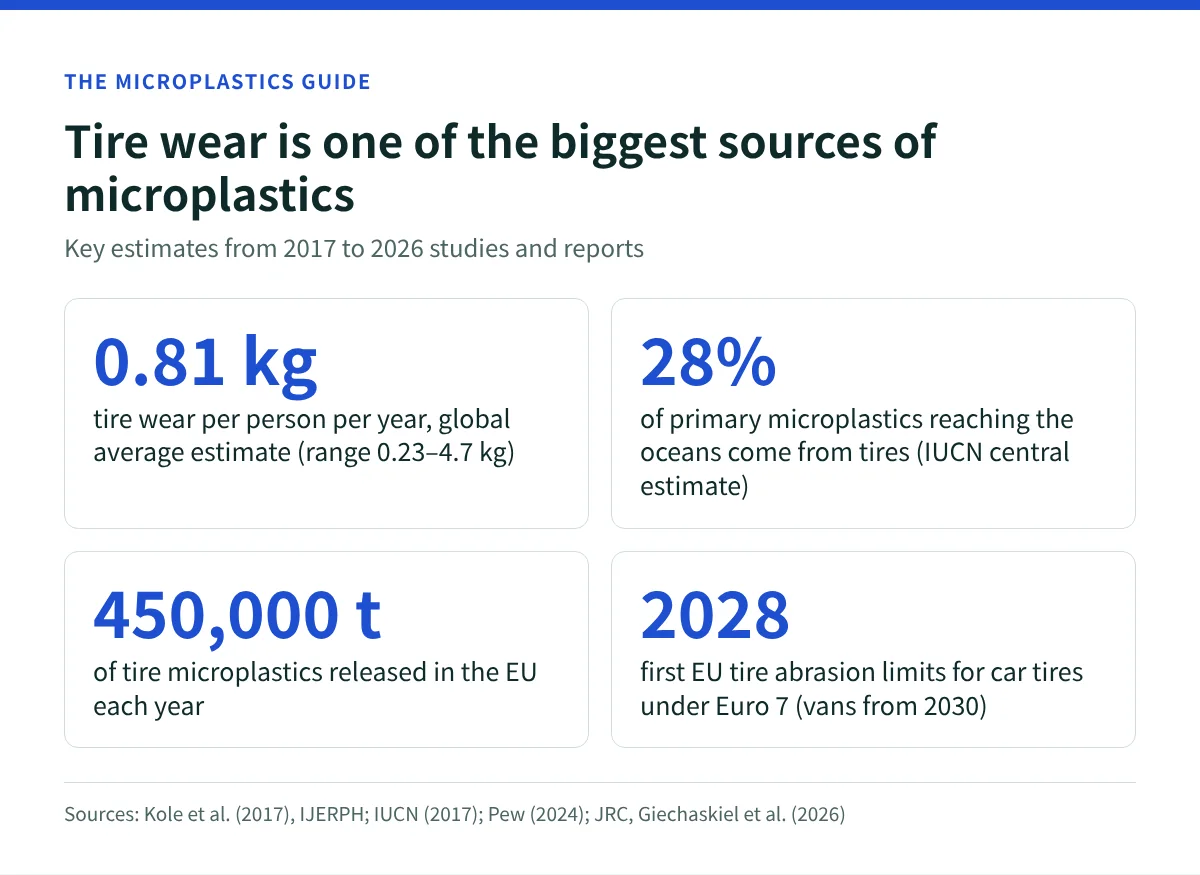
Every car tire slowly turns into dust, and much of that dust counts as microplastic. A 2017 study estimated tire wear at about 0.81 kg (1.8 lb) per person per year worldwide. That makes tires one of the largest sources of microplastics, alongside synthetic clothing covered in our clothing, laundry and air guide.
What are tire wear particles made of?
Tire wear particles form when the tread rubs against the road. They are a mix of tire rubber and bits of road surface. Modern tires contain synthetic rubber, a plastic-like polymer, so researchers count these particles as microplastics.
The mix also carries additives. Swiss researchers described Swiss tire and road wear particles as about 60% rubber, 30% soot and 10% heavy metals in a 2022 article from EPFL.
How much microplastic do car tires shed?
Estimates vary by country, vehicle and method. The 2017 review by Kole and colleagues found a per-person range of 0.23 to 4.7 kg a year, with countries that drive more at the high end.
At the national level, Switzerland generates over 13,500 metric tons of tire and road wear particles a year, according to the same EPFL article. About 8,900 tons of that reaches air, soil and water.
Across the EU, tire dust adds up to about 450,000 metric tons of microplastic a year, according to The Pew Charitable Trusts in 2024. Pew calls it the second-largest quantified source in the EU after paint.
Globally, the International Union for Conservation of Nature estimated that tires cause about 28% of primary microplastics released to the oceans in a 2017 report. Synthetic textiles came first at about 35%.
Which cars and tires wear the fastest?
Weight, tire type and driving style all matter. A 2022 study tracked 76 taxis in China for 22 months and measured more than 500 tire wear samples. Here is what it found (Liu et al., 2022):
| Factor | What the study found |
|---|---|
| Hybrid vs. gasoline car | 72 vs. 53 mg of tire wear per km |
| Winter tires | 160 mg per km, about 3 times summer tires |
| Front vs. rear tire | Left-front tires wore 1.7 times faster than left-rear |
| Driving behavior | Hard braking and acceleration had the largest effect |
Heavier vehicles generally shed more. An OECD report from 2020 estimated that heavier, long-range electric cars could emit 3% to 8% more fine particles (PM2.5) from wear than comparable gasoline cars. Lighter electric cars emitted 11% to 13% less.
Independent tester Emissions Analytics reported that gentle driving with regenerative braking can offset the extra tire wear from battery weight. Its tests also found tire wear far exceeds the particle mass from modern tailpipes.
Where does tire dust end up?
Rain washes tire particles from roads into soil, rivers and the sea, and a share stays in the air. The Kole review estimated that tire wear makes up 3% to 7% of airborne fine particles (PM2.5).
Tire chemicals can travel with the particles. The best-known is 6PPD-quinone, which forms when the tire additive 6PPD reacts with ozone. The US EPA says stormwater levels of this chemical were lethal to coho salmon within hours, based on a 2021 study.
In November 2024, EPA issued an advance notice of proposed rulemaking on 6PPD under the Toxic Substances Control Act. It is gathering data and has not banned the chemical.
Are tire microplastics harmful to people?
Strong: tires are a major source of microplastics in the environment. Many independent estimates agree, even though the exact numbers differ.
Strong: 6PPD-quinone is highly toxic to coho salmon. This is well established for fish, not for people.
Emerging: effects on human health. EPA says limited information is available on the human health effects of 6PPD-quinone. Breathing fine particles in general is a known health risk, but studies have not isolated the harm from tire particles alone.
There is no proven way to remove microplastics from the body. For what researchers have found inside human tissue, see what the 2025–2026 brain studies show. For the regulatory picture in the US, read about the EPA's drinking water watch list.
What is the EU doing about tire wear?
The EU's Euro 7 vehicle rules, agreed in 2024, are the first anywhere to cover tire microplastics. A 2026 paper from the European Commission's Joint Research Centre says abrasion limits apply to car tires from 2028 and to van tires from 2030.
Limits for trucks and buses come later. If UN test methods are delayed, the EU can set its own limits before the end of 2030.
How can drivers reduce tire microplastics?
You cannot stop tire wear, but you can slow it:
- Brake and accelerate smoothly. These were the driving habits with the biggest effect on wear in the 2022 taxi study.
- Swap winter tires back in spring. They wore about three times faster than summer tires in that study.
- Choose a lighter vehicle when you can. The OECD lists lighter vehicles as a way to cut wear emissions.
- Drive less. Walking, cycling and public transport avoid tire wear entirely.
Old tires also become the rubber crumb on sports pitches, which the EU will stop selling in 2031; see artificial turf microplastics and the infill ban.
Tires are only one source you meet every day. Our everyday sources guide covers the others.
Frequently asked questions
Are tires made of plastic?
Tires are made mostly of rubber, and much of that is synthetic rubber made from petroleum. Synthetic rubber is a polymer like plastic, so most researchers count tire wear particles as microplastics. Tires also contain fillers such as carbon black and many chemical additives.
Do electric cars produce more tire microplastics?
It depends on weight and driving. A 2020 OECD analysis estimated that heavy, long-range electric cars could emit slightly more fine wear particles than gasoline cars, while lighter ones emitted less. Smooth driving and regenerative braking can offset some of the extra wear.
Is 6PPD-quinone dangerous to humans?
It is not known. The chemical is highly toxic to coho salmon, but EPA says there is limited information on human health effects. EPA is collecting data under the Toxic Substances Control Act.
Keep reading
Sources
- Kole et al. (2017), Wear and Tear of Tyres: A Stealthy Source of Microplastics in the Environment, International Journal of Environmental Research and Public Health
- Boucher and Friot, IUCN (2017): Primary Microplastics in the Oceans: A Global Evaluation of Sources
- EPFL (2022): Unraveling the secrets of microplastics released by tires
- The Pew Charitable Trusts (2024): Pew applauds EU's first-of-its-kind legislation to tackle microplastics emissions from tyres
- Giechaskiel et al., JRC (2026): Abrasion Rates and Service Life of C2 Tyres for Vans, ENG
- Liu et al. (2022), Impact of vehicle type, tyre feature and driving behaviour on tyre wear under real-world driving conditions, Science of The Total Environment
- OECD (2020): Non-exhaust Particulate Emissions from Road Transport, highlights
- Emissions Analytics: Gaining traction, losing tread
- US EPA: 6PPD-quinone
- US EPA (November 2024): EPA issues advance notice of proposed rulemaking to protect salmon from chemical used in rubber products