
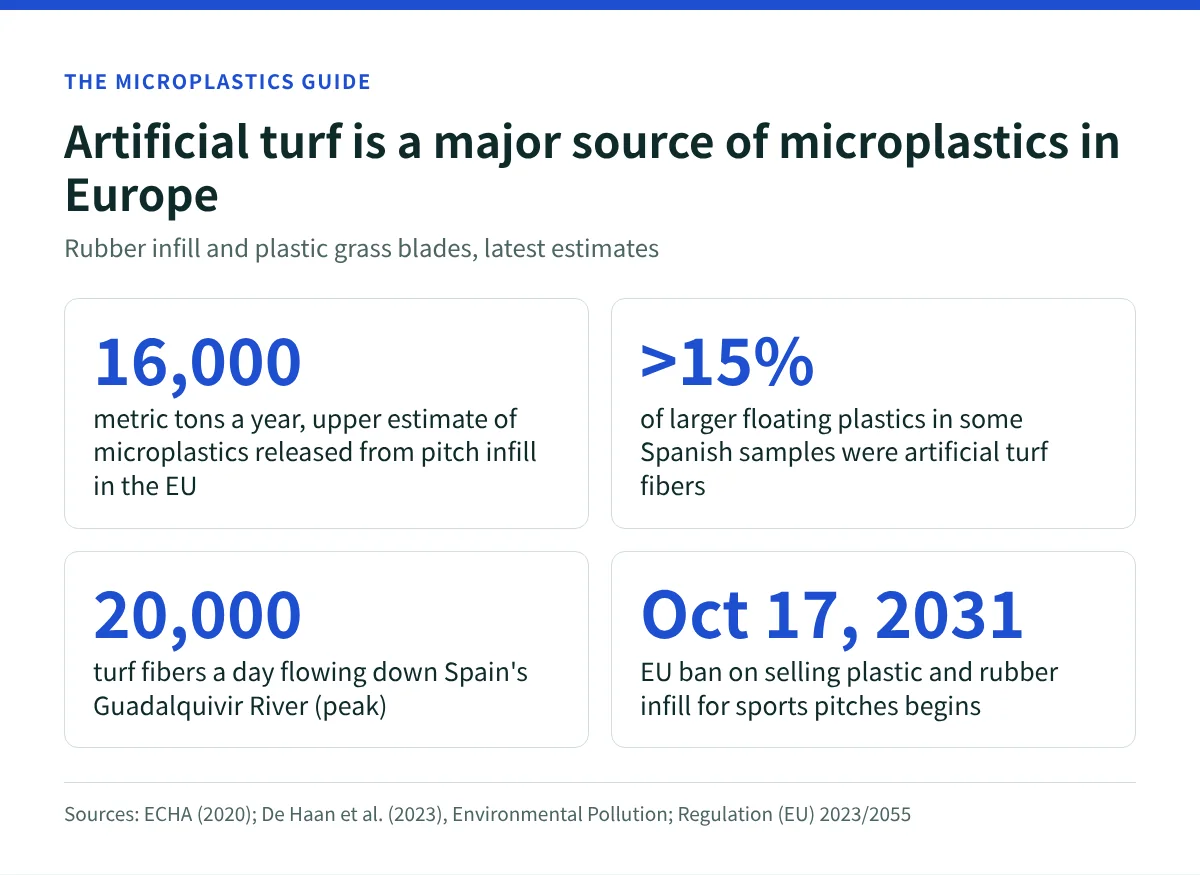
Yes, in the EU. The black rubber crumb on many sports pitches counts as microplastic, and EU regulators estimated in 2020 that infill releases up to 16,000 metric tons a year. A ban on selling new plastic and rubber infill starts on October 17, 2031. Turf blades are plastic fibers too, like the synthetic textiles in our clothing, laundry and air guide. To cut fibers from what you wear, see how to avoid microplastics in clothing.
What is rubber crumb infill made of?
Most "third-generation" pitches have plastic grass blades with loose granules between them. The granules keep the blades upright and cushion falls. The most common type is crumb rubber (SBR) ground from old car tires. Others are EPDM and TPE, which are also synthetic polymers (Pitchcare, 2025).
Because the granules come from tires, they share many ingredients with road dust. Our article on how much car tires shed explains that wider problem.
How much microplastic does artificial turf release?
Estimates vary widely, and this is the most disputed part of the topic.
The European Chemicals Agency (ECHA) called infill the largest source in its microplastics proposal. It estimated up to 16,000 of about 42,000 metric tons a year of intentionally added microplastics released in the EU (2020).
A 2021 review by Dutch researchers argues the true losses are much lower. It found pitches need about 0.6 to 1.2 metric tons of refill a year, mostly to make up for compaction. Earlier estimates had assumed 3 to 5 tons of loss per pitch.
The same review estimated that 12 to 40 kg (26 to 88 lb) a year per field leaves on players' shoes and clothing. Drain filters cut what reached a nearby ditch to about 1 kg a year in a Swedish case.
Do the plastic grass blades shed too?
Yes. A 2023 study in Environmental Pollution sampled Spanish rivers and coastal waters. Turf fibers made up over 15% of the floating plastics larger than 5 mm in some samples.
The researchers counted up to 20,000 turf fibers a day flowing down the Guadalquivir River. They found turf fibers in 62% of marine samples and 37% of river samples near Barcelona and Andalusia.
What exactly does the EU ban cover?
The European Commission adopted its microplastics restriction in September 2023. It aims to prevent about half a million metric tons of releases. The rules entered into force on October 17, 2023.
Here is how infill fits in, based on SGS's summary of Regulation (EU) 2023/2055:
| Question | Answer |
|---|---|
| What is banned? | Selling granular infill made of synthetic polymers for sports surfaces |
| From when? | October 17, 2031 |
| Is artificial turf banned? | No, only the loose plastic or rubber infill |
| What about existing pitches? | They can keep using the infill already installed |
| What can replace it? | Cork, olive stones, wood chips or turf systems without infill |
The existing-pitch rule and alternatives come from Pitchcare (2025). The tire recycling industry opposes the ban and disputes the release data (European Rubber Journal, 2024).
Is artificial turf safe for kids and players?
Strong: turf infill and blades release microplastics into the environment. Regulators and independent studies agree on that, even though the amounts are Contested.
Emerging: health effects. The EU ban is about pollution, not player health. ECHA concluded in 2017 that risk from recycled rubber granules is at most a very low concern. It still advised players to wash after play.
In the US, EPA and CDC/ATSDR published research in July 2019 and April 2024. They found chemicals are present in tire crumb and exposure can occur, but is likely limited. Only about 1% to 3% of metals dissolved into simulated body fluids.
The agencies stress these reports are not a risk assessment. For how microplastics in general relate to health, see our health effects guide.
How can you reduce turf microplastics?
For players and parents:
- Shake out shoes, socks and bags at the field. That keeps granules out of cars, homes and washing machines.
- Wash hands after play, as ECHA advised, especially before eating.
- Empty granules into the trash, not down drains or onto lawns.
For schools, clubs and towns choosing a surface:
- Ask about containment: drain filters, boot-cleaning stations and barriers around the pitch.
- Compare infill-free systems or natural infills such as cork, which are already sold in Europe.
Turf is one of many hidden sources. Our everyday sources guide covers the rest, and the EPA's drinking water watch list shows where US regulation stands.
Frequently asked questions
Is artificial turf being banned in Europe?
No. The EU restriction bans selling plastic and rubber infill from October 17, 2031, not the turf itself. Pitches built before then can keep their infill, and new pitches can use natural or no infill.
Is crumb rubber dangerous for children?
Current evidence suggests the risk is low. ECHA found at most a very low level of concern in 2017, and US agencies found exposure is likely limited. Neither is a full risk assessment, so basic hygiene after play is still sensible.
Does artificial grass in a backyard shed microplastics?
Its blades are plastic, so they can break into fibers over time, as the Spanish river study showed for turf in general. Most garden turf has no rubber infill, so it is not covered by the EU infill ban.
Keep reading
Sources
- ECHA (December 2020): Scientific committees: EU-wide restriction best way to reduce microplastic pollution
- ECHA (2020): Questions and answers on the restriction of intentionally added microplastics
- European Commission (September 2023): Commission adopts measures to restrict intentionally added microplastics
- SGS (October 2023): EU regulates microplastics under REACH
- De Haan et al. (2023), The dark side of artificial greening: Plastic turfs as widespread pollutants of aquatic environments, Environmental Pollution
- Phys.org (October 2023): Artificial turf is an important source of plastic pollution
- Verschoor et al. (2021), Fate of recycled tyre granulate used on artificial turf, Environmental Sciences Europe
- US EPA: Federal research on recycled tire crumb used on playing fields and playgrounds
- Pitchcare (2017): Recycled rubber infill causes a very low level of concern, says ECHA
- Pitchcare (2025): Is artificial turf being banned? We tackle the misconceptions
- European Rubber Journal (2024): Tire rubber infill allowed in synthetic turf for two more decades?