
To avoid microplastics in clothing, choose natural fibers for new items you wear and wash often, favor tightly woven fabrics, and keep the clothes you already own. This matters because about 69% of all fiber produced in 2024 was synthetic, and 59% was polyester. Our clothing, laundry and air guide covers the bigger picture, including washing machine filters.
Do clothes shed microplastics when you wear them?
Yes. A 2020 study in Environmental Science & Technology tested four polyester garments. Wearing them released up to 400 fibers per gram of fabric in 20 minutes of normal activity.
The same team estimated that one person releases more than 900 million polyester fibers a year into the air by wearing clothes. That was roughly three times their estimate of 300 million from washing.
Fibers released into the air can end up in indoor dust. So avoiding microplastics in clothing is not only about the washing machine. It is also about what you wear, sit on and sleep under.
Which fabrics shed the most microplastics?
Synthetic fibers such as polyester, nylon and acrylic are plastic. How much they shed depends a lot on how the fabric is built.
In the 2020 study, a polyester-cotton blend shed the most during both washing and wearing. A woven polyester garment shed the least.
A 2023 University of Leeds study tested 16 fabrics. It found that yarn type and knitted or woven construction mattered more than wash settings. A chenille polyester was the worst shedder.
Fleece is another heavy shedder. A UC Santa Barbara study reported in 2017 found about 100,000 fibers per fleece jacket per wash.
Here is a quick fabric-by-fabric guide based on these studies:
| Fabric | Is it plastic? | What studies suggest |
|---|---|---|
| Polyester fleece | Yes | Heavy shedder in washing tests |
| Chenille and fuzzy synthetic knits | Yes | Worst performer in the 2023 Leeds tests |
| Polyester-cotton blends | Partly | Shed the most of four garments in the 2020 study |
| Tightly woven polyester | Yes | Shed the least of those four garments |
| Recycled polyester | Yes | Same polymer as new polyester |
| Cotton, linen, wool, silk | No | Shed natural fibers, not plastic |
| Viscose, lyocell | No | Plant-based (cellulose), though chemically processed |
Recycled polyester is still polyester. It made up about 12% of polyester produced in 2024, and it can shed fibers like any other polyester.
Are natural fibers really better?
For plastic, yes: cotton, linen, wool and silk do not shed plastic. But all fabrics shed fibers.
A global survey of ocean water found that only 8.2% of fibers were synthetic. Most were cellulosic, from plants such as cotton or from wood-based fibers (79.5%), and 12.3% were animal fibers such as wool (2020).
Dryers tell a similar story. A 2022 PLOS ONE study found lint filters caught polyester better than cotton. So most fibers dryers released into the air were likely cotton. Our article on dryer microplastics explains how to empty the lint filter so fewer fibers escape.
Natural fibers break down more readily than plastic, but they can still carry dyes and finishes. Choosing them reduces plastic, not lint.
How strong is the evidence?
- Strong: synthetic clothes shed plastic microfibers when washed and worn. Many studies agree.
- Emerging: wearing may release more fibers than washing. That estimate comes from one study of four garments.
- Contested: whether new or old clothes shed more. The Leeds study found shedding drops after the first wash and levels off by the third. The UC Santa Barbara study found aged fleece jackets shed more than new ones.
No study has shown that wearing synthetic clothes harms your health. Research so far measures shedding, not health effects. Our reduce exposure guide puts clothing alongside other everyday sources.
What are the best ways to avoid microplastics in clothing?
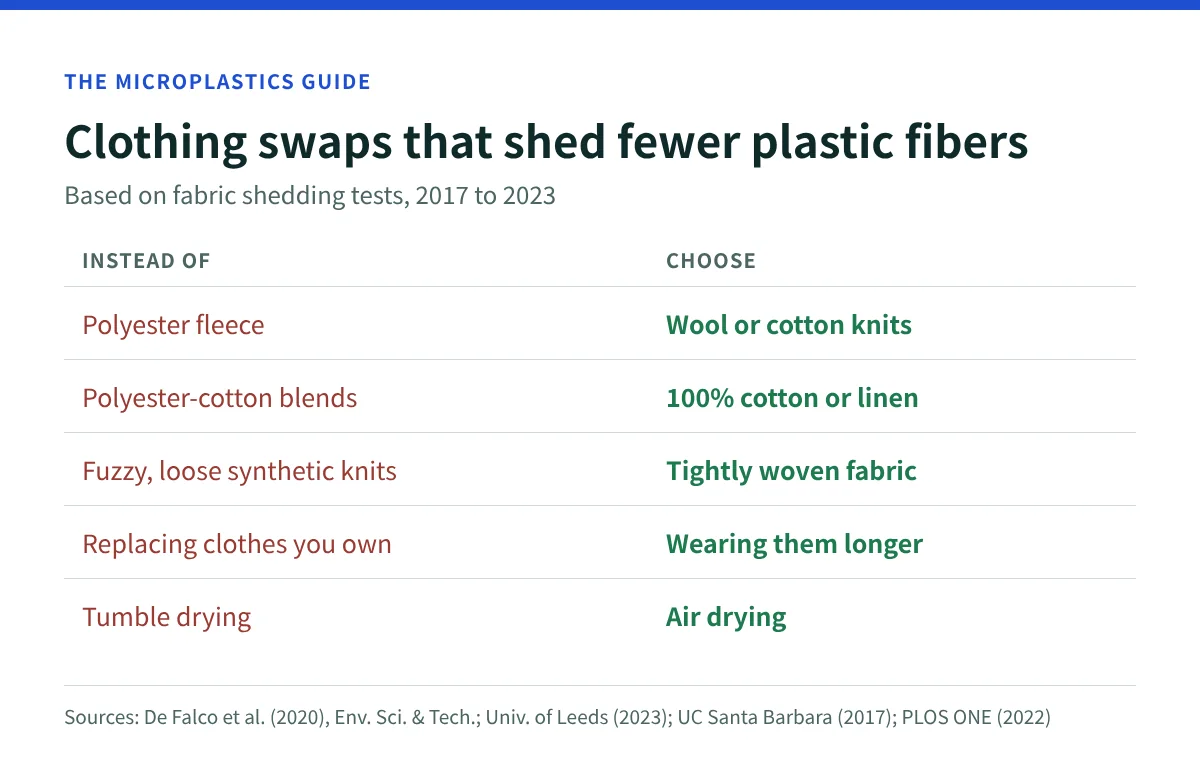
You do not need to replace your wardrobe. Buying new clothes creates new fibers, and the Leeds results suggest fabrics shed most when new.
- Keep and wear what you own. Replacing working clothes adds new shedding garments.
- Choose natural fibers for new basics. Think T-shirts, underwear, sleepwear and sweaters you wash often.
- Check blends on the label. A shirt that is 60% cotton and 40% polyester is still partly plastic.
- Prefer tight, smooth weaves over fuzzy, loose or brushed synthetics.
- Skip fleece where wool or cotton knits work. Keep synthetics for gear that needs them, like rain shells.
- Air-dry when you can. Dryers send fibers into the air, and they shed natural fibers too.
- Wash full loads, gently. The Leeds team found a fuller drum and lower agitation cut shedding.
Clothing is not the only textile source. Plastic grass blades shed too, as our article on artificial turf microplastics shows. Reusable cloth pads raise the same fabric questions, covered in microplastics in tampons and pads. Wondering about the detergent itself? See whether laundry pods release microplastics.
Frequently asked questions
Is there microplastic-free clothing?
Clothes made entirely from cotton, linen, wool, silk or hemp do not shed plastic fibers. Check the label for synthetic blends, elastane in waistbands and polyester sewing thread or lining.
Should I throw away my polyester clothes?
No. Throwing away working clothes does not remove the plastic, and new garments may shed more at first. Wear what you own, wash it gently, and choose natural fibers when you replace items.
Do microplastics from clothes get into your body?
Fibers shed while wearing clothes end up in indoor air and dust, which people breathe. Studies have not shown that this causes health problems. There is also no proven way to remove microplastics from the body.
Keep reading
Sources
- Textile Exchange (2025): Materials Market Report 2025
- University of Plymouth (March 2020): Wearing clothes could release more microfibres to the environment than washing them, on De Falco et al. (2020), Environmental Science & Technology
- University of Leeds (February 2023): How much microfibre do we emit with our washing?
- UC Santa Barbara (2017): Below the Surface, on Hartline et al., Environmental Science & Technology
- Suaria et al. (2020), Microfibers in oceanic surface waters: A global characterization, Science Advances
- EurekAlert (April 2022): Clothes dryers release microfibres into the air, on a Northumbria University study in PLOS ONE