
Yes, single-use breast milk storage bags can shed tiny plastic particles. In a 2023 lab study, all 6 bag products tested released particles of polyethylene (PE), PET and nylon.
The authors estimated that a baby fed only from such bags might take in 0.61 to 0.89 milligrams of particles a day. That figure comes from one small, preliminary study, and nobody knows yet what it means for health. For wider feeding advice, see our babies and kids guide.
Do breast milk storage bags release microplastics?
The best-known test comes from researchers at Xi'an Jiaotong University in China. Liu and colleagues published it in Environmental Pollution in February 2023 and called it "a preliminary study."
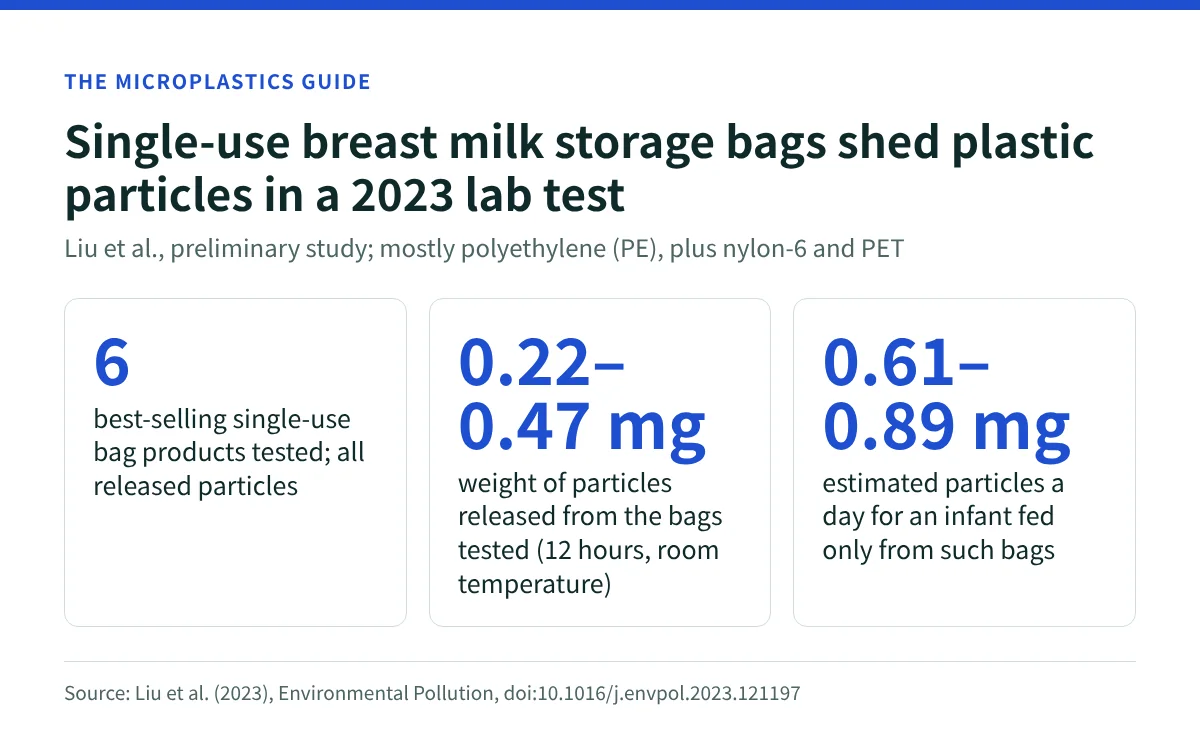
They tested 6 best-selling single-use bags. Labels listed PE, low-density PE and PET. According to the Food Packaging Forum, the bags were filled with a soap-like test solution and left for 12 hours at room temperature.
Every product released particles. Most were PE, followed by nylon-6 and PET, confirmed by a method called micro-Raman spectroscopy. Most particles were smaller than 300 micrometers, and some were smaller than 1 micrometer.
How much plastic could a baby take in from storage bags?
The researchers weighed what came off the bags. As News-Medical reported, the released particles weighed between 0.22 and 0.47 milligrams.
They then used a typical daily intake of 650 to 850 milliliters of milk. On that basis, an infant fed only from these bags might take in 0.61 to 0.89 milligrams a day. A milligram is a thousandth of a gram.
| Question | What the 2023 study found |
|---|---|
| Bags tested | 6 single-use products (PE, LDPE, LLDPE, PET labels) |
| Test conditions | Test solution, 12 hours, room temperature |
| Plastics found | Mostly PE, then nylon-6 and PET |
| Particle size | Mostly under 300 micrometers; some under 1 micrometer |
| Estimated infant intake | 0.61 to 0.89 mg a day, if fed only from bags |
The test did not use real milk, freezing or thawing. Real-life release could be higher or lower.
How strong is the evidence?
Emerging that single-use bags can shed particles. Contested for how much reaches a baby. Not known for health effects.
A 2026 systematic review in npj Science of Food looked at 22 primary studies on plastic in infant food. It said data on storage bags "remain scarce." It also warned that weighing particles, as the bag study did, cannot tell exactly how much of the mass is plastic.
The same review concluded that the scale of infant exposure remains difficult to determine. Studies use different methods, and some lacked blank controls. Our explainer on why microplastic numbers vary covers these problems.
Bags are not the only source. A 2021 study in Nature Nanotechnology found that steam-disinfected silicone bottle nipples shed particles. UMass Amherst estimated a baby could take in more than 0.66 million such particles by age one. Studies of microplastics in babies' stool also point to many small daily sources.
Should you stop using breast milk storage bags?
No. Breast milk is still the recommended food, and microplastics are not a reason to stop pumping or breastfeeding. Bags made for breast milk are also a safe-handling choice. The CDC says to use breast milk storage bags or clean, food-grade glass or plastic containers with tight lids.
What matters most is food safety first, then simple steps that may cut particle release:
- Never microwave milk. The CDC says never to thaw or heat breast milk in a microwave. Lab studies of plastic baby bottles also link hot liquids to more particle release.
- Warm gently. Thaw in the fridge overnight, or set the sealed container in warm, not hot, water.
- Pour into glass before warming if you can. Transferring thawed milk to a glass bottle limits warm milk's contact time with the bag.
- Use glass or hard containers for fridge milk. For milk you will use within the CDC's 4-day fridge window, a glass bottle avoids the bag altogether.
- Freeze flat, handle gently. Avoid squeezing, rubbing or cutting bags more than needed.
- Never reuse single-use bags. The CDC also warns against plastic bags not made for breast milk.
The CDC's room-temperature limit is 4 hours at 77°F (25°C) or colder. Thawed milk should not be refrozen. Our guide to reducing exposure has more everyday steps for the whole family.
Frequently asked questions
Are glass containers better than bags for breast milk?
Glass does not shed plastic particles, so it removes that one source. The CDC accepts both glass and food-grade plastic. Glass takes more freezer space, so many parents use it for fridge milk and bags for the freezer.
Does freezing breast milk in plastic bags release microplastics?
No study we found has measured this directly. The 2023 test used room temperature only. Freezing is still the CDC's recommended way to keep milk for months, with about 6 months best and up to 12 months acceptable.
Is there a way to remove microplastics from breast milk or a baby's body?
No. There is no proven way to remove microplastics from milk or from the body, and no "detox" is recommended. Lowering heat and plastic contact is the practical step.
Keep reading
Sources
- Liu et al. (2023), Release of microplastics from breastmilk storage bags and assessment of intake by infants: A preliminary study, Environmental Pollution
- News-Medical (February 2023): New insights into the release of microplastics from breastmilk storage bags
- Food Packaging Forum (March 2023): Studies detect microplastics in food and link it to packaging, processing equipment
- Price et al. (2026), Evidence, implications and mitigation of plastic-derived contaminants in infant food: A systematic review, npj Science of Food
- News-Medical (September 2026): Why scientists still cannot say how much plastic infants are actually consuming
- Su et al. (2021), study of micro- and nanoplastics released from steam-disinfected silicone-rubber baby teats, Nature Nanotechnology
- UMass Amherst (November 2021): Steam disinfection of baby bottle nipples exposes babies and environment to micro- and nanoplastics
- US Centers for Disease Control and Prevention (2026): Breast Milk Storage and Preparation