Yes, microplastics have been found in babies' stool, and in some studies at higher levels than in adults. A 2021 study from New York found more than 10 times as much PET, the plastic in many bottles and polyester fabrics, in 1-year-olds' stool as in adults' stool.
The studies are small, and nobody yet knows what these amounts mean for a baby's health. For bottle and formula advice, see our babies and kids guide.
How many microplastics are in baby poop?
In September 2021, a team led by Kurunthachalam Kannan at New York University published the best-known study in Environmental Science & Technology Letters. They tested stool from 6 one-year-old infants, 10 adults and 3 newborns, all from New York State. Every sample contained at least one type of microplastic.
The team looked for two plastics. Average PET levels in infant stool were more than 10 times higher than in adult stool. Levels of polycarbonate (PC), a hard plastic, were similar in both groups.
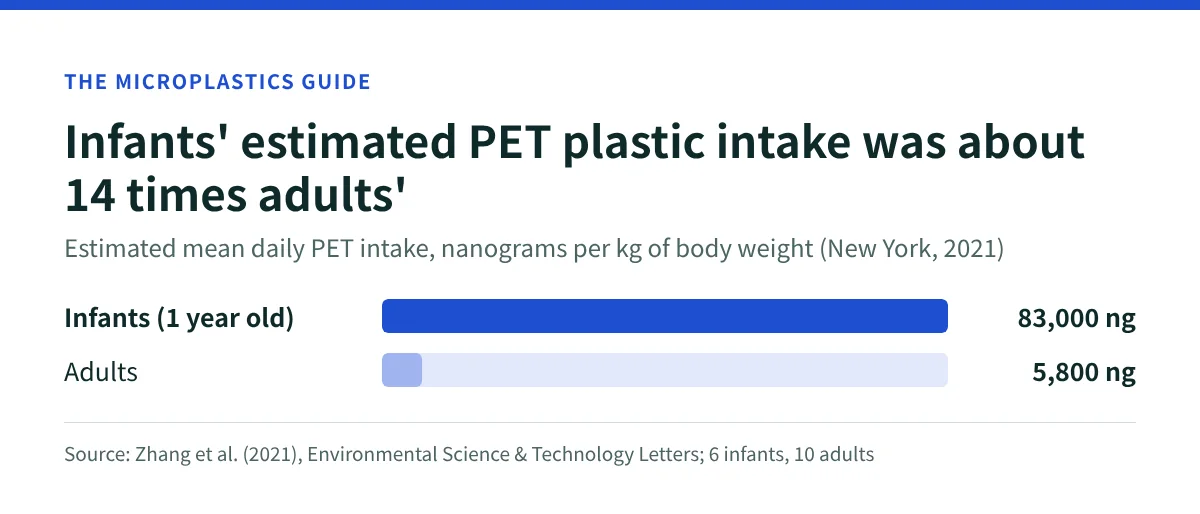
The researchers then estimated daily intake per kilogram of body weight. By their estimate, infants took in about 83,000 nanograms of PET per kilogram a day, compared with about 5,800 nanograms for adults. That is roughly 14 times more. A nanogram is a billionth of a gram, so these are tiny masses.
Do newborns already have microplastics?
Emerging. Several small studies have reported plastic in meconium, a newborn's first stool, which forms before birth. The New York team found PET and PC in some of its 3 meconium samples.
In a 2021 study in Pharmaceutics, both meconium samples tested contained polyethylene, polypropylene or polystyrene particles larger than 50 micrometers. But one blank control sample also contained polypropylene. The authors warned that hospitals carry a high contamination risk and that results "should be interpreted with caution."
A 2022 pilot study of 18 mother-and-baby pairs in Science of the Total Environment reported 16 types of plastic. According to a summary, median levels were about 54 particles per gram in meconium and 27 per gram in infant stool. The authors said contamination from dust, diapers and air still had to be ruled out.
| Study (year) | Who was tested | Main finding |
|---|---|---|
| NYU, ES&T Letters (2021) | 6 infants, 10 adults, 3 newborns | PET in infant stool over 10 times adult levels |
| Braun et al., Pharmaceutics (2021) | 2 newborns | Plastic in both meconium samples; one control also contaminated |
| Liu et al., Sci. Total Environ. (2022) | 18 mother-baby pairs | 16 plastic types; median 54 particles/g in meconium |
These findings fit with reports of microplastics in the placenta, which suggest some exposure starts before birth.
Why would babies take in more microplastics than adults?
The New York researchers suggested that frequent contact with plastic bottles, teethers and toys may explain the higher levels. That is a reasonable idea, but their study did not test it directly.
Body size also matters. Babies eat, drink and breathe more per kilogram than adults, so the same exposure counts for more. They also crawl on floors and put hands and objects in their mouths, where household dust collects synthetic fibers.
Air is another route for older children. A 2025 study in Environment International measured air at a primary school in Portugal. Classrooms averaged 21.8 nanograms of plastic per cubic meter, versus 13.4 in the schoolyard.
How strong is the evidence?
Emerging that babies are exposed. Contested for exact amounts. Not known for health effects.
Every study above tested fewer than 20 babies. Methods differ, so one study's nanograms cannot be compared with another's particle counts. Contamination from gloves, diapers, lab air and equipment is a real problem, as the Pharmaceutics control sample showed.
Stool is also what passes through the body, not what stays in it. High levels in stool show exposure, not harm. A 2022 World Health Organization review of evidence up to the end of 2021 did not reach a firm conclusion on health risk. It mainly set out the research still needed. Smaller particles, called nanoplastics, were not measured in most baby studies and may matter more.
What can parents do to lower exposure?
There is no proven way to remove microplastics from a baby's body, and no test or "detox" is recommended. Calm, practical steps cut everyday exposure:
- Prepare formula in a glass or stainless steel container, let it cool, then pour it into the bottle. Our babies and kids guide has the full step-by-step method.
- Never heat milk, formula or baby food in plastic, especially in a microwave. Warm it in glass in a bowl of warm water. If you pump, see what tests found on breast milk storage bags and microplastics.
- Serve warm food on stainless steel, glass or ceramic dishes rather than plastic.
- Choose teethers made of food-grade silicone, natural rubber or wood.
- Vacuum with a HEPA filter and damp-dust floors where babies crawl.
- Keep feeding your baby as your doctor advises. Microplastics are not a reason to stop breastfeeding or formula.
See our guide to reducing exposure for steps the whole family can take.
Frequently asked questions
Is baby formula full of microplastics?
A 2022 pilot study reported microplastics in both breast milk and formula samples, but it was small. How you prepare a bottle seems to matter more than the formula itself. Hot water in a plastic bottle releases particles, so mix formula in glass or steel.
Should I test my baby for microplastics?
No. There is no clinical test, and research methods are still being standardized. A result would not change how your baby is cared for.
Do diapers expose babies to microplastics?
No study we found has measured how many particles, if any, reach a baby from diapers. The authors of the 2022 pilot study flagged diapers as a possible source of sample contamination. Our check on whether diapers contain plastic explains what they are made of.
Keep reading
Sources
- Zhang et al. (2021), Occurrence of Polyethylene Terephthalate and Polycarbonate Microplastics in Infant and Adult Feces, Environmental Science & Technology Letters
- American Chemical Society via EurekAlert! (September 2021): Infants have more microplastics in their feces than adults
- Food Packaging Forum (2021): Microplastics measured in newborn, infant and adult feces
- Phys.org (September 2021): Infants have more microplastics in their feces than adults, study finds
- Braun et al. (2021), Detection of Microplastic in Human Placenta and Meconium in a Clinical Setting, Pharmaceutics 13(7):921
- Liu et al. (2022), pilot study of microplastics in placenta, meconium, infant feces, breast milk and formula, Science of the Total Environment
- News-Medical (September 2022): Microplastics detected in placentas, infant feces, breastmilk and infant formula
- Torres-Agullo et al. (2025), Airborne microplastics and plastic additives in a school environment, Environment International, via News-Medical
- World Health Organization (2022): Dietary and inhalation exposure to nano- and microplastic particles and potential implications for human health