
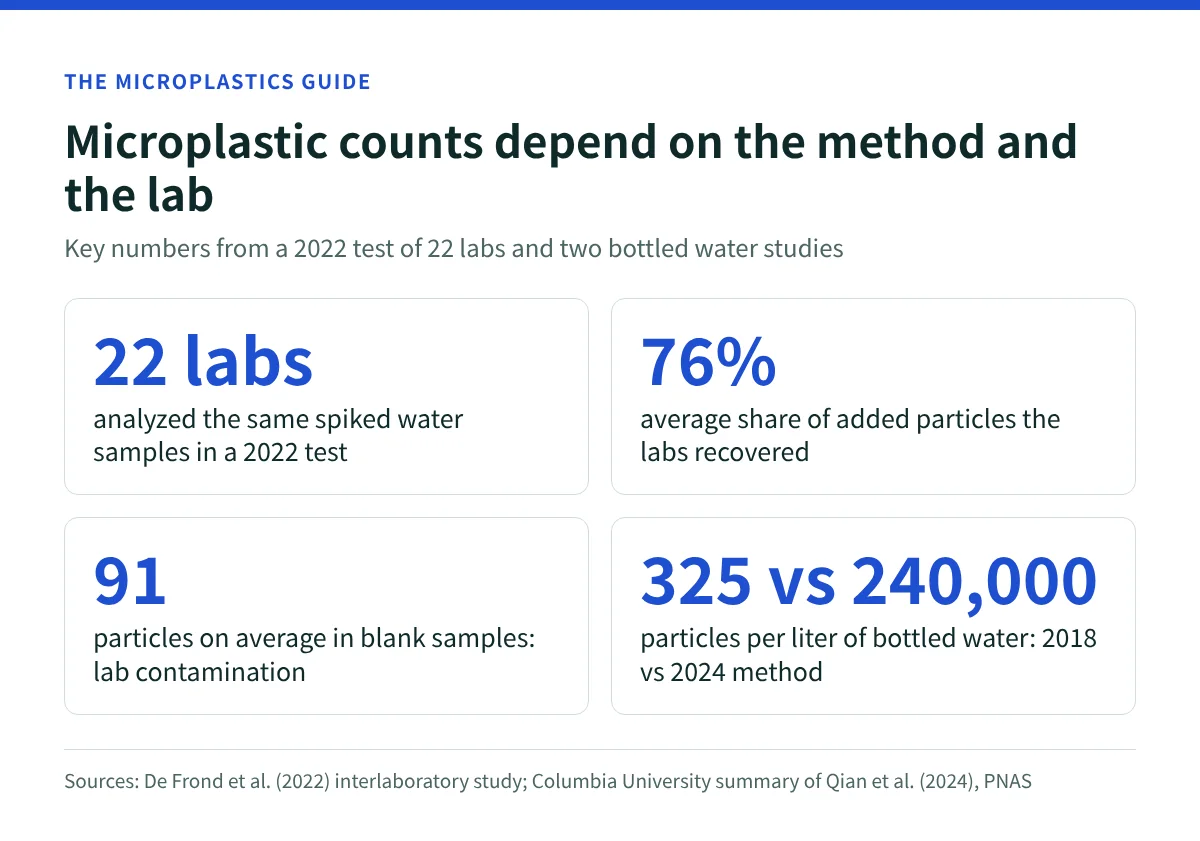
How microplastics are measured largely decides how many are found. In bottled water, a 2018 study counted about 325 particles per liter, while a 2024 laser method found about 240,000, mostly nanoplastics. Neither number is simply "wrong": each method sees a different slice of particle sizes.
This matters for every headline you read. Our health effects guide rates studies partly on how they measured plastic. Below is a plain guide to the main methods and their limits.
What methods do scientists use to measure microplastics?
There are two broad families. One counts particles. The other weighs the total plastic.
Counting methods look at particles one by one. Light microscopy, infrared (FTIR) and Raman spectroscopy belong here. They give number, size and shape, but not total mass, as a 2025 review in Analyst explains.
Mass methods heat a sample and read the gases it releases. The best known is pyrolysis gas chromatography–mass spectrometry (Py-GC/MS). It reports micrograms of each plastic but destroys the sample, so size and shape are lost.
| Method | What it reports | Typical smallest particle |
|---|---|---|
| Light microscopy | Count, shape, color | About 20–50 µm |
| Micro-FTIR (infrared) | Count and plastic type | About 10 µm |
| Micro-Raman | Count and plastic type | About 1 µm |
| Stimulated Raman (SRS) imaging | Count and plastic type | Down to 100 nm (2024 study) |
| Py-GC/MS | Mass of each plastic | No size limit; no particle data |
Size limits come from the 2025 Analyst review and, for SRS, Columbia University's 2024 summary. One µm (micrometer) is a thousandth of a millimeter.
Strong. It is well established that each method has a size floor and reports different units. That alone explains much of the gap between studies.
Why do microplastic studies get such different numbers?
Smaller particles are far more numerous, so a method that sees smaller bits finds many more. The 2024 Columbia study saw particles down to 100 nanometers, and about 90% of what it found were nanoplastics. Our article on nanoplastics vs microplastics explains that size line.
Other choices also change results. Studies differ in sampling tools, how they dissolve organic material, and how they decide a particle is plastic. The 2025 review says these differences "can produce highly variable results" and that validated reference materials are still missing.
How accurate are microplastics lab tests?
The best test so far is to send identical samples to many labs. In a 2022 interlaboratory study, 22 labs from six countries analyzed water samples with known particles added.
- Labs recovered on average 76% of the added particles by microscope.
- Recovery for the three largest size groups was higher, at 92%.
- FTIR named the right plastic for 95% of particles; Raman for 91%.
- Blank samples averaged 91 particles, showing contamination from the lab itself.
- FTIR took about 12 minutes per particle, so large studies are slow.
These results shaped California's testing rules. The State Water Board's methods, revised in May 2022, use infrared and Raman. The study found Raman worked well above 20 µm and infrared above 50 µm.
Strong for larger particles in clean water. Emerging for small particles, food and human tissue, where methods are less tested.
Why are microplastics in the human body numbers contested?
Tissue is harder than water. In January 2026, Packaging Europe summarized a Guardian report in which several chemists questioned high-profile body studies. They cited missing blanks, few repeat measurements and weak contamination control.
One concern is specific to Py-GC/MS. Chemist Dušan Materić said fat "is known to make false-positives for polyethylene." The brain is about 60% fat, versus about 5% for the liver. This is why the "spoonful of plastic" brain figure is disputed; see our myth check on plastic in the brain.
The study authors disagree with much of this criticism. Senior author Matthew Campen said "there is no recipe book" yet for this work. Researchers broadly accept that particles are present in tissue; the amounts are what remain uncertain.
Contested. Exact amounts of plastic in human organs should be read as rough, unconfirmed estimates.
How can you read a microplastics study yourself?
You do not need a lab to spot weak claims. Ask these questions:
- What size range? A study that counts down to 1 µm will find far more than one that stops at 50 µm.
- Count or mass? Particles per liter and micrograms per gram cannot be compared directly.
- Were blanks run? Good studies report contamination in empty "blank" samples.
- Was plastic type confirmed? Spectroscopy or Py-GC/MS should back up what a microscope sees.
- Has anyone repeated it? One study is a signal, not a settled fact.
For practical steps, our drinking water guide explains filter certifications. Note that no method shows a way to remove microplastics already in the body.
Frequently asked questions
Can I test my home for microplastics?
Not reliably with home kits. Credible results need lab equipment such as FTIR, Raman or Py-GC/MS, plus contamination controls. Even expert labs recovered about 76% of added particles in a 2022 test.
Is there a standard method for measuring microplastics?
Not one for all samples. California adopted standard methods for drinking water in 2021 and revised them in 2022. ISO published general principles for environmental samples, ISO 24187, in September 2023.
Why do newer studies find more microplastics?
Newer tools can see smaller particles, and small particles are far more numerous. The 2024 bottled water count was 10 to 100 times higher than earlier figures, mostly because it included nanoplastics.
Keep reading
Sources
- Zhou et al. (2025), Global insights into microplastic contamination in marine life: detection methods and current status, Analyst
- De Frond et al. (2022), Monitoring microplastics in drinking water: an interlaboratory study to inform effective methods (abstract, SCCWRP)
- California State Water Resources Control Board, Microplastics in drinking water (methods and policy)
- Columbia Climate School, Lamont-Doherty (2024), Bottled water can contain hundreds of thousands of previously uncounted tiny plastic bits
- Packaging Europe (January 2026), Bombshell article casts doubt on studies of microplastics in the human body
- ISO 24187:2023, Principles for the analysis of microplastics present in the environment