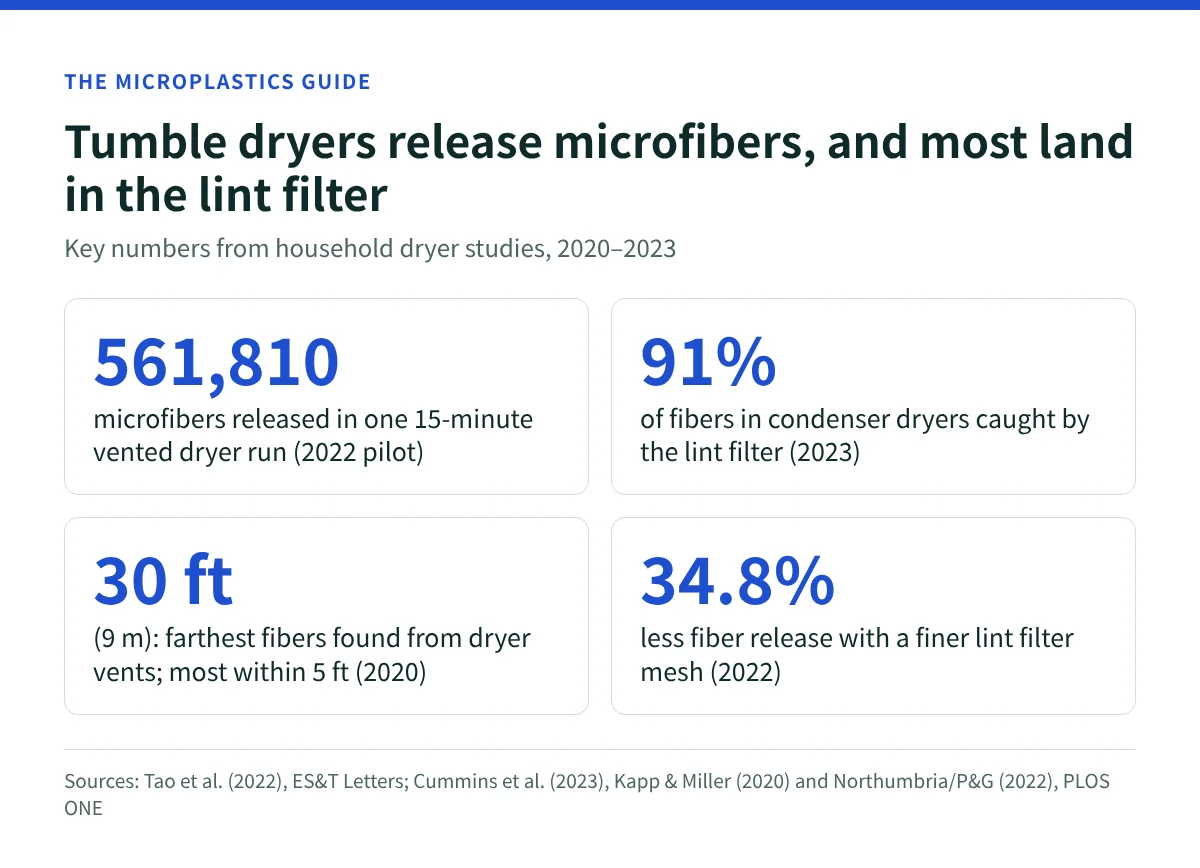
Tumble dryers do release microfibers, and many of them are plastic. A 2022 pilot study counted up to 561,810 microfibers leaving a vented dryer in 15 minutes. A 2023 study found that most fibers land in the lint filter, so emptying it the right way matters. Our clothing and laundry guide covers the wider picture.
Do dryers release microplastics?
Yes, but not every fiber is plastic. Dryers shed fibers from whatever you dry. Polyester, nylon and acrylic fibers are microplastics. Cotton and wool fibers are not.
Researchers at City University of Hong Kong dried polyester and cotton clothing in a vented dryer. They published the pilot study in Environmental Science & Technology Letters in 2022. Both fabrics shed. Polyester release rose as the load got heavier, while cotton release stayed about the same.
The team estimated that one dryer could vent 90 to 120 million microfibers a year to outdoor air in a Canadian household.
Do dryers shed more microfibers than washing machines?
It may be similar, or more. Here is what the main studies found:
| Study | What it found |
|---|---|
| City University of Hong Kong (2022, pilot) | Dryer released 1.4 to 40 times more fibers than washers in earlier studies, for the same amount of clothing |
| Northumbria University and P&G (2022, PLOS ONE) | Drying a load released almost the same amount of fibers into the air as washing it released into water |
| Northumbria University and P&G (2023, PLOS ONE) | Real household loads released 256 to 342 ppm of microfibers (fiber mass relative to the laundry) in both vented and condenser dryers |
The 2022 Northumbria study involved over 1,200 garments from European and North American households. The Hong Kong comparison used washer figures from earlier studies, not a side-by-side test.
There is one important difference. Washer water often goes to a treatment plant that removes many fibers. Air from a vented dryer usually goes straight outside.
How far do dryer fibers travel?
Not very far, mostly. In a 2020 PLOS ONE study, Kirsten Kapp and Rachael Miller dried pink polyester fleece blankets and collected fibers on snow around the vents. They found fibers up to about 30 feet (9 m) away, but most fell within 5 feet (1.5 m).
The same study collected 35 to 70 mg of lint per three drying cycles from the exhaust. The authors called dryers an underestimated source of microfiber pollution.
Are condenser and heat pump dryers better?
For air, yes. For water, not automatically. Condenser dryers, including heat pump models, do not vent outside. A 2023 study by Northumbria University and Procter & Gamble was the first to test them.
It found 91% of fibers in the lint filter. The rest collected in the condenser and went down the drain. The authors estimated this at 641 tonnes a year in the UK and EU.
The bigger risk is how people clean the filter. Rinsing it under the tap could send ten times more fibers into waterways, the researchers said.
Does a finer lint filter or fabric softener help?
In tests, yes. The 2022 Northumbria study found that shrinking lint filter pores from 0.2 to 0.04 mm² cut fiber release by 34.8%. Lint filters also caught polyester better than cotton, so most fibers escaping to air were likely cotton.
The same study found that using an anti-wrinkle fabric conditioner with a dryer sheet cut exhaust emissions by 44.9%. P&G, which sells these products, co-funded and co-authored the work.
How strong is the evidence?
Strong that dryers release microfibers. Four studies from three research groups agree on this, though two were partly funded by industry.
Emerging on how much. The Hong Kong work was a pilot study. The yearly estimates are models built on small samples. The 2023 authors said their study should be repeated with a larger sample.
Unknown on health. No study we found links dryer fibers to health effects in people. Most measured fibers are vented outside or caught in filters.
What can you do?
You do not need to stop using your dryer. These steps cut the fibers it releases:
- Air-dry when you can. A drying rack releases no dryer exhaust at all.
- Empty the lint filter into the trash. Use your hand, a soft brush, a cloth or a vacuum, as the 2023 study's authors advise. Avoid rinsing it in the sink.
- Clean the filter after every load, the same dry way.
- Hang fleece and athleisure to dry. Synthetic fibers are the plastic ones, and polyester clothing shed fibers in the dryer studies above.
- Wash fewer, fuller loads, as our guide on how to avoid microplastics in clothing explains.
If you use detergent pods, our check on laundry pods and PVA film explains a separate debate.
Frequently asked questions
Is dryer lint microplastic?
Partly. Lint is a mix of fibers from everything you dry. Fibers from polyester, nylon and acrylic are microplastics, while cotton and wool fibers are not.
Should I put dryer lint in the trash or compost?
The 2023 study's authors advise putting it in household waste. Lint from synthetic clothes contains plastic fibers, so composting it can spread them into soil.
Do dryer sheets reduce microplastics?
In one 2022 study, a dryer sheet with an anti-wrinkle conditioner cut exhaust fibers by 44.9%. That study was co-funded by a company that sells these products, and it has not been repeated independently.
Keep reading
Sources
- City University of Hong Kong (2022): Clothes dryers are an overlooked source of airborne microfibers, on Tao et al. in Environmental Science & Technology Letters
- Kapp and Miller (2020), Electric clothes dryers: An underestimated source of microfiber pollution, PLOS ONE
- DOAJ record (2020): Kapp and Miller, Electric clothes dryers, PLOS ONE abstract
- DOAJ record (2022): The impact of fabric conditioning products and lint filter pore size on airborne microfiber pollution arising from tumble drying, PLOS ONE
- EurekAlert (April 2022): Northumbria University release on the PLOS ONE tumble drying study
- Cummins et al. (2023), Impact of vented and condenser tumble dryers on waterborne and airborne microfiber pollution, PLOS ONE (Northumbria research portal)
- DOAJ record (2023): Cummins et al., Impact of vented and condenser tumble dryers, PLOS ONE abstract
- EurekAlert (May 2023): Northumbria University release on condenser tumble dryers and waterborne microfibers
- Phys.org (May 2023): Sustainable ventless dryers contribute to waterborne microfiber pollution