Laundry pods do not leave solid microplastic flakes in your wash, because their film is polyvinyl alcohol (PVA), which dissolves in water. The open question is what happens next: a 2021 model from Arizona State University estimated that as much as 75% of that dissolved PVA passes through US treatment plants. For the much larger laundry source, shed clothing fibers, see our clothing, laundry and air guide.
Are laundry pods made of plastic?
The clear film around laundry and dishwasher pods is PVA, also written PVOH. It is a synthetic polymer, the same broad family as plastics, but it is designed to dissolve in water. Many detergent sheets use PVA too: EPA's 2023 letter refers to PVA "used in laundry and dishwasher detergent pods and sheets" (US EPA, 2023).
So whether pods are "plastic" depends on the definition. Chemically, PVA is a plastic-type polymer. Practically, it does not stay solid in the wash the way a polyester fiber or a microbead does.
Do laundry pods release microplastics?
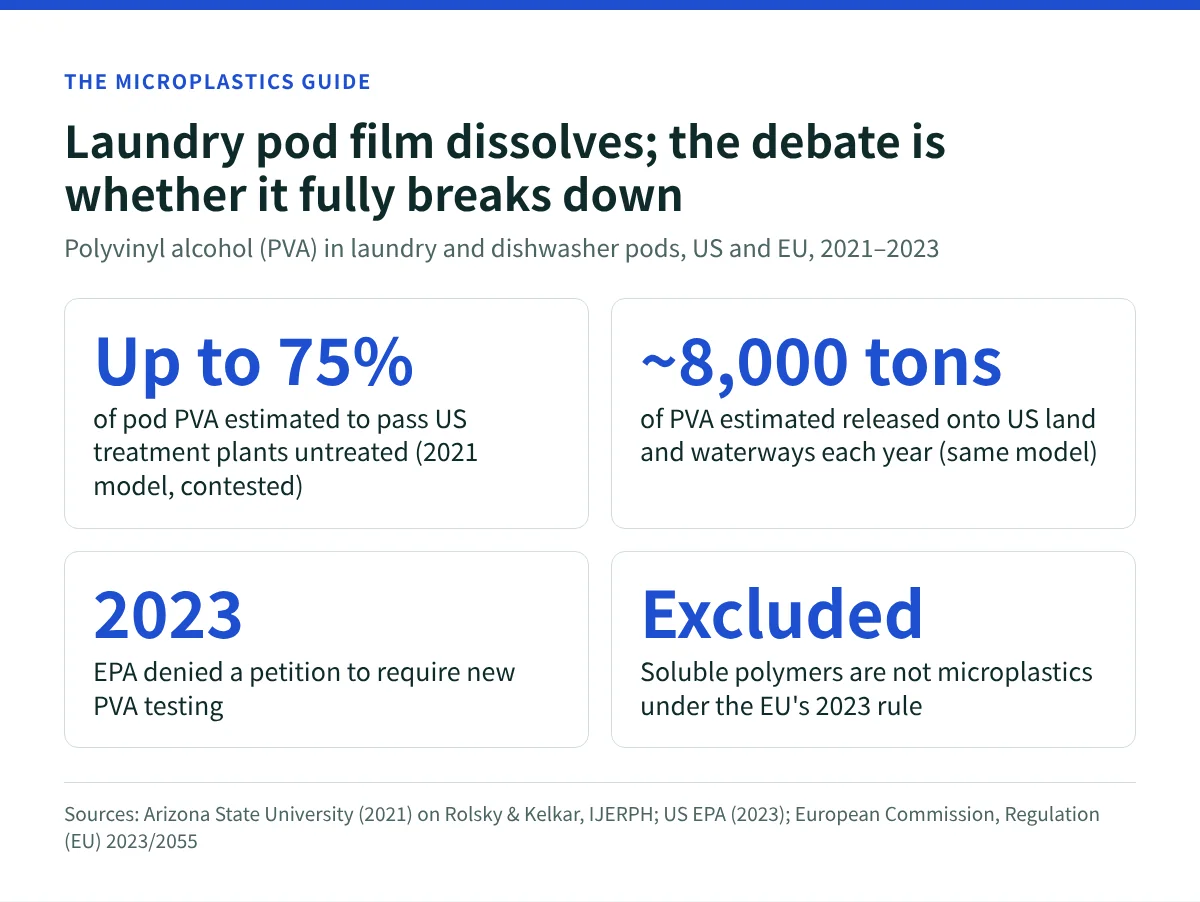
Under the main legal definition, no. The EU's 2023 microplastics restriction covers synthetic polymer particles below 5 mm that are "organic, insoluble and resist degradation", according to the European Commission. The regulation text says the Commission chose to exclude "natural, degradable and soluble polymers" from that definition.
Critics use a different frame. They argue that dissolved PVA is still a synthetic polymer, and that what matters is whether it breaks down fully before reaching rivers and soil.
What did the 2021 PVA study find?
Researchers Charlie Rolsky and Varun Kelkar at Arizona State University combined US pod use with wastewater data. Their model, published in June 2021 in the International Journal of Environmental Research and Public Health, estimated that as much as 75% of PVA goes untreated in the US each year.
That works out to about 8,000 tons a year released onto land and into waterways, the university said. The release adds that the research was supported in part by Plastic Oceans International and Blueland, a company that sells pod alternatives.
The authors were careful about harm. "We know it's out there, but we don't know whether it's causing harm," Rolsky said in the 2021 release.
What do EPA and the detergent industry say?
In January 2023, Blueland and the Plastic Pollution Coalition petitioned EPA to require new PVA testing. On April 21, 2023, EPA denied the petition in full.
EPA said the petition relied on studies of microplastics "rather than the soluble PVA used in Safer Choice-certified products." It added that only certain PVA structures are allowed in products with its Safer Choice label, and that the evidence shows they meet that standard.
The American Cleaning Institute, the US detergent trade group, goes further. Its fact page, updated in April 2026, says detergent-grade PVA is "not a microplastic" and biodegrades in wastewater treatment. It calls the 2021 model's assumptions unsupported. Note that this is an industry source.
| Question | Who says what | Evidence rating |
|---|---|---|
| Does pod film dissolve in water? | All sides agree | Strong |
| Is dissolved PVA a microplastic? | EU rule excludes soluble polymers; critics call it dissolved plastic | Definitions differ |
| Does most PVA break down in treatment plants? | 2021 model says up to 75% passes through; industry and EPA disagree | Contested |
| Does PVA from pods harm wildlife or people? | No study has shown this; data are thin | Emerging (unknown) |
How strong is the evidence?
Contested. The 75% figure comes from one modeling study, not from measuring PVA in rivers. It was partly funded by a company with a commercial stake. Industry studies point the other way, and EPA sided with them in 2023.
Real-world outcomes likely vary. Kelkar noted that it is unknown what happens to PVA in cooler regions where treatment-plant bacteria are less active. No study has linked pod PVA to human health effects.
What does this mean for you?
Pod film is a minor and uncertain issue next to synthetic clothing, which sheds solid plastic fibers in every wash. Our guide on how to avoid microplastics in clothing covers that bigger source. If you want to skip PVA anyway, the options are simple:
- Powder detergent in a cardboard box. No film to dissolve.
- Unwrapped tablets. Check that the tablet is pressed powder, not wrapped in film.
- Liquid detergent. No film, though the jug is usually plastic.
- Read the label. Look for "polyvinyl alcohol," "PVA" or "PVOH" on sheets and pods.
- Be wary of "biodegradable" claims. Lab tests do not always match real conditions, as with compostable plastics.
The EU's 2023 rules on intentionally added microplastics also cover detergents and glitter; see what the EU glitter ban covers.
Frequently asked questions
Do dishwasher pods contain microplastics?
Dishwasher pods use the same water-soluble PVA film as laundry pods. Under the EU definition, dissolved PVA is not a microplastic. Whether all of it breaks down in treatment plants is still debated.
Are detergent sheets better than pods?
Not necessarily for PVA. Many detergent sheets also contain PVA, and EPA's 2023 letter covers both pods and sheets. Check the ingredient list if you want to avoid it.
Does PVA from pods end up in my body?
No study has shown that PVA from laundry pods reaches people in meaningful amounts. Research on pod PVA has focused on wastewater and the environment, not human exposure.
Keep reading
Sources
- Arizona State University (July 2021): Are laundry and dish pods biodegradable? Not exactly, ASU study shows, on Rolsky and Kelkar (2021), International Journal of Environmental Research and Public Health
- US EPA (April 21, 2023): Response to TSCA section 21 petition on polyvinyl alcohol
- American Cleaning Institute (updated April 2026): Get the facts about PVA and detergent pods
- European Commission (September 2023): Commission Regulation (EU) 2023/2055 on synthetic polymer microparticles
- European Commission press release IP/23/4581 (September 2023) on the restriction of microplastics intentionally added to products