
The "spoonful of plastic in your brain" claim comes from a single February 2025 study that reported a median of about 4,900 micrograms of plastic per gram of brain tissue. In December 2025, Germany's Federal Institute for Risk Assessment (BfR) called those amounts "implausibly high," so the spoon figure should be treated as Contested, not as fact.
Plastic particles probably do reach the brain. But how much is there, and what it does, is still unknown. For the wider picture, see our guide to microplastics and health.
Where did the "spoon of plastic in the brain" claim come from?
The study was published in Nature Medicine on February 3, 2025, by a team at the University of New Mexico led by Matthew Campen. It analyzed brain, liver and kidney tissue from autopsies. A 2025 expert roundup by the Science Media Centre noted it was based on 52 brain samples from two years, 2016 and 2024.
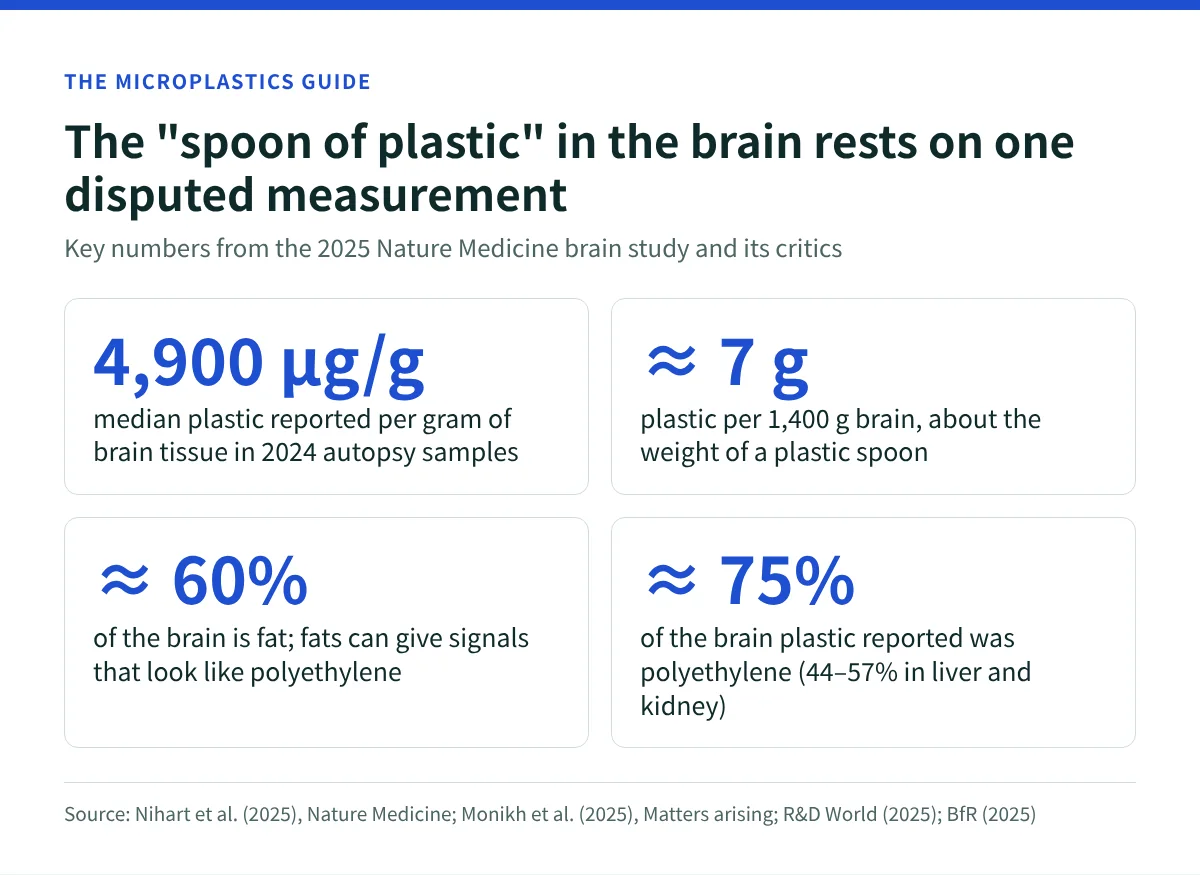
The spoon comes from simple math. R&D World explained it in 2025: 4,900 µg per gram times an average 1,400-gram brain is about 6.9 grams. A disposable plastic spoon weighs about 7 grams.
According to The Transmitter, nearly 400 news outlets covered the paper. The image was easy to remember, which helped it spread.
Is there really enough plastic in the brain to make a spoon?
Contested. Probably not, based on the critiques published so far. No one has repeated the result with a different method and found spoon-sized amounts.
The main problem is the measuring method, called pyrolysis gas chromatography–mass spectrometry (Py-GC/MS). It heats a sample and reads the gases released. Fats can release gases that look like polyethylene.
A formal Matters Arising letter by Fazel Monikh and eight co-authors, published in Nature Medicine in 2025, listed the concerns:
- The brain is about 60% fatty acids, versus under 5% in liver and kidney.
- Polyethylene made up about 75% of the plastic mass reported in brains, versus 44–57% in liver and kidney.
- In some brain samples, more than 10% of the tissue was left undigested and could be misread.
- No procedural or reagent blanks were reported to check for lab contamination.
- The rise from 3,345 µg/g (2016) to 4,917 µg/g (2024) could reflect more fat in tissue, not more plastic.
The critics also estimated the particle count the reported mass implies. They argued it would not physically fit in brain tissue.
What did Germany's BfR say about the brain study?
In its December 2025 assessment, the BfR called the study important and said the finding "warrants further investigation." It also listed serious limits:
| BfR concern | What it means |
|---|---|
| Plastic in handling | Brains were stored in plastic buckets and cut on polyethylene boards. |
| Missing blanks | Background contamination could not be assessed. |
| Signal mix-up | Fatty-acid residues could inflate polyethylene values. |
| Study design | Small, non-representative, cross-sectional sample. |
The BfR said the measured amounts were "implausibly high" and could overestimate exposure. It also reported a mean of 27,215 µg/g in a dementia group of 12 brains. It noted that dementia may damage the brain's barriers, so more plastic could be a result of disease rather than a cause.
The BfR's conclusion was clear: there is "currently no evidence of a causal link" between current micro- and nanoplastic exposure and health problems.
Did other scientists challenge the spoon claim?
Yes. In January 2026, the Guardian reported that seven high-profile studies of microplastics in human tissue had been formally challenged, including the brain paper. A Mother Jones reprint of that report quotes Dušan Materić of Germany's Helmholtz Centre for Environmental Research calling the paper "a joke." He suggested rising obesity could explain the trend.
Earlier, in February 2025, chemist Oliver Jones of RMIT said levels higher than in sewage sludge "seems unlikely." The same month, a PubPeer commenter found duplicated supplementary images. Campen called that error "purely clerical."
Campen has said the field is young and lacks standard methods. He described most criticism as "conjectural" and said his team is working on better tests.
What do we actually know about plastic in the brain?
- Emerging: Very small particles can probably reach the brain. A larger 2026 study in Nature Health examined 191 brain samples with two other techniques, laser infrared imaging and electron microscopy.
- Contested: The amount. Our article on how much plastic is in the brain compares the two biggest studies, which differ about a hundredfold.
- No evidence yet: That brain plastic causes dementia or other brain disease. Links so far are associations.
Size matters too. Learn why nanoplastics behave differently from microplastics. The same measurement debate affects studies of microplastics in the placenta.
What should you do about it?
There is no proven way to remove microplastics from the brain or body. Be wary of products sold as a plastic "detox."
Cutting everyday exposure is still a reasonable precaution. Our ranked list of changes starts with the easiest steps, such as not heating food in plastic.
Frequently asked questions
Is the spoonful of plastic in your brain true?
It is not established. The figure comes from one 2025 study whose method may mistake brain fat for polyethylene. Germany's BfR called the amounts implausibly high, and no other study has confirmed them.
Who first said there is a spoon of plastic in the brain?
The comparison followed a February 2025 Nature Medicine study led by Matthew Campen at the University of New Mexico. News reports turned its median of about 4,900 µg per gram into roughly 7 grams per brain, about one plastic spoon.
Can plastic in the brain cause dementia?
There is no evidence that it does. The 2025 study found more plastic in people with dementia, but dementia can weaken the brain's barriers. That means the plastic could be a result of disease, not its cause.
Keep reading
Sources
- Nihart et al. (2025), Bioaccumulation of microplastics in decedent human brains, Nature Medicine
- Monikh et al. (2025), Matters arising: Bioaccumulation of microplastics in decedent human brains (accepted manuscript)
- German Federal Institute for Risk Assessment (BfR), Microplastics in the brain (December 2025)
- BfR, Microplastics in the brain: BfR evaluates new study (July 2025)
- R&D World (2025), Does your brain really have enough plastic in it to make a spoon?
- The Transmitter (February 2025), Spoonful of plastics in your brain paper has duplicated images
- Science Media Centre (February 2025), Expert reaction to study on microplastics in human brains
- Mother Jones / The Guardian (January 2026), Scary research findings on microplastics and human health may be flawed
- mindbodygreen (May 2026), Researchers found microplastics in nearly every brain sample