
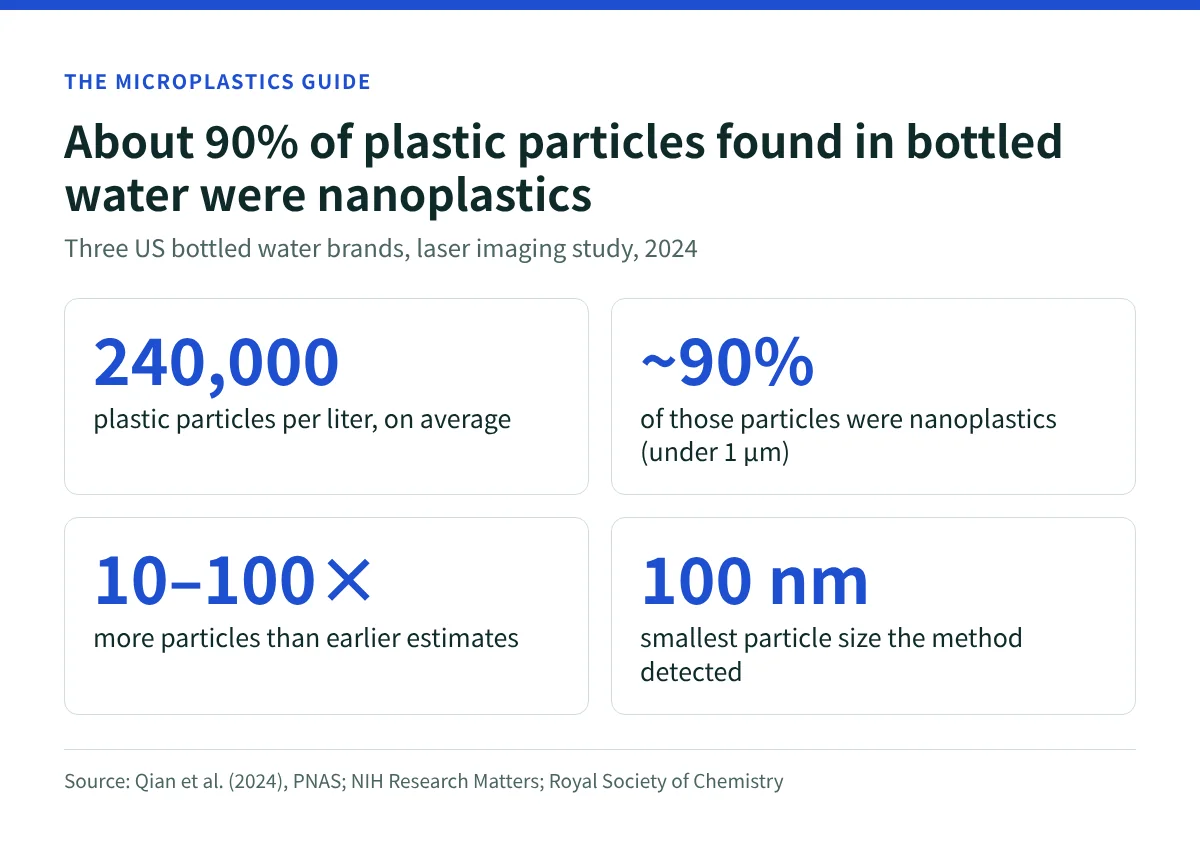
Nanoplastics are plastic particles smaller than 1 micrometer (µm), a thousand times smaller than a millimeter. They matter because they are far more numerous than larger microplastics: a 2024 study found about 240,000 particles per liter of bottled water, and about 90% were nanoplastics. Whether they harm people is not yet known. For the wider picture, see our health effects guide.
What is the difference between nanoplastics and microplastics?
The difference is size. Microplastics are pieces under 5 millimeters (mm), and nanoplastics are the smallest end of that range. There is no single official cut-off yet.
| Who | Nanoplastic size | Year |
|---|---|---|
| Gigault et al., Environmental Pollution | 1 to 1,000 nanometers (nm) | 2018 |
| European Food Safety Authority (EFSA) | 1 to 100 nm | 2016 |
| US National Institutes of Health (NIH) | Under 1 µm (1,000 nm) | 2024 |
Strong. Most researchers now use 1 µm as the line, following the 2018 proposal by Gigault and colleagues. EFSA's 2016 statement used a stricter 100 nm limit. When you read a headline, check which definition the study used.
Regulators mostly work with the upper limit. The EU restriction on synthetic polymer microparticles, in force since October 17, 2023, covers particles of 5 mm or less. For compliance checks, it counts particles down to 0.1 µm (100 nm).
How many nanoplastics are in bottled water?
In January 2024, a Columbia University team led by Wei Min and Beizhan Yan published their results in PNAS. They used a new laser imaging method that identifies single particles by their chemistry. They tested three popular US bottled water brands, which they did not name.
The NIH summary reports about 240,000 plastic particles per liter on average. That is 10 to 100 times more than earlier estimates, which mostly counted larger microplastics. The method could detect particles down to 100 nm.
Polyamide, a type of nylon, was the most common plastic. PET, the plastic most water bottles are made from, was also abundant. The team also saw millions of other tiny particles that did not match the seven plastics they searched for.
Emerging. This is one study of three brands, so it may not represent all bottled water. It still shows why older counts were too low: they could not see nanoplastics.
Are nanoplastics more harmful than microplastics?
Nobody knows yet. Scientists suspect smaller particles could be more of a concern, because they can reach places larger ones cannot. The evidence for that comes mainly from cells and animals.
A 2025 review in Frontiers in Toxicology gathered this research. Key points:
- In a lab model of the blood-brain barrier, 0.2 µm polystyrene particles crossed more than 1.0 µm particles.
- In pregnant animals, swallowed nanoplastics crossed the gut and the placenta and reached fetal organs.
- Many studies used high doses of new, smooth polystyrene beads. Real-world particles are mixed, weathered and usually present at lower doses.
- All human evidence so far is observational, so it shows associations, not cause.
Emerging. The lab and animal findings are consistent, but they do not show that today's real-life exposure harms people. In July 2024, the US Food and Drug Administration said current scientific evidence does not demonstrate that levels detected in foods pose a risk to human health.
The same gap shows up in cancer research: a 2026 mouse study tied polystyrene nanoplastics to faster colon tumor growth, as our article on microplastics and colon cancer explains. Size also decides whether particles can get past your skin, as our article on whether microplastics can be absorbed through skin explains.
Why are nanoplastics so hard to measure?
They are too small for the standard methods used to count microplastics. EFSA said in 2016 that analytical methods still had to be developed for nanoplastics, and that knowledge on their toxicity was "particularly needed."
Measurement limits also explain why studies disagree. Our article on how much plastic is in the brain shows estimates differing about a hundredfold. Similar debates affect studies of microplastics in the placenta. Our guide to how microplastics are measured compares the main lab methods and their size limits.
What can you do about nanoplastics?
There is no proven way to remove microplastics or nanoplastics from the body, and "detox" products have no evidence behind them. What you can control is avoidable exposure:
- Drink tap water, filtered if you like, instead of bottled water where tap water is safe. Our drinking water guide explains filter certifications.
- Other drinks carry particles too; see how many microplastics are in beer, wine and soft drinks.
- Keep plastic away from heat and wear, as our ranked list of changes describes.
- Follow the EPA's work on microplastics in drinking water for future testing rules.
Frequently asked questions
Can nanoplastics enter your cells?
Lab studies show that very small plastic particles can be taken up by cells and cross barriers such as the blood-brain barrier in models. Whether this happens in people at everyday doses, and what it does, is not known.
Are nanoplastics in tap water too?
Probably, since nanoplastics form when larger plastic breaks down. But few studies can measure them, so reliable numbers for tap water are not yet available.
What size is a nanoplastic compared with a microplastic?
A nanoplastic is usually under 1 micrometer, or 1,000 nanometers. A microplastic can be up to 5 millimeters, which is 5,000 times larger than that.
Keep reading
Sources
- Qian et al. (2024), Rapid single-particle chemical imaging of nanoplastics by SRS microscopy, PNAS (NIH Research Matters summary)
- Royal Society of Chemistry (2024): High levels of nanoplastics found in bottled water
- Gigault et al. (2018), Current opinion: What is a nanoplastic?, Environmental Pollution (abstract)
- FoodNavigator (2016): EFSA statement on microplastics and nanoplastics in food
- Fang et al. (2025), Overall effects of microplastics on brain, Frontiers in Toxicology
- Packaging Law (2024): FDA publishes web page on microplastics and nanoplastics in food
- SGS (2023): EU regulates microplastics under REACH