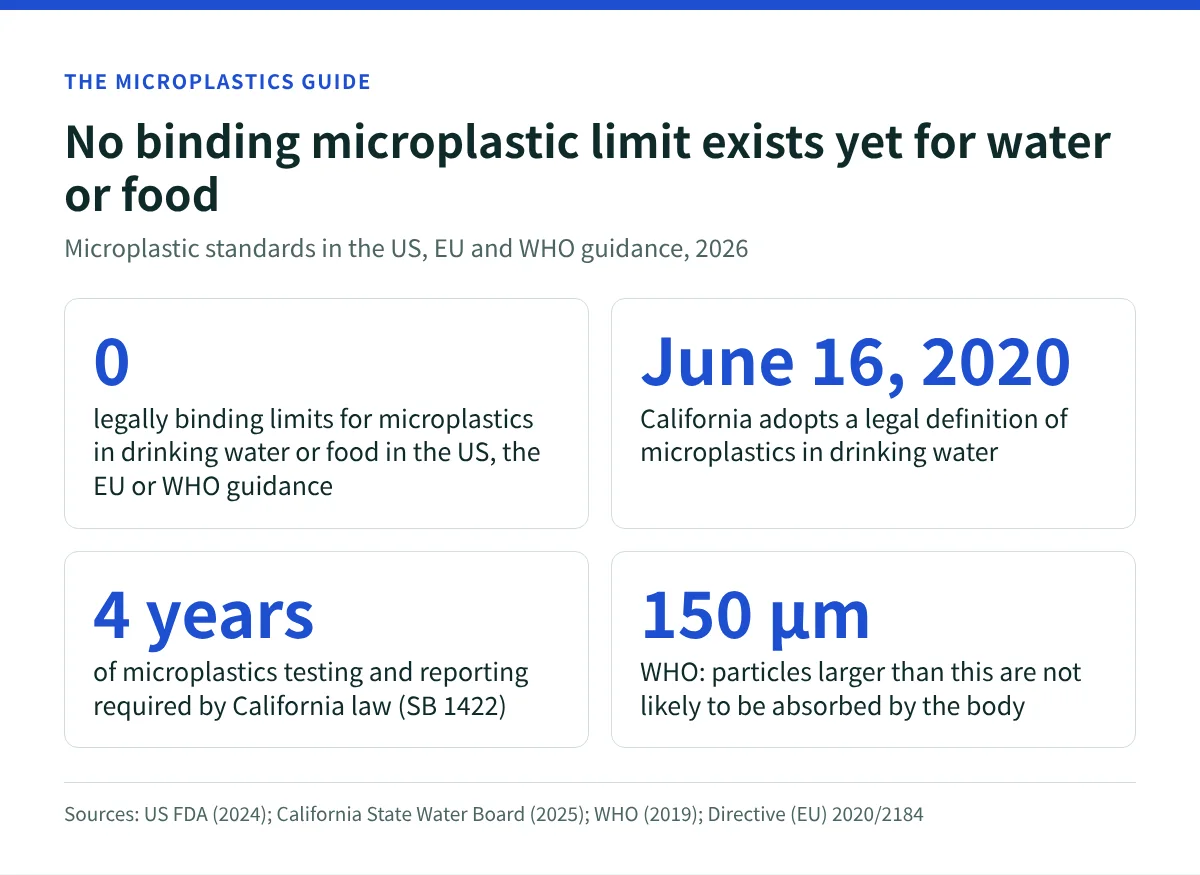
There is no legally binding microplastic standard for drinking water or food anywhere in the US or the EU as of 2026, and the World Health Organization has not set a guideline value. What exists instead are definitions, testing rules and measurement methods that could support limits later.
This matters because many people assume their tap water meets a "microplastics limit." It does not, because none exists yet. For the bigger picture on water, see our drinking water guide.
Is there a legal limit for microplastics in drinking water?
No. The US Food and Drug Administration states that "there currently are no regulatory levels set for microplastics or nanoplastics in drinking water," according to its microplastics in foods page (2024). Drinking water limits in the US are set by the EPA, which has not set one for microplastics.
The EPA has proposed adding microplastics to its research list of contaminants, which is not a limit; we explain that step in what the EPA watch list means for your tap. According to Pew (2026), seven governors asked the EPA in late 2025 to add microplastics to its 2027 national testing round, but the agency's preliminary decision left them out.
What has California required?
California is the furthest ahead in the US, but it tests rather than limits. A 2018 state law, SB 1422, requires the State Water Board to adopt a definition and "four years of testing and reporting of microplastics in drinking water," according to the State Water Board (updated 2025).
The board adopted its definition of microplastics in drinking water on June 16, 2020. It also published standard Raman and infrared lab methods in 2021 and revised them in 2022. The law tells the board to consider a "notification level" only "if appropriate."
The board's 2022 draft policy handbook found "insufficient evidence to issue a notification level or other numerical guidance." It planned two testing phases:
| Phase | Planned dates | What is tested | Smallest particles |
|---|---|---|---|
| Phase I | Fall 2023 to fall 2025 | Source water | 50 micrometers |
| Phase II | Fall 2026 to fall 2028 | Treated drinking water | 5 micrometers |
Pew reports that New Jersey has also passed a law to test for microplastics in drinking water. Bills have been introduced in Illinois, Michigan and Rhode Island.
What does the EU require?
The EU has a framework but no limit yet. The recast Drinking Water Directive (EU) 2020/2184, adopted December 16, 2020, required the European Commission to adopt "a methodology to measure microplastics" by January 12, 2024.
That method exists "with a view to including them on the watch list." The directive says each watch list item gets "a guidance value," which is a monitoring trigger, not a binding maximum. The directive names microplastics alongside pharmaceuticals and endocrine-disrupting compounds as substances of concern.
What does WHO say?
The WHO has not issued a guideline value. In its 2019 statement, it said microplastics in drinking water "don't appear to pose a health risk at current levels," based on limited information. That review drew on 50 studies, according to the Food Packaging Forum (2019).
WHO added that particles larger than 150 micrometers are not likely to be absorbed by the body. It called for standard methods to measure microplastics in water, which is exactly what California and the EU have since worked on.
Are there limits for microplastics in food?
No. The FDA says there are no regulations that authorize microplastics as food ingredients, and that current evidence "does not demonstrate" that detected levels pose a health risk. It also notes there are "no standard definitions" for the size of microplastics or nanoplastics.
How strong is the evidence?
Strong that no binding limits exist: every official source above says so directly. Emerging on health risk: agencies say the data are too limited to set safe levels, partly because labs still measure particles differently. See why microplastics numbers vary so much.
What does this mean for you?
No limit does not mean "proven safe" or "proven harmful." It means regulators lack the data to set a number. You can still lower your intake from water:
- Drink tap water rather than bottled water when your tap water is safe.
- Use a filter certified for microplastics reduction under NSF/ANSI 401, or a reverse osmosis system.
- If you rely on a private well, read what is known about well water microplastics.
Frequently asked questions
Does the EPA regulate microplastics in tap water?
Not yet. The FDA confirms there are no regulatory levels for microplastics in US drinking water. The EPA's proposed listing starts a research process and does not set a limit.
Is there a safe level of microplastics?
No safe or unsafe level has been set. WHO said in 2019 that current levels in drinking water do not appear to pose a health risk, but it called for more research.
Which country has the strictest microplastic standards?
No country has a binding drinking water limit. California's testing program and the EU's measurement method are among the most advanced steps, but both stop short of a maximum level.
Keep reading
Sources
- US FDA (2024), Microplastics and Nanoplastics in Foods
- California State Water Resources Control Board (updated 2025), Microplastics in drinking water
- California State Water Board (2022), Proposed Policy Handbook for microplastics testing in drinking water
- Directive (EU) 2020/2184 on the quality of water intended for human consumption, Article 13
- WHO (2019), WHO calls for more research into microplastics and a crackdown on plastic pollution
- Food Packaging Forum (2019), WHO report on microplastics in drinking water
- Pew Charitable Trusts (2026), 5 actions states are taking to combat microplastic pollution