
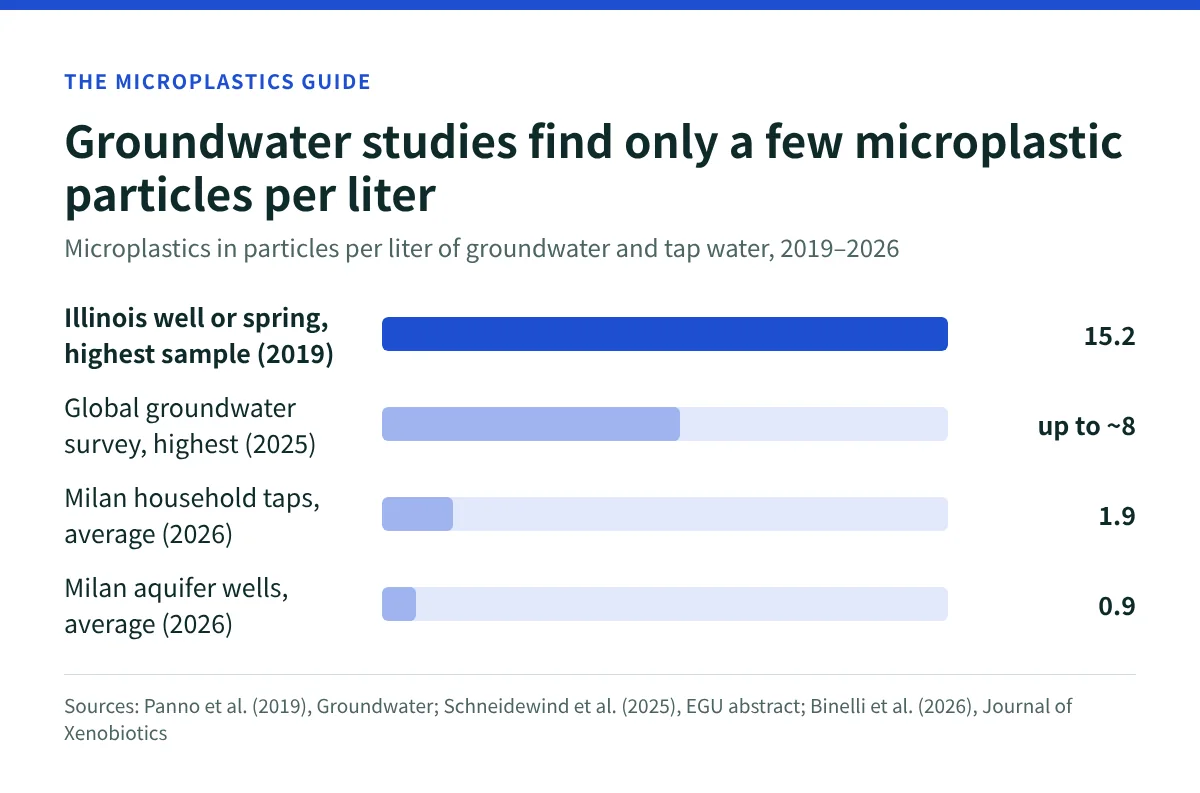
Yes, well water can contain microplastics, but the levels measured so far are low. A 2019 Illinois study found plastic in 16 of 17 groundwater samples, with a peak of 15.2 particles per liter. For how this compares with city water and bottled water, see our drinking water guide.
Does well water contain microplastics?
Most likely, at least in small amounts. Groundwater is filtered through soil and rock, but some particles still get through.
The first study to look for microplastics in fractured limestone aquifers was published in the journal Groundwater in 2019. Researchers sampled 17 wells and springs in two Illinois aquifers. All but one sample held plastic fibers.
The same samples carried medicines and household chemicals. That pointed the team toward household septic systems as one likely source. One researcher noted that a single load of laundry can release many polyester fibers, as our guide to avoiding microplastics in clothing explains.
About 40 million people in the US rely on a private well for drinking water, according to the USGS. Few of those wells have ever been tested for microplastics.
How much plastic is in groundwater compared with tap water?
Only a handful of field studies exist, and they use different methods. Still, the numbers are in the same low range.
| Study | Water tested | Microplastics found |
|---|---|---|
| Illinois, 2019 | 17 wells and springs | Up to 15.2 particles per liter |
| Global survey, 2025 | Groundwater from many sites | About 0.1 to almost 8 particles per liter |
| Milan, Italy, 2026 | Aquifer wells feeding the city | 0.9 particles per liter on average |
| Milan, Italy, 2026 | Taps in 10 apartments | 1.9 particles per liter on average |
The 2025 global survey is an early conference result. It filtered about 300 liters of groundwater per site and found fragments more often than fibers.
The 2026 Milan study followed one groundwater supply from aquifer to tap. The authors called its levels among the lowest reported worldwide. Apartment taps averaged 1.9 particles per liter, and the authors suspect building plumbing added some of them. Our article on plastic pipes and microplastics looks at that question.
These counts are tiny next to bottled water studies that count nanoplastics. That is partly because these studies did not measure the smallest particles. Our explainer on how microplastics are measured covers why numbers vary so much.
Which wells are most at risk?
A 2024 systematic review of groundwater studies found higher levels near cities, industrial areas and landfills. Levels were lower where people had little impact. The most common plastics were polypropylene and polyethylene.
Geology matters too. Fractured limestone, or karst, lets surface water move quickly underground. Such aquifers supply about 25% of the world's drinking water, the Illinois team noted.
Possible sources named in that study include:
- Household septic systems, which receive laundry water
- Runoff from roads
- Landfills
- Agricultural land
Who tests well water for microplastics?
Usually no one. In the US, private well water is not regulated, treated or monitored by officials, the CDC says. The owner is responsible for making sure it is safe.
Rules for public systems are only starting to move. In 2026 the EPA proposed adding microplastics to its drinking water watch list, which does not set any limit.
In Europe, the Drinking Water Directive lets countries exempt individual supplies serving fewer than 50 people or under 10 cubic meters a day. The EU adopted a standard method to measure microplastics in drinking water in 2024, but it sets no limits.
How strong is the evidence?
- Strong: microplastics can reach groundwater. Several independent field studies have found them.
- Emerging: how much is in a typical private well. Studies are few, sample sizes are small, and none has surveyed US household wells at scale.
- Contested: whether well water has fewer microplastics than treated surface water. Methods and size cutoffs differ too much to compare fairly.
No study has shown health harm from microplastics in well water. Research on health effects is still early, as our health effects guide explains.
What can well owners do?
Microplastics are only one well water question, and the health evidence on them is still early. Germs and many chemicals have well-known health risks.
- Test every year. The CDC advises testing well water at least once a year for germs and chemicals.
- Keep the septic system in good shape, and keep it well away from the wellhead.
- Filter at the tap if you want extra protection. A filter with an NSF/ANSI 401 microplastics claim must remove at least 85% of 0.5 to 1 µm particles. Reverse osmosis removes more.
- Change cartridges on schedule. In Milan, large carbon filters did not lower counts, possibly because they were saturated or wearing down.
Our products guide explains how to check a filter's certification.
Frequently asked questions
Does a water softener remove microplastics?
A softener is designed to remove hardness minerals, not particles. We found no study showing it reduces microplastics. A filter certified for microplastics reduction is the tested option.
Is well water safer than city water for microplastics?
Not clearly. Groundwater studies report low counts, but they use different methods than tap water studies. Plumbing inside the home can add particles to either kind of supply.
Can I get my well tested for microplastics?
There is no legal limit for microplastics in US or EU drinking water, so a result would be hard to interpret. Methods also vary between labs. A yearly test for germs and chemicals is the better first step.
Keep reading
Sources
- University of Illinois (January 2019): Microplastic contamination found in common source of groundwater, on Panno et al. (2019), Groundwater
- USGS: Updated information on locations of domestic well use
- Schneidewind et al. (2025), Microplastic particles in groundwater systems worldwide, EGU General Assembly 2025 abstract
- Binelli et al. (2026), From Aquifer to Tap: Comprehensive Quali-Quantitative Evaluation of Plastic Particles Along a Drinking Water Supply Chain of Milan (Northern Italy), Journal of Xenobiotics 16(1):18
- Lee, Cha, Ha & Viaroli (2024), Microplastic pollution in groundwater: a systematic review, Environmental Pollutants & Bioavailability 36(1)
- CDC: About drinking water safety and private wells
- Directive (EU) 2020/2184 on the quality of water intended for human consumption, Article 3
- AgencyIQ (2024): Commission issues methodology to measure microplastics in drinking water
- Tap Water Data: Filters for microplastics and NSF/ANSI 401