
There is no proof that microplastics cause colon cancer in people. In November 2026, news reports covered a Chinese mouse study in which long-term exposure to polystyrene nanoplastics led to more and more severe tumors. A 2026 review of 14 studies concluded that the human evidence is still small and mostly correlational. For the wider picture, see our health effects guide.
Why are microplastics being linked to colon cancer?
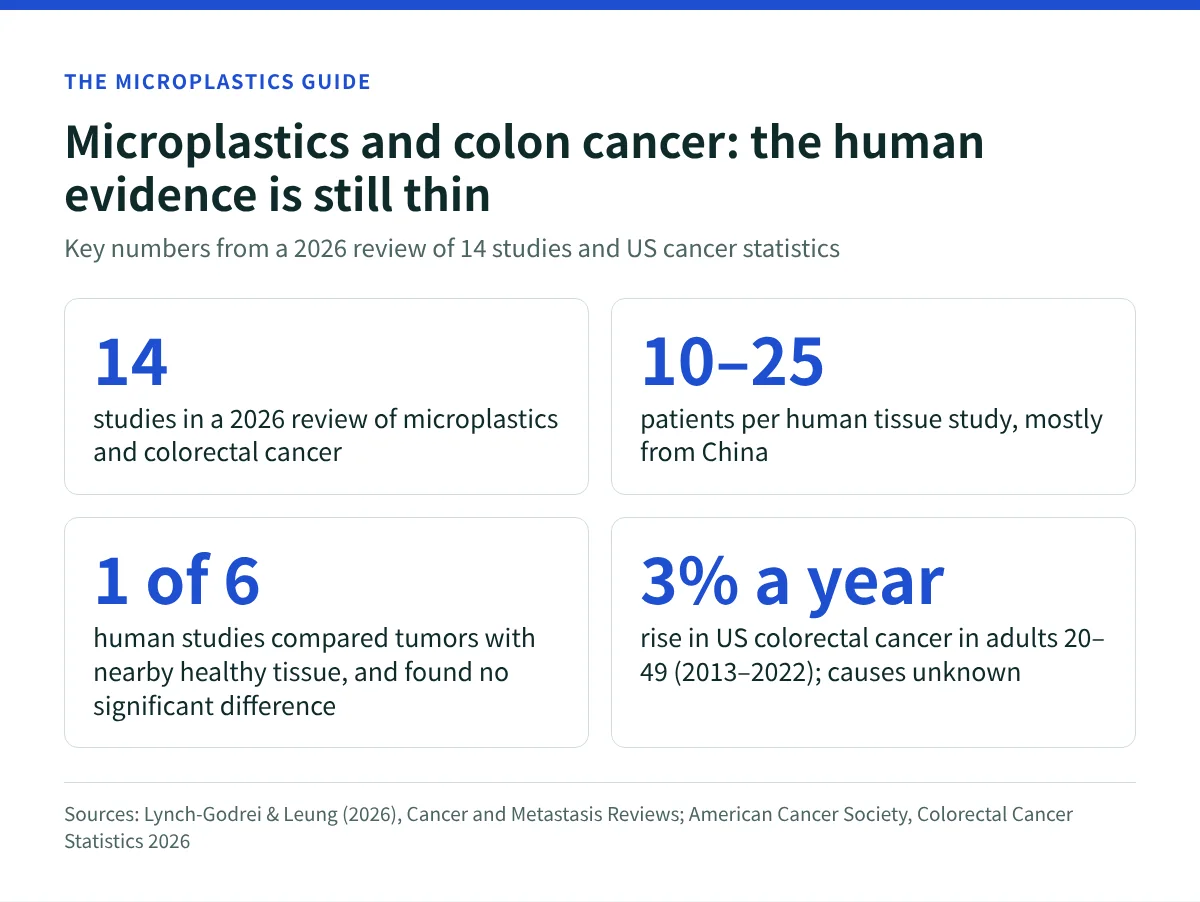
The concern comes from a real trend with no clear cause. The American Cancer Society's 2026 report found that colorectal cancer rose about 3% a year in US adults aged 20 to 49 from 2013 to 2022.
The disease is common overall. The ACS expects about 158,850 new US cases and 55,230 deaths in 2026.
Scientists are looking for exposures that grew over past decades. Microplastics are one candidate, alongside highly processed food and sedentary lifestyles, as a Washington Post report republished on November 15, 2026 explained.
Part of the recent rise is probably due to more testing. The same report notes the US lowered the screening start age from 50 to 45 in 2021, which finds more cancers in younger adults.
What did the 2026 mouse study find?
A team at Central South University in China gave polystyrene nanoplastics to mice that are genetically prone to colon cancer. According to news coverage of the study, exposed mice developed more tumors, and more severe ones, than unexposed mice.
The particles built up in the colon, disrupted the cells lining the gut and changed the gut bacteria. The paper's title, Polystyrene nanoplastics promote colorectal tumorigenesis via gut microbiota-metabolite-Th17 cell axis, points to an immune pathway driven by gut bacteria. We could not open the full paper, so we do not report its doses or mouse numbers.
Emerging. This is an animal result in mice already prone to tumors. It does not show that plastic starts cancer, or that everyday human doses do the same.
What do human studies show?
The best summary is a mini review by Anisha Lynch-Godrei and Christopher Leung, published online on July 31, 2026, in Cancer and Metastasis Reviews. It screened 41 records and kept 14 studies.
| Type of evidence | What it found | Rating |
|---|---|---|
| Human colorectal tumor tissue (5 studies) | Particles found in all samples in 4 studies, and in 5 of 10 in the fifth | Emerging |
| Tumor vs. nearby healthy tissue (1 study, 2025) | No significant difference in total particles; more PVC in tumors | Contested |
| Stool of patients vs. controls (1 study, 2025) | 62 vs. 43 particles per gram of dry stool | Emerging |
| Cells and mice | Oxidative stress, DNA damage, gut bacteria changes, faster tumor growth | Emerging |
The human studies were small, with 10 to 25 patients each, and five of the six came from China. One Turkish study from 2023 compared 16 cancer patients with 15 controls and reported more particles in tumor tissue.
The review lists key gaps. Mice did not develop new colon cancer from plastic alone; tumor loads rose only in models that already had tumors or colitis. Tumors might also trap particles, rather than particles causing tumors. And no study yet links microplastics to early-onset colon cancer.
How strong is the evidence?
Emerging for a possible role; not established for cause. The lab findings fit together, but finding plastic in a tumor does not prove it caused the tumor. Measurement is also hard, as our guide on why microplastic numbers vary so much explains.
Experts are split. In the Post report, University of Otago surgeon Frank Frizelle said microplastics may damage the colon's protective mucus layer. He also said: "My own thoughts are that it's going to prove not to be the microplastics themselves."
Similar debates surround the size of particles that reach organs and reports of plastic in the brain.
What does this mean for you?
There is no proven way to remove microplastics from the body, and "detox" products have no evidence behind them. Here is what does have a basis:
- Get screened. Screening removes polyps before they turn into cancer. US guidelines start at 45; ask your doctor if you have symptoms or a family history.
- Don't heat food in plastic. Heat speeds up the release of chemicals from plastic, the Post report notes. Our food and kitchen guide lists safer containers.
- Cut easy exposures. Our ranked list of changes shows which swaps matter most.
Frequently asked questions
Do microplastics cause colon cancer?
No study shows that microplastics cause colon cancer in people. Mouse and cell studies suggest they might speed up tumors that already exist. Human studies are small and show associations only.
Why are more young people getting colon cancer?
Nobody knows for sure. US rates in adults under 50 have risen for decades, and suspected factors include highly processed food and inactivity. Microplastics are being studied but are unproven.
Is Styrofoam linked to colon cancer?
The 2026 mouse study used polystyrene nanoplastics, the plastic in foam cups and trays. That does not show that eating from foam containers causes cancer. Avoiding heat in any plastic container is still a sensible step.
Keep reading
Sources
- Lynch-Godrei & Leung (2026), The link between microplastics and colorectal cancer, Cancer and Metastasis Reviews
- Polystyrene nanoplastics promote colorectal tumorigenesis via gut microbiota-metabolite-Th17 cell axis (2026), Molecular Cancer
- JournalArta (2026): Microplastics study finds tumor growth in cancer-prone mice
- The Washington Post via The Peninsula (2026): The link between microplastics and one of the deadliest cancers, and what to do
- American Cancer Society (2026): Colorectal Cancer Statistics, 2026 press release
- American Cancer Society (2026): Key statistics for colorectal cancer