
Studies have found microplastics in honey and sugar, but in small and uneven amounts. A 2024 study of 32 honeys from Türkiye reported an average of 314 particles per kilogram, and a 2024 Indian survey found up to 68 pieces per kilogram of sugar. Earlier honey results are disputed, so treat all of these numbers with care. For the bigger picture on food, see our food and kitchen guide.
Does honey contain microplastics?
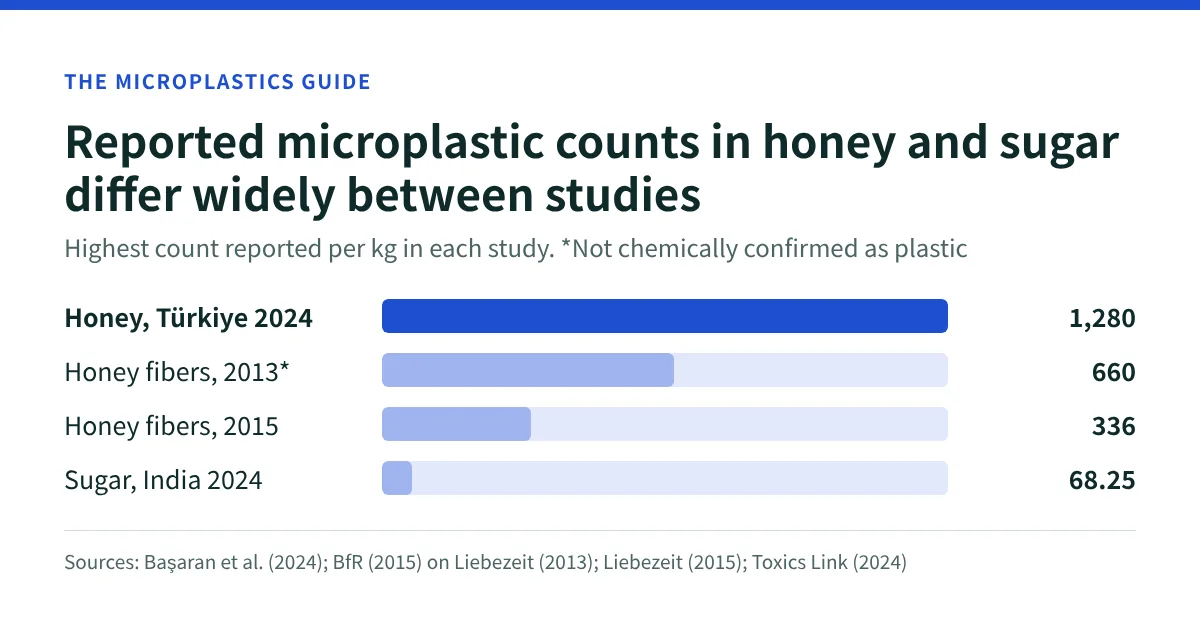
Some honey does, according to recent tests that checked the chemistry of each particle. The 2024 Turkish study, in the Journal of Food Composition and Analysis, found 0 to 1,280 particles per kg in honey produced in 2023. The plastics included EVA, polyethylene, polypropylene and nylon, mostly as fibers and fragments.
The same team estimated intake at about 1.2 particles a day for people eating monofloral honey and 0.85 for multifloral honey.
A 2024 Brazilian study tested honey from a native stingless bee in São Paulo. All 8 samples held particles, at 0.1 to 2.6 per milliliter. Most were transparent polypropylene fibers under 299 micrometers, confirmed by infrared spectroscopy.
Why are the early honey studies disputed?
The first honey counts came from a German team in 2013. They tested 19 honeys from Germany, France, Italy, Spain and Mexico and reported 40 to 660 fibers and 0 to 38 fragments per kg. They used stains and a microscope at 30x, but did not identify what the particles were made of.
Germany's Federal Institute for Risk Assessment (BfR) reviewed this in 2015. It noted that food control labs in two German states could not confirm the findings at 800 to 1,000x magnification. The BfR said the study had only limited evidential value.
A 2017 Swiss study in Food Additives & Contaminants checked five honeys with Raman and infrared spectroscopy. The most common black particles, at 1,760 to 8,680 per kg, were soot or char, likely from beekeepers' smokers. Many clear fibers were cellulose, not plastic, and other bits were glass or chitin. The authors found no sign of significant microplastic contamination.
The same German team's 2015 follow-up of 47 honeys reported 10 to 336 synthetic fibers per kg. Particles on flowers suggested bees carry them in while collecting nectar.
Does sugar contain microplastics?
Yes, in the few products tested. The Indian research group Toxics Link tested five sugar types in 2024 and found 11.85 to 68.25 pieces per kg, with the highest level in non-organic sugar. The same survey also tested salt, which we cover in microplastics in sea salt vs. rock salt.
A 2024 Turkish study in Process Safety and Environmental Protection tested 15 beet sugar products and found plastic in all of them. White sugar held the most, ahead of brown sugar and molasses. Polyethylene, polypropylene, PET and polystyrene were most common.
| Food | Study (year) | Samples | What was reported |
|---|---|---|---|
| Honey | Türkiye (2024) | 32 | 0 to 1,280 per kg, average 314 |
| Honey | Brazil (2024) | 8 | 0.1 to 2.6 per mL, all samples positive |
| Honey | Switzerland (2017) | 5 | No significant microplastic contamination |
| Sugar | India (2024) | 5 | 11.85 to 68.25 per kg |
| Beet sugar | Türkiye (2024) | 15 | Plastic in every product |
Where do the particles come from?
Nobody knows for sure. For honey, the 2015 German study pointed to bees carrying particles from flowers. The Swiss team traced many look-alike particles to beekeeping practice, such as smoke.
For beet sugar, the Turkish authors suggested processing and packaging. PET might come from filters or packs, and polyethylene and polypropylene from machines or storage. These are hypotheses, not tested sources.
Lab contamination matters too. Airborne fibers from clothing can land in samples, which is why careful labs run blanks. Our article on how scientists measure microplastics explains why counts differ so much.
How strong is the evidence?
- Emerging: microplastics are present in some honey and sugar. Recent studies used spectroscopy, but samples are small and from a few countries.
- Contested: the 2013 honey counts. Official labs could not reproduce them, and later work found many particles were not plastic.
- No evidence of harm: no study links eating honey or sugar to health effects from microplastics. In 2015 the BfR said there were no reliable data on microplastics in honey to assess any risk.
What does this mean for you?
Current evidence gives no reason to give up honey because of microplastics. There is no proven way to remove microplastics from the body once eaten.
- Eat a varied diet, so no single food is a large source of particles.
- Store opened sugar in a closed glass or metal container to keep out dust; this is sensible, though not tested for microplastics.
- Focus on bigger, better-studied steps, like the ones in our guide to reducing exposure.
- Read new "plastic in your food" headlines for sample size and whether particles were chemically confirmed.
Frequently asked questions
Is raw or local honey free of microplastics?
Not necessarily. Honey from urban stingless-bee hives in Brazil contained particles in every sample, and a 2024 study found particles in honey produced in Türkiye in 2023. No study has compared raw and processed honey directly.
Does brown sugar have fewer microplastics than white sugar?
In one 2024 Turkish study of beet sugar, white sugar had the most particles per kg, with brown sugar and molasses lower. That is one study of 15 products, so it is not enough to recommend one sugar over another.
Should I filter honey to remove microplastics?
No study has tested whether home straining removes microplastics. The particles in the Brazilian study were tiny fibers under 299 micrometers, about 0.3 mm, so a strainer is unlikely to be a reliable fix.
Keep reading
Sources
- Başaran et al. (2024), Microplastics in honey from Türkiye: occurrence, characteristic, human exposure, and risk assessment, Journal of Food Composition and Analysis
- Rani-Borges et al. (2024), More than just sweet: microplastics in honey products and a case study of Melipona quadrifasciata honey, Environmental Science: Processes & Impacts
- BfR (2015), Mikroplastikpartikel in Lebensmitteln, Opinion No. 013/2015
- Mühlschlegel et al. (2017), Lack of evidence for microplastic contamination in honey, Food Additives & Contaminants: Part A
- Liebezeit and Liebezeit (2015), Origin of Synthetic Particles in Honeys, Polish Journal of Food and Nutrition Sciences
- South First (2024), Toxics Link study finds microplastics in all Indian salt and sugar brands
- Spectroscopy (2025), Plastic in sugar: spectroscopy reveals microplastic contamination in beet sugar (Yurtsever and Cuevelek, 2024)