
Most salt contains some microplastics. A 2018 study of 39 brands from 21 countries found particles in 36 of them, and sea salt usually had the most. But later studies show rock salt is not always cleaner, and salt is a small part of total exposure. For the bigger picture, see our food and kitchen guide.
How much microplastic is in salt?
The best-known study came from researchers in South Korea, including Seung-Kyu Kim of Incheon National University, and Greenpeace East Asia. It was published in Environmental Science & Technology in October 2018. Only 3 of the 39 brands had no detectable particles.
Counts varied widely by salt type. Sea salts reached up to 1,674 particles per kilogram, lake salts 28 to 462, and rock salts 0 to 148. Salt sold in Asia, especially Indonesia, had the highest levels.
The researchers estimated that an average adult could take in about 2,000 particles a year from salt.
Does sea salt have more microplastics than rock salt?
Often, but not always. Sea salt is made by evaporating seawater, so it carries whatever plastic is in that water. Rock salt is mined from ancient deposits that formed long before plastic existed. Yet processing, grinding and packaging can add particles to any salt.
Three studies show how mixed the results are:
| Study | Where | What it found |
|---|---|---|
| Kim et al., 2018 | 39 brands, 21 countries | Sea salt highest; rock salt lowest (0–148 per kg) |
| Taghipour et al., 2023 | 40 samples, Iran | Sea salt about 1,475 per kg and rock salt about 1,356 per kg on average; no significant difference |
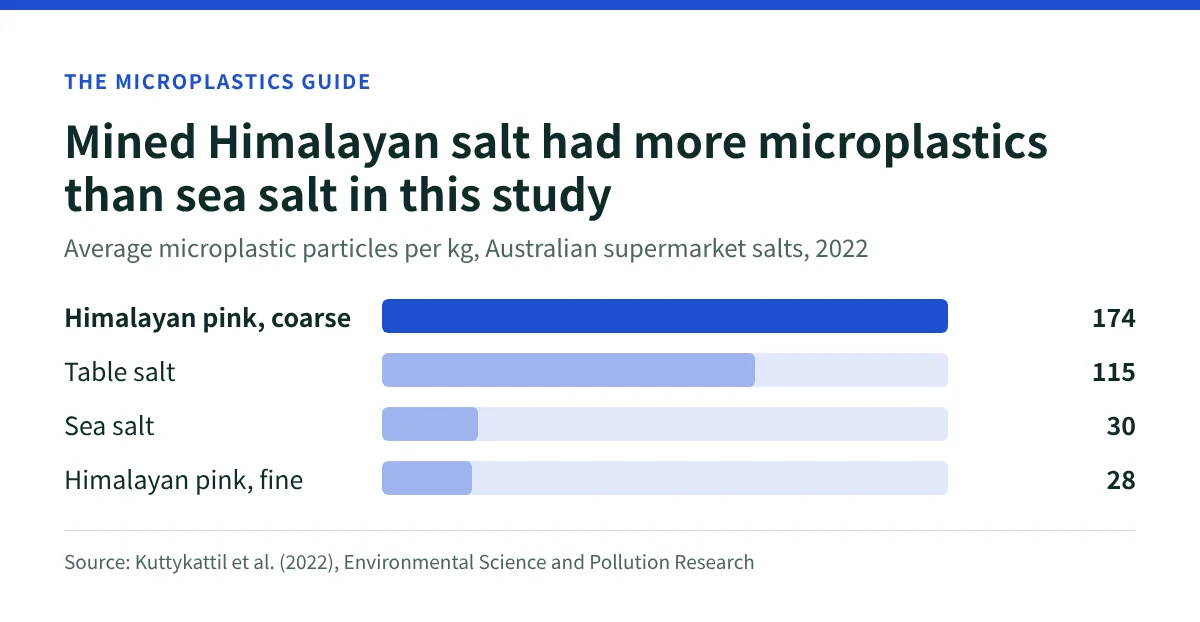
| Kuttykattil et al., 2022 | Supermarkets in Newcastle, Australia | Coarse Himalayan pink salt highest at about 174 per kg; sea salt about 30 per kg |
In the Iranian study, the statistical test found no real difference between sea and rock salt (p = 0.942). In the Australian study, fine Himalayan salt had about 28 particles per kg, close to sea salt.
Numbers also differ by country and lab. A 2024 Indian survey by Toxics Link found 6.71 to 89.15 pieces per kg in 10 salts. Iodized salt had the most, and organic rock salt had the least. The same survey also tested sugar; see what tests found in honey and sugar.
What kinds of plastic are in salt?
Mostly fragments and fibers from everyday plastics. In the Australian salts, polyamide (nylon) made up 33.8% of particles and polyurethane 31%. In the Iranian salts, the most common material was cellulose acetate, which the authors linked mainly to cigarette butts.
How strong is the evidence?
Strong that most salt contains some microplastic particles. Many studies on several continents agree.
Contested that sea salt always has more than rock salt. Results depend on the source, processing and lab method. There is still no standard method for counting microplastics in salt, so studies cannot be compared directly.
Emerging on health effects. No study has shown that microplastics from salt harm people. The European Food Safety Authority says it cannot yet conclude on health effects of microplastics in food. Its full scientific opinion is due by the end of 2027.
Should you switch to a different salt?
You do not need to. Salt is a minor route compared with others. The Australian team estimated about 155 particles a year for an adult eating the WHO maximum of 5 grams of salt a day. Other routes, such as drinking water, are also under study; see our article on the EPA's drinking water watch list. Chewing gum is another small source; see how many microplastics chewing gum releases. Seafood is a larger dietary source; see which fish and shellfish have the most microplastics.
If you want to cut salt exposure anyway:
- Use less salt overall. This also helps blood pressure, and it lowers particle intake whatever salt you buy.
- Do not pay extra for "pure" claims. No salt type is reliably plastic-free in the studies above.
- Store salt in glass, ceramic or steel with a lid, to keep household dust and fibers out. The same materials beat plastic for serving hot food; see whether melamine and bamboo plates are safe.
- Focus on bigger sources first, such as heating food in plastic. Our ranked list of changes shows where effort pays off most.
There is no proven way to remove microplastics already in the body. For why headline numbers vary so much, read what the 2025–2026 brain studies show.
Frequently asked questions
Is Himalayan pink salt free of microplastics?
No. In a 2022 Australian study, coarse Himalayan pink salt had the highest count of the salts tested, about 174 particles per kg. Fine Himalayan salt had about 28 per kg. Mined salt can pick up particles during grinding and packaging.
Is there a microplastic-free salt?
Three of 39 brands showed no particles in the 2018 study. They were a refined sea salt from Taiwan, a refined rock salt from China and an unrefined French sea salt. Results for one batch do not guarantee every batch, so no salt type is reliably free.
Is the plastic in salt dangerous?
There is no evidence yet that microplastics from salt harm health. The amounts are small, and EFSA says the data are not yet enough for a full risk assessment. Eating less salt is a good idea for other health reasons.
Keep reading
Sources
- Kim et al. (2018), Global pattern of microplastics in commercial food-grade salts, Environmental Science & Technology, summarized by Food Packaging Forum
- National Geographic (2018): Microplastics found in 90 percent of table salt
- Kuttykattil et al. (2022), Consuming microplastics? Investigation of commercial salts as a source of microplastics in diet, Environmental Science and Pollution Research
- Taghipour et al. (2023), Incidence and exposure to microplastics in table salt present in the Iran market, Toxicology Reports
- Business Standard (2024): Toxics Link study finds microplastics in Indian salt and sugar brands
- European Food Safety Authority: Microplastics and nanoplastics in food