
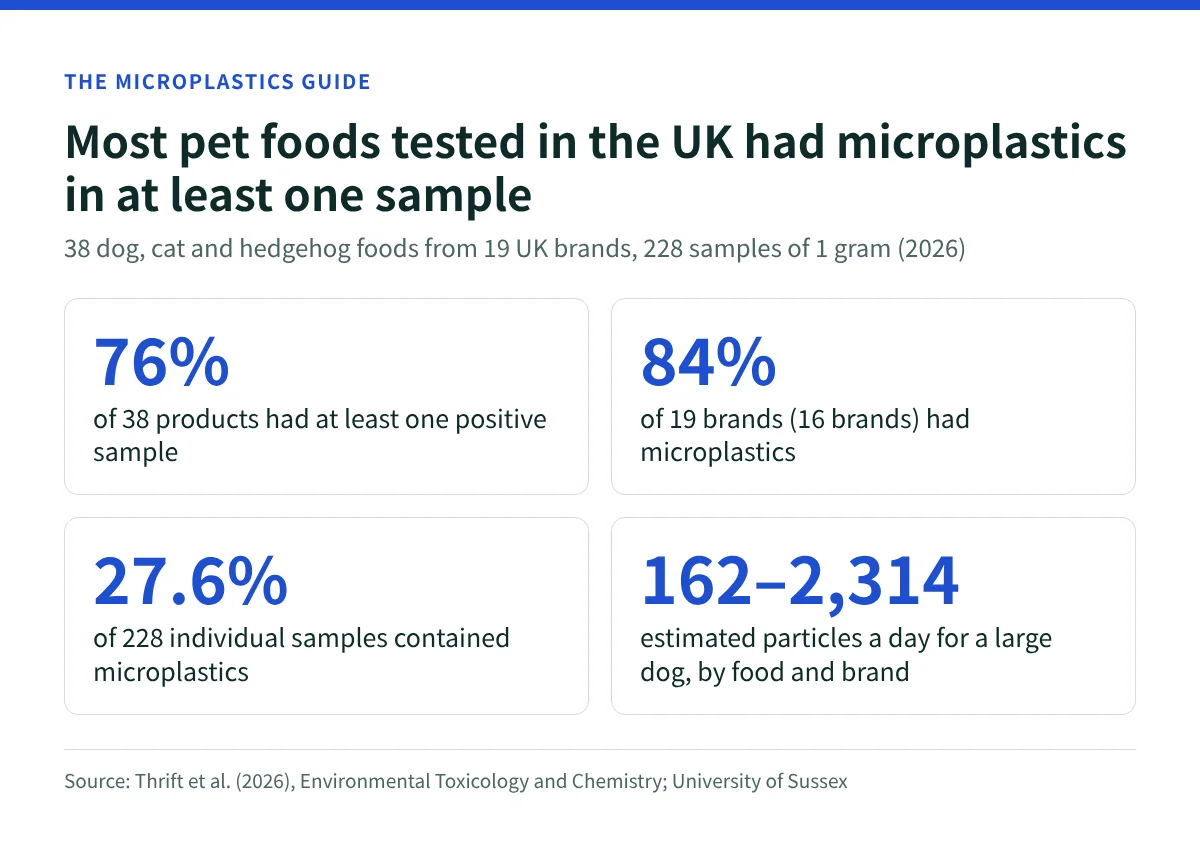
Most commercial pet foods tested so far contain some microplastics. A 2026 study from the Universities of Sussex and Exeter found plastic particles in 76% of 38 dog, cat and hedgehog food products sold in the UK. The effects on pet health have not been studied. Our guide to lower-plastic products covers the wider picture for your home.
How many microplastics are in pet food?
The UK team bought six packs of each product from different batches. They tested 228 samples of 1 gram each from 19 brands. All the cat and dog foods were chicken-flavored.
The results, published in Environmental Toxicology and Chemistry in June 2026, were:
- 63 of 228 samples (27.6%) contained microplastics.
- 29 of 38 products (76%) had at least one positive sample.
- 47% of products had two or more positive samples out of six.
- 16 of 19 brands (84%) had at least one contaminated sample.
Value-priced foods, under £3 per kg (about US$1.72 per pound), had significantly more positive samples than premium foods. Of products listing "meat and animal derivatives," 90% had at least one positive sample.
Which plastics were found in dog and cat food?
The UK study identified polyester, polyacrylamide, polyethylene and polypropylene. About 60% of particles were fibers and 40% were fragments, sized 0.09 to 3.8 millimeters. The polymers were most often linked to industrial uses and textiles, then packaging.
An earlier 2019 US study by Zhang, Wang and Kannan looked for two plastics, PET and polycarbonate. It tested 58 pet foods from the US, Thailand and Canada. PET in cat food ranged from below 1,500 to 12,000 nanograms per gram.
The researchers do not yet know where the plastic comes from. Ingredients, packaging and processing are all possible sources.
Is dry or wet pet food worse?
It depends on how you count. In the UK study, dry food had more particles per gram. But wet food has fewer calories per gram, so pets eat more of it. That can mean a higher daily intake.
For a 35 kg (77 lb) dog eating wet food, the moderate estimate was about 313 particles a day. Across all foods and scenarios, the range was 162 to 2,314 particles a day.
Do microplastics build up in pets' bodies?
Much of it seems to pass straight through. In the 2019 US study, median PET levels were 61,000 ng/g in cat feces and 30,000 ng/g in dog feces. Median levels in food were below 1,500 ng/g. Feces held far more than food, which suggests food may not be pets' only source.
Some particles may still reach tissues:
| Study | Animals | What it found |
|---|---|---|
| Prata et al., 2022, Animals | 25 dogs and 24 cats, Portugal | Suspected particles in 80 of 242 tissue samples; median of zero per gram |
| Yu and colleagues, 2024, Toxicological Sciences | 47 dog testes, US | Average 122.63 µg/g; human testes averaged 329.44 µg/g |
The Portuguese study called the levels "none to low." The New Mexico study found higher PVC levels linked to lower sperm counts in dogs. That is an association, not proof of harm.
How strong is the evidence?
Emerging that many commercial pet foods contain microplastics. Two studies in different countries agree, but samples are small and only one tested many brands.
Contested on amounts in tissues. Methods differ widely. The testes study measured plastic by mass after heating tissue, while the Portuguese study counted particles under a microscope. Our article on nanoplastics vs microplastics explains why size and method change the numbers.
Effects on pet health are unknown. The UK study did not measure health outcomes. See our health effects guide for what research shows in people.
What can pet owners do?
No type of pet food has been shown to be reliably free of microplastics. The three clean brands in the UK study were not named. A complete, balanced diet remains the priority. Practical steps:
- Do not switch foods for this reason alone. Ask your vet before changing your pet's diet.
- Choose a stainless steel, glass or ceramic bowl over a scratched plastic one. Bowls have not been studied, but this removes one worn plastic surface.
- Bag and bin dog waste. Researchers note that excreted particles can reach soil.
Hard plastic dishes deserve a check in your own kitchen too; see whether melamine and bamboo plates are safe. There is no proven way to remove microplastics from the body, for pets or people.
Frequently asked questions
Does dog food contain microplastics?
Often, yes. In the 2026 UK study, 76% of dog, cat and hedgehog food products had microplastics in at least one sample. Only about a quarter of individual samples were positive, so levels vary from bag to bag.
Is premium pet food lower in microplastics?
In the UK study, value-priced foods had significantly more positive samples than premium foods. This is one study of 19 UK brands, so it does not prove that any single premium product is lower.
Are microplastics harmful to cats and dogs?
No one knows yet. Studies have found particles in pet food, feces and some tissues. One study linked PVC levels in dog testes to lower sperm counts, but that is an association, not proof of harm.
Keep reading
Sources
- University of Sussex (2026): Microplastics found in over 75% of pet food products for dogs, cats and hedgehogs
- Thrift et al. (2026), Microplastic prevalence in commercially available petfoods, Environmental Toxicology and Chemistry
- Petfood Industry (2026): Study: Microplastics found in many commercial pet food products
- Zhang, Wang and Kannan (2019), Polyethylene terephthalate and polycarbonate microplastics in pet food and feces from the United States, Environmental Science & Technology
- Bhowmik, Saha and Saha (2024), Microplastics in Animals: The Silent Invasion, Pollutants
- Prata et al. (2022), Microplastics in Internal Tissues of Companion Animals from Urban Environments, Animals
- Yu and colleagues, University of New Mexico (2024), microplastics in canine and human testis, Toxicological Sciences, via ScienceDaily