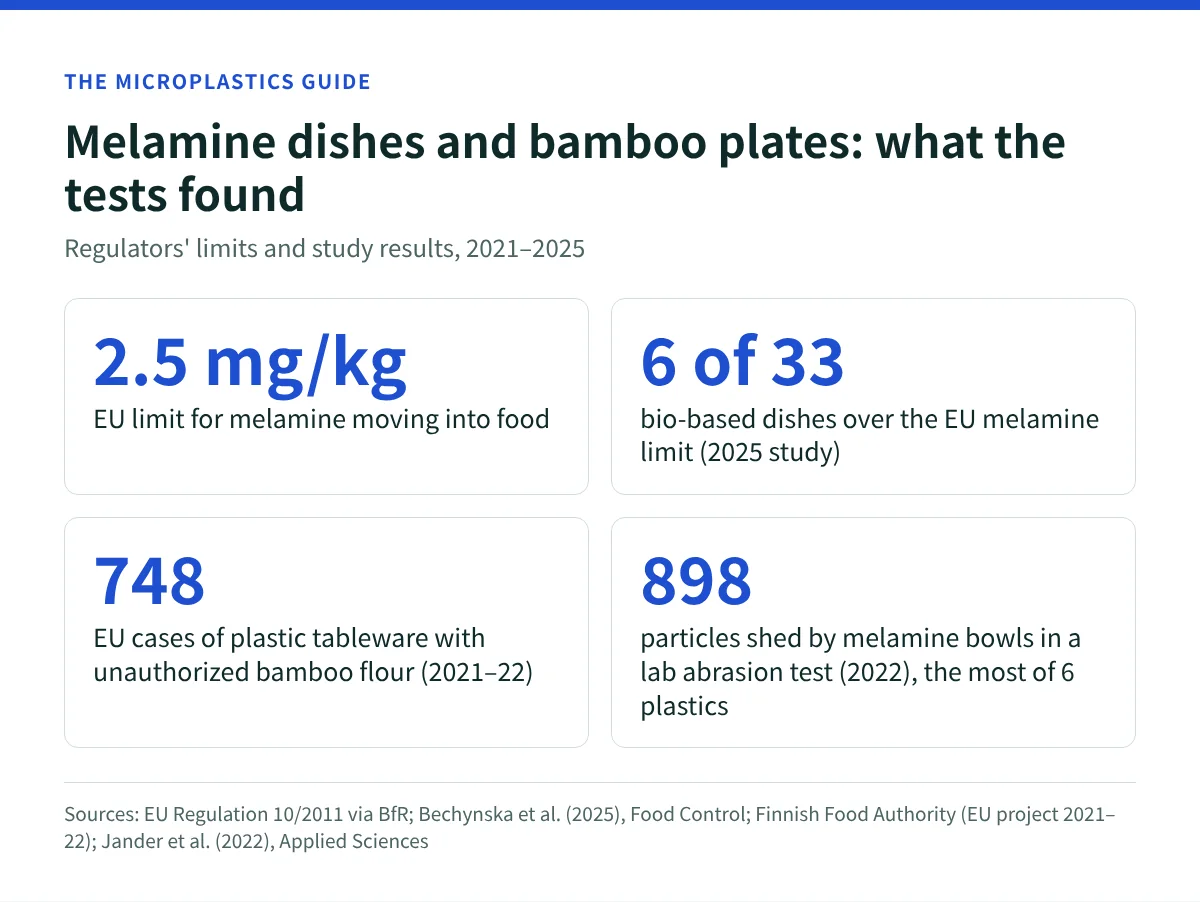
Melamine dishes are safe for cold or warm food, but heat and acid make them release more melamine. A 2025 Czech study found migration above the EU limit in 6 of 33 bio-based dishes, almost all labeled "bamboo." Here is what that means for the plates in your cupboard. For other swaps, see our buyer's guide to products that help.
What are melamine dishes made of?
Melamine dishes are made from melamine-formaldehyde resin. This is a hard, heat-set plastic, often used for picnic plates, kids' bowls and restaurant trays. It is light and hard to break, which is why it is popular with families.
Many "bamboo" plates are not pure bamboo. They are bamboo powder mixed into melamine resin. Finland's food authority says these products were often marketed as natural, compostable or recyclable, which was misleading. For what "compostable" really means, see whether biodegradable plastic still makes microplastics. Plates carved from solid bamboo or wood, with no plastic, are a different product.
Is melamine safe for hot food?
Not ideal. The US Food and Drug Administration says melamine does not migrate into most foods. It found measurable migration only into acidic foods under exaggerated test conditions. It also notes that heating acidic foods to high temperatures can increase migration.
A small 2013 study in JAMA Internal Medicine tested this in people. Adults who ate about 500 mL of hot noodle soup, near 194°F (90°C), from melamine bowls excreted up to 8.35 micrograms of melamine a day. With ceramic bowls, the figure was 1.31 micrograms. Outside experts said even the higher level was far below safety limits. The authors warned that results vary by brand.
Germany's Federal Institute for Risk Assessment (BfR) gives the clearest advice. It says melamine resin should not be used with hot food or to heat food in the microwave. It expects no health effects with cold or lukewarm food.
Can you microwave melamine plates?
No. The FDA advises against heating food or drinks in melamine dinnerware in the microwave. Heat food in microwave-safe ceramic or glass, then serve it on melamine if you like.
Are bamboo melamine plates banned?
In the EU, yes, in practice. Bamboo powder is not an authorized additive under the EU plastics rules, Regulation (EU) 10/2011. An EU control project from 2021 to April 2022, with 21 countries, recorded 748 cases of plastic tableware with unauthorized bamboo flour. Of those, 644 products were already on the EU market.
Tests found the problem was real, not just paperwork. Finland's authority says migration of formaldehyde and melamine was found in many cases to considerably exceed the limits. The EU limits are 2.5 mg of melamine and 15 mg of formaldehyde per kilogram of food.
The 2025 study by Bechynska and colleagues in Food Control confirms the pattern. Melamine or related compounds turned up in 20 of 21 bamboo-labeled items. Fourteen of the 33 items were made for children. Tests used acidic liquids and hot lemon tea at 158°F (70°C) for 2 hours.
In the US, bamboo-melamine plates are still widely sold. The FDA guidance above applies to them too.
Do melamine dishes shed microplastics?
They can, when they are worn or scratched. In a 2022 lab study in Applied Sciences, researchers put six kinds of plastic bowls under mechanical stress. Melamine bowls released 898 particles, the most of any material. Low-density polyethylene released the fewest, 331.
The same plastic is used in melamine foam cleaning sponges. A 2024 study in Environmental Science & Technology found these sponges shed about 6.5 million microplastic fibers per gram of sponge worn away. Our guide to kitchen sponge microplastics compares which dish sponges shed the most.
How strong is the evidence?
Strong that melamine and formaldehyde migrate more with heat and acid. Regulators in the US, Germany and the EU agree.
Strong that many bamboo-melamine products failed EU migration limits. This comes from official checks and a 2025 peer-reviewed study.
Emerging on microplastics from dishes. The 2022 particle counts come from a lab abrasion test, not from daily meals. No study has shown that particles from plates harm people. There is also no proven way to remove microplastics from the body. For why body-burden numbers vary so much, see what the 2025–2026 brain studies show.
What should you use instead?
You do not need to throw out melamine plates. Use them for the right jobs:
| Use | Melamine or bamboo-melamine | Better choice |
|---|---|---|
| Cold snacks, fruit, salads | Fine | Any material |
| Hot soup, noodles, coffee | Avoid | Ceramic, glass or stainless steel |
| Reheating in the microwave | Do not use | Microwave-safe glass or ceramic |
| Acidic food, such as tomato sauce or citrus | Keep it brief and cool | Glass or ceramic |
| Kids' everyday plates | Use for cold food | Stainless steel or tempered glass |
- Check the label. Words like "bamboo fiber" or "plant-based" on a hard, glossy plate usually mean melamine resin.
- Replace scratched or cracked pieces. Damaged surfaces release more, and the 2022 study links wear to more particles.
- Wash gently. Avoid scouring melamine dishes, and skip melamine foam sponges on them.
Pets often eat from plastic bowls too; our look at pet food microplastics covers what studies found in dog and cat food.
For more on kitchen exposure, read our food and kitchen guide and our article on sea salt vs. rock salt.
Frequently asked questions
Is melamine toxic?
Melamine can harm the kidneys and urinary tract at high doses. Normal use of melamine dishes with cold or warm food is considered safe by the FDA and BfR. The risk rises with hot, acidic food and the microwave.
Are bamboo plates safe for babies?
Pure bamboo or wood plates are a different product from bamboo-melamine plates. In the 2025 Czech study, 14 of 33 tested items were made for children, and some exceeded EU melamine limits. For hot baby food, stainless steel or tempered glass is a simpler choice.
Can melamine go in the dishwasher?
Many melamine dishes are labeled dishwasher-safe, so follow the maker's label. The regulators cited here focus on hot food and microwaving rather than washing. Replace pieces that look dull, scratched or cracked.
Keep reading
Sources
- US Food and Drug Administration: Questions and answers on melamine tableware
- German Federal Institute for Risk Assessment (BfR): Questions and answers on tableware and kitchen utensils made of melamine-formaldehyde resin
- Finnish Food Authority: Plastic products containing bamboo or other unauthorised vegetable fibres (EU control project 2021–2022)
- Bechynska et al. (2025), Comprehensive assessment of bamboo and other bio-based dishes contamination, Food Control, summarized by Food Packaging Forum
- Wu et al. (2013), JAMA Internal Medicine, expert reaction from Science Media Centre New Zealand
- Jander et al. (2022), Release of Microplastics from Reusable Kitchen Plasticware and Generation of Thermal Potential Toxic Degradation Products in the Oven, Applied Sciences
- Su et al. (2024), Mechanochemical Formation of Poly(melamine-formaldehyde) Microplastic Fibers During Abrasion of Cleaning Sponges, Environmental Science & Technology, via ScienceDaily