
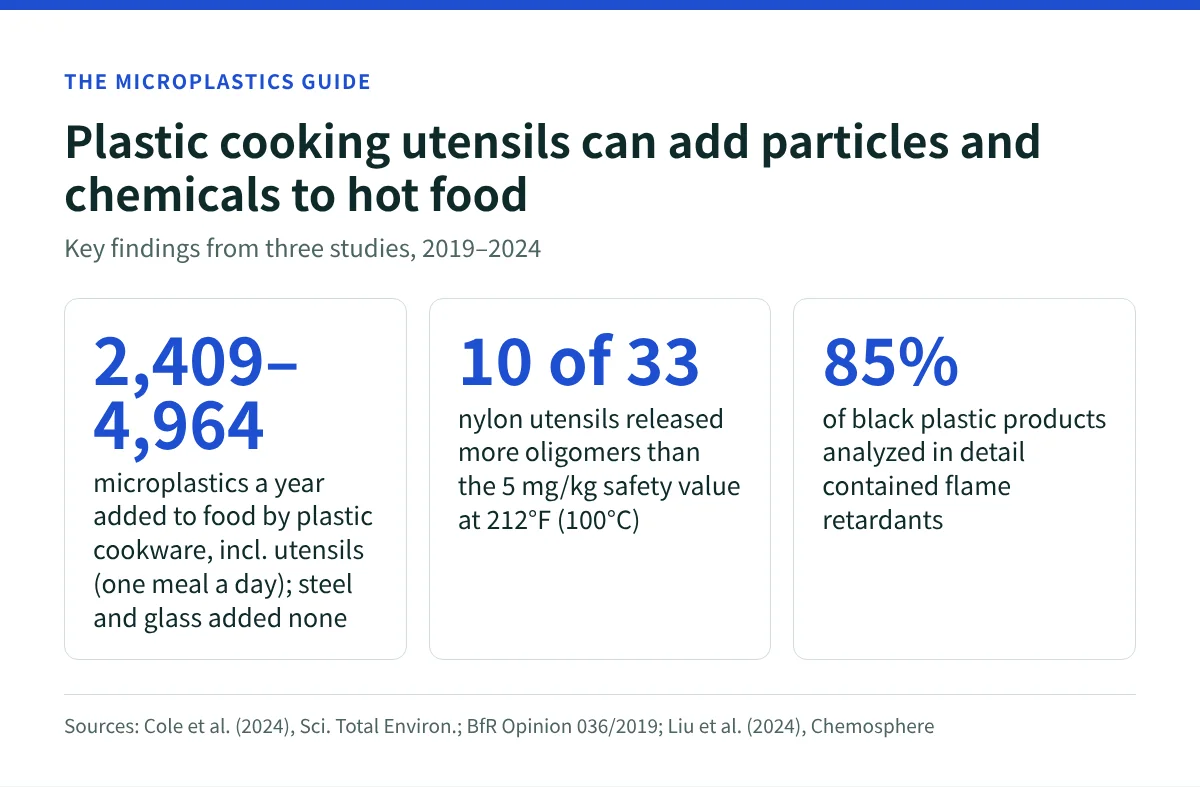
Plastic cooking utensils can add small amounts of microplastics and plastic chemicals to hot food. A 2024 study in Science of the Total Environment estimated that plastic cookware, including utensils, adds 2,409 to 4,964 microplastics a year to home-cooked meals. Stainless steel and glass added none. This guide explains what is known about nylon, black plastic and other spatulas. For more low-plastic swaps, see our buyer's guide to products that help.
Do plastic cooking utensils shed microplastics?
Yes, in small numbers. Researchers at Plymouth Marine Laboratory and partners prepared jelly as a food test, using heating, cooling, cutting, whisking and storage. They compared plastic chopping boards, utensils, containers and nonstick pans with stainless steel and glass. Both new and old plastic items were tested.
Plastic tools raised microplastic levels in the food. The particles were PTFE, polyethylene and polypropylene, 13 to 318 micrometers long. Assuming one home-cooked meal a day, that is 2,409 to 4,964 particles a year. Non-plastic cookware did not add microplastics.
The study grouped utensils with other plastic tools. It did not give a separate count for spatulas or spoons. A 2024 review in Heliyon of 30 papers on kitchen sources found no research at all on plastic serving tools such as ladles and pasta forks. It also noted that even a soft silicone whisk released PTFE particles from new nonstick pans.
Are nylon spatulas safe?
Nylon, also called polyamide, raises a different issue: chemicals, not only particles. Nylon can release small molecules called oligomers into hot food. Germany's Federal Institute for Risk Assessment (BfR) tested 33 polyamide kitchen utensils in 2016 and 2017. Each one was kept in a food simulant at 212°F (100°C) for 30 minutes or two hours.
The results varied a lot. Oligomer release ranged from 0.94 to 10.87 mg per kilogram of food. Ten of the 33 utensils exceeded the 5 mg/kg value the BfR considers acceptable. In its 2019 opinion, the BfR advises keeping contact with hot food short, especially above 158°F (70°C).
That does not mean a nylon spatula is dangerous for a quick stir. The concern is long contact: a spoon left resting in simmering sauce, or a utensil soaking in a hot pot.
Is black plastic cookware safe?
The concern here is flame retardants. Some black plastic is made from recycled electronics, which can contain these chemicals. A 2024 study in Chemosphere screened 203 black plastic household products sold in the US. Flame retardants were found in 85% of the products analyzed in detail, including kitchen utensils.
The study then went viral, and an error followed. The authors had compared their exposure estimate with the US EPA's safe daily dose, but multiplied wrong. The estimate was about one tenth of that safe dose, not close to it. A 2025 correction also lowered the estimated median intake from 34,700 to 7,900 nanograms a day. The authors say their main findings stand.
Experts quoted by Scientific American suggest not leaving black utensils in hot pans for long, and discarding damaged ones.
How strong is the evidence?
- Emerging that plastic utensils add microplastics to food. The 2024 cookware study is small, used a jelly simulant and grouped utensils with other tools.
- Strong that nylon utensils can release oligomers at high heat. The BfR measured this directly in many products. Whether typical home use causes harm is not known.
- Contested for black plastic health risk. Flame retardants were really found, but the dose comparison was corrected after publication, and only nine utensils were analyzed in detail.
No study has shown that cooking with plastic utensils harms people. There is also no proven way to remove microplastics from the body.
Which cooking utensil material is best?
For hot cooking, non-plastic tools avoid both particles and plastic chemicals. Here is a quick comparison:
| Material | Microplastics | Main caution |
|---|---|---|
| Stainless steel | None added in the 2024 study | Can scratch nonstick pans |
| Solid wood or bamboo | Not plastic (not tested in that study) | Avoid bamboo-melamine blends |
| Silicone heads | Limited evidence | Check the handle and core material |
| Nylon (polyamide) | Can shed; releases oligomers in heat | Keep hot contact short |
| Black plastic (unknown type) | Can shed | May contain recycled flame retardants |
Practical steps:
- Use wood or steel for long, hot jobs like stirring soups, sauces and frying.
- Do not leave plastic spoons resting in hot pots. Take them out between stirs.
- Throw out melted, cracked or damaged plastic tools, as experts quoted by Scientific American advise for black plastic.
- Protect nonstick pans with wood. Studies in the 2024 review found steel tools scratching nonstick coatings released particles.
- Watch for "bamboo" tools mixed with melamine. Our guide to melamine and bamboo plates explains why heat matters for that plastic.
At the sink, the same thinking applies to scrubbers: see which kitchen sponges shed the most microplastics. For more swaps around the stove, read our food and kitchen guide.
Frequently asked questions
Are silicone spatulas better than plastic?
Silicone heads are a common choice for hot cooking. But there is little research on whether silicone utensils shed particles. One review noted a silicone whisk still released particles from a new nonstick pan's coating.
Should I throw away my black plastic spatula?
You do not need to panic. The corrected comparison puts the estimated flame retardant dose at about one tenth of the EPA's safe daily level. A simple approach is to replace black plastic tools with wood or steel as they wear out, and to discard any damaged one.
Is it safe to stir with a nylon spoon?
Brief stirring is the use the BfR considers acceptable. Its advice is to keep contact with food above 158°F (70°C) as short as possible. Avoid leaving nylon tools sitting in boiling liquid.
Keep reading
Sources
- Cole et al. (2024), Microplastic and PTFE contamination of food from cookware, Science of the Total Environment 929: 172577 (PubMed)
- Plymouth Marine Laboratory (2024), New study shows plastic and non-stick cookware is a source of microplastics
- Snekkevik et al. (2024), Beyond the food on your plate: Investigating sources of microplastic contamination in home kitchens, Heliyon
- German Federal Institute for Risk Assessment (2019), Polyamide kitchen utensils: keep contact with hot food as brief as possible, Opinion No. 036/2019
- Liu, Brandsma & Schreder (2024), From e-waste to living space: Flame retardants contaminating household items add to concern about plastic recycling, Chemosphere 365: 143319
- Liu, Brandsma & Schreder (2025), Corrigendum, Chemosphere 385: 144552
- Scientific American: Study miscalculation has everyone talking about black plastic spatulas again