
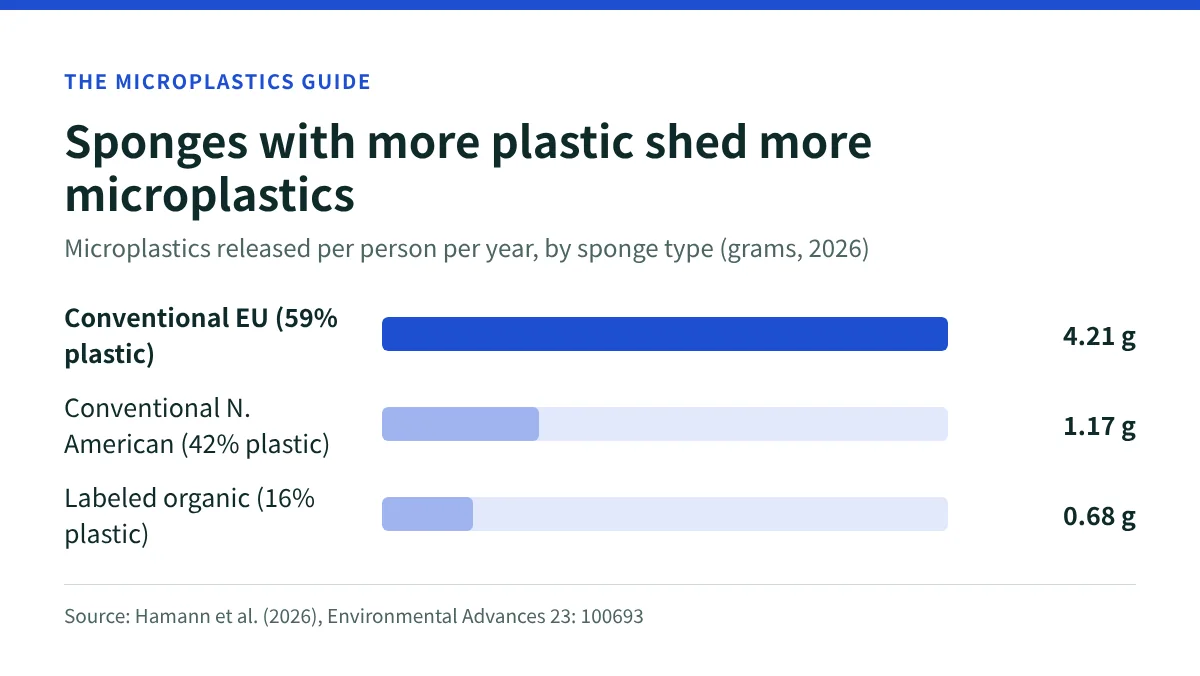
Yes, kitchen sponges shed microplastics as they wear down. A 2026 study in Environmental Advances estimated that dish sponges release 0.68 to 4.21 grams of microplastics per person each year. Sponges with less plastic released the least. This guide explains what the studies measured and how to pick a lower-shedding sponge. For other swaps, see our buyer's guide to products that help.
Do kitchen sponges shed microplastics?
They do. Most dish sponges are made partly of plastic: polyurethane foam, polyester or nylon scrub pads, and polypropylene fibers. Each time you scrub, small pieces break off and go down the drain.
A team led by the University of Bonn tested this in real homes. Volunteers in Germany, the US and Canada used one of three sponge types in their daily dishwashing. The team weighed each sponge before and after use. In the end, 68 sponges were analyzed: 27, 13 and 28 per type.
The team also built a scrubbing machine they called "SpongeBot." It squeezed sponges thousands of times in water kept at 86°F (30°C), to see how fast each type wore down.
Which dish sponges shed the most microplastics?
The sponges with the most plastic shed the most. The three types tested were:
| Sponge type in the 2026 study | Main materials | Plastic by weight | Microplastics per person per year |
|---|---|---|---|
| Conventional European | Polyurethane foam, viscose-polypropylene cloth, nylon-polyester scrub layer | 59.3% | 4.21 g |
| Conventional North American | Cellulose sponge, recycled polyester scrub layer | 41.9% | 1.17 g |
| Labeled "organic" | Cellulose sponge, sisal and recycled PET scrub layer | 15.9% | 0.68 g |
The figures come from the full paper's results. The difference between the conventional European sponge and the other two was statistically significant.
Scaled up, the numbers add up. If every household in Germany used the highest-shedding sponge, the authors estimate up to 355 tonnes of microplastics a year. They assumed wastewater plants hold back about 90%. Part of what treatment plants catch still reaches soil through sewage sludge.
Do melamine foam sponges shed microplastics?
Yes, and in large numbers. Melamine foam sponges, often sold as "magic erasers," are made of melamine-formaldehyde plastic. A 2024 study in Environmental Science & Technology rubbed sponges from three brands against rough metal surfaces. They released about 6.5 million microplastic fibers per gram of sponge worn away.
The researchers then made a rough global estimate. Using Amazon sales from August 2023, and assuming each sponge wears down by 10%, they calculated about 1.55 trillion fibers released a month. They noted that the real figure could be higher, since they used only one retailer. Denser sponges wore down more slowly and shed fewer fibers.
The same plastic is used in melamine dishes. Our check of melamine and bamboo plates explains what happens when those wear.
How strong is the evidence?
Emerging that kitchen sponges are a real but modest source. The 2026 study is the first to measure sponge wear in homes. Its sample was small, and some sponges were dropped because they gained weight or grew mold. The authors call sponges a minor to medium source compared with other household sources.
Emerging for melamine foam fibers. The 2024 results come from a lab abrasion test, not daily cleaning. The global figure is an estimate built on sales data and an assumed wear rate.
Neither study measured how much sponge plastic people swallow. Both looked at what goes down the drain. No study has shown harm to people from sponge particles. There is also no proven way to remove microplastics from the body. To see why particle counts vary so widely between studies, read how microplastics are measured.
How do you choose a sponge that sheds less?
You do not need to throw out your sponges today. Swap them for lower-plastic types as they wear out.
- Pick a lower-plastic sponge. Look for cellulose foam with a plant-fiber scrub side, such as sisal. In the 2026 study, this type shed about one sixth as much as the highest-plastic sponge.
- Read the materials list. Polyurethane, polyester, polyamide (nylon) and polypropylene are all plastics. A sponge can say "eco" and still contain some, like the "organic" sponge tested, which was 15.9% PET.
- Use melamine foam sparingly. Save it for tough marks, and choose a dense one if you buy it.
- Keep sponges in use longer. The authors say a longer life helps, but only alongside other steps.
- Use less running water. Water use caused 85% to 97% of the dishwashing's total environmental impact in the 2026 study, far more than sponge wear.
"Compostable" or "plant-based" labels deserve a closer look. Our guide on whether biodegradable plastic still makes microplastics explains why. For more ways to cut plastic at the sink and stove, see our food and kitchen guide.
Frequently asked questions
Are cellulose sponges plastic-free?
Pure cellulose foam is made from plant material, not plastic. But many cellulose sponges have a polyester or nylon scrub pad attached. In the 2026 study, a cellulose sponge with a recycled polyester pad was still 41.9% plastic by weight.
Do magic erasers release microplastics?
Yes. Melamine foam sponges, often sold as magic erasers, are made of plastic. A 2024 lab study found they shed about 6.5 million microplastic fibers per gram of sponge worn away. Denser foam shed fewer fibers.
How often should you replace a kitchen sponge?
The studies here did not set a replacement schedule for hygiene. For microplastics, the 2026 authors say keeping a sponge in use longer can lower its impact. Replace it when it smells, falls apart or looks moldy.
Keep reading
Sources
- Hamann et al. (2026), From sink to sea: Microplastic release from kitchen sponges and potential environmental effects, Environmental Advances 23: 100693 (Leiden University repository record)
- Hamann et al. (2026), full text PDF, Environmental Advances (open access, CC BY 4.0)
- University of Bonn (2026), Dishwashing with side effects: Kitchen sponges release microplastics
- Su et al. (2024), Mechanochemical Formation of Poly(melamine-formaldehyde) Microplastic Fibers During Abrasion of Cleaning Sponges, Environmental Science & Technology, via Phys.org
- American Chemical Society via ScienceDaily (2026), Common cleaning sponge found to release trillions of microplastic fibers