
There is still no global plastics treaty in November 2026. The last full negotiating round, in Geneva, ended without consensus on 15 August 2025, and the next one is planned for March 2027. For readers worried about microplastics in the body, our health effects guide explains what science knows so far; this article explains where the treaty that could cut plastic at its source now stands.
What is the global plastics treaty?
It is a planned, legally binding UN agreement to end plastic pollution. In March 2022 in Nairobi, the UN Environment Assembly adopted resolution 5/14. It asked an Intergovernmental Negotiating Committee (INC) to finish the text by the end of 2024.
That deadline was missed. The committee met in Punta del Este, Paris, Nairobi and Ottawa, then in Busan from 25 November to 1 December 2024, without a deal.
Why did the Geneva plastics treaty talks fail?
The second Busan-style round, INC-5.2, ran in Geneva from 5 to 15 August 2025. It adjourned after ten days with no agreed text.
The main split is over production. A majority of countries back binding measures on how much new plastic is made. A bloc of mostly oil-producing states, including Saudi Arabia, Kuwait and Russia, prefers a treaty focused on waste management.
The stakes are large. The OECD reported that global plastic production doubled between 2000 and 2019 to 460 million tonnes, and only 9% of plastic waste was recycled.
What has happened since Geneva?
The first chair resigned after Geneva. On 7 February 2026, a one-day session in Geneva elected Julio Cordano of Chile as the new chair. He won the second secret ballot 92 votes to 53.
In August 2026, Cordano issued an informal "Aid to Negotiations." He calls it a reference document, not a negotiated text. Campaign group EIA said measures to tackle plastic at its source were "diluted, deferred or dropped altogether".
Informal talks followed. A closed meeting in Bangkok from 27 to 30 September 2026 drew 427 delegates from 154 committee members.
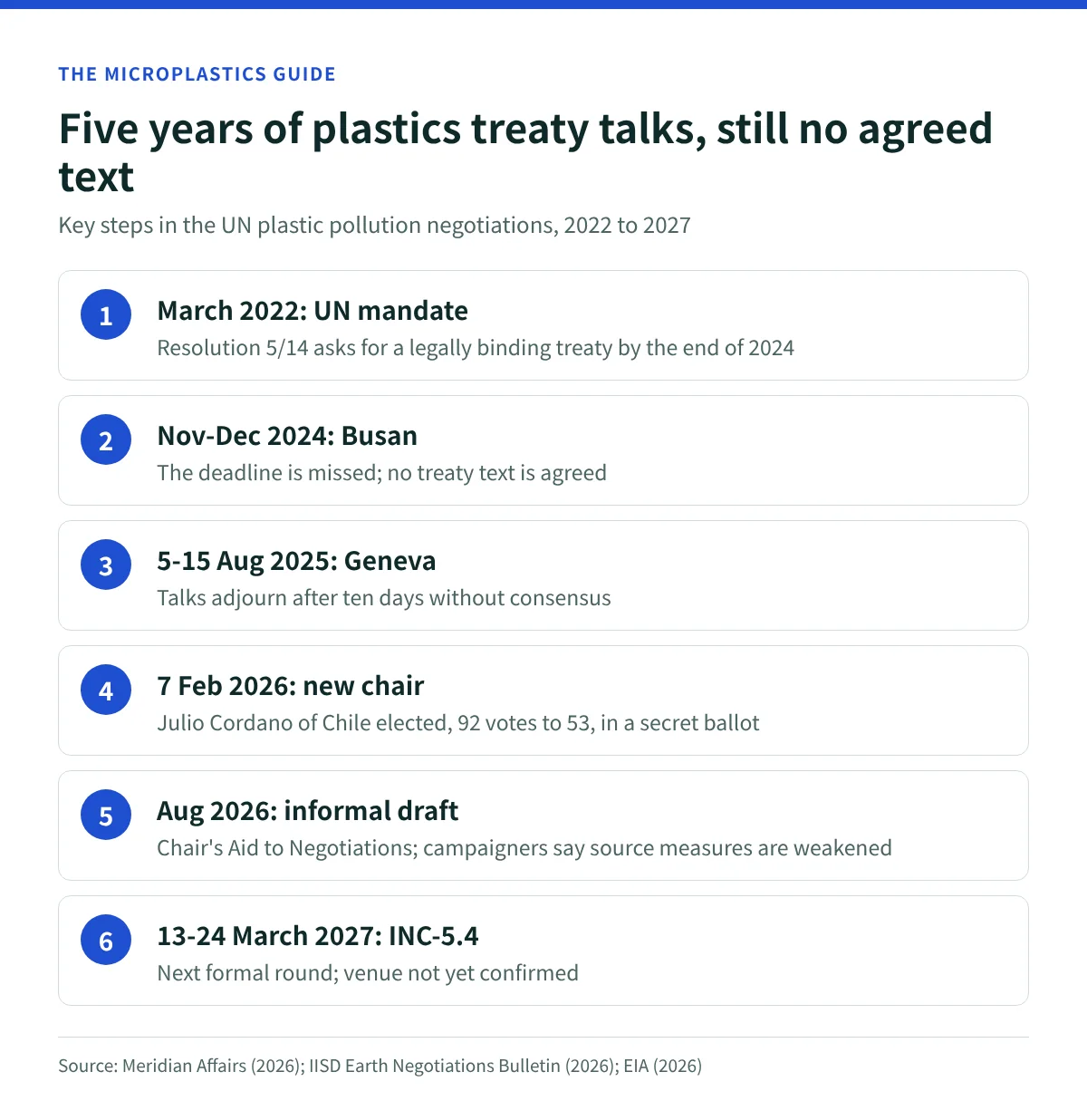
What are the key dates for the plastics treaty?
| Date | Event |
|---|---|
| March 2022 | UN resolution 5/14 starts the talks |
| Nov–Dec 2024 | Busan round ends without a treaty |
| 5–15 Aug 2025 | Geneva round ends without consensus |
| 7 Feb 2026 | Julio Cordano elected chair |
| Aug 2026 | Chair's informal Aid to Negotiations |
| 16 Nov 2026 | EU high-level event at COP31 |
| 13–24 Mar 2027 | INC-5.4 planned; venue not yet confirmed |
The European Commission is hosting a high-level exchange on the treaty on 16 November 2026 at COP31. As of 30 September 2026, no country had formally offered to host INC-5.4, and Nairobi was held in reserve.
Does the plastics treaty cover microplastics?
Only briefly, so far. An April 2026 briefing by the Environmental Investigation Agency counted 34 microplastic references in the 2023 Zero Draft but three in the Geneva text.
According to that briefing, the Geneva text mentions "intentionally added microplastics" once. It also lists unintentional releases twice, and it dropped earlier language on plastic pellets. EIA calls this framework inadequate; this is an advocacy group's analysis, and other parties may read the text differently.
Open questions that matter for health include:
- Chemicals of concern: the criterion for listing them is still in brackets, meaning not agreed.
- Health: the reference to human health in the treaty's objective is also bracketed.
- Voting: a three-fourths majority vote as a last resort is still disputed.
- Entry into force: the number of ratifications needed is open at 50, 60 or 97.
How strong is the evidence?
Strong: no treaty has been agreed, and the next formal round is not before March 2027. Official records and several independent reports agree on this timeline.
Strong: plastic production has grown fast. The OECD figures above come from its 2022 Global Plastics Outlook.
Contested: whether a treaty can cap production. Governments remain split, and the final text could still change a lot.
Emerging: what a treaty would mean for microplastics in people. Researchers have found microplastics in human tissue, as our article on the 2025–2026 brain studies explains. But no study shows how much a treaty would lower personal exposure.
What does the plastics treaty mean for you?
Nothing changes in your kitchen yet. Even after a treaty is signed, countries must ratify it before it takes effect.
National and regional rules move faster. The EU already restricts microplastics added to products on purpose, which is why loose plastic glitter is being phased out. The EU is also the first region to set limits on tire wear, a large unintentional source.
What you can do now:
- Cut the biggest personal sources using our guide to reducing exposure, such as not heating food in plastic.
- Follow the March 2027 round. It is the next real chance for a global deal.
- Ignore "detox" claims. There is no proven way to remove microplastics from the body.
Frequently asked questions
Is there a global plastics treaty in 2026?
No. Negotiations began in 2022 but have not produced an agreed text. The next formal session, INC-5.4, is planned for 13 to 24 March 2027.
Why are countries divided on the plastics treaty?
Most countries want binding limits on plastic production and harmful chemicals. A group of mostly oil-producing states prefers a treaty focused on waste management and recycling. The two sides also disagree on whether decisions can be made by vote.
Will the plastics treaty ban microplastics?
It is unclear. The 2025 Geneva text mentioned intentionally added microplastics only once, according to an EIA count. The EU already restricts microplastics added to products on purpose under its own law.
Keep reading
Sources
- Meridian Affairs (2026): Plastics after Geneva: The Global Treaty Talks on the Road to INC-5.4
- Earth Negotiations Bulletin, IISD (2026): Summary of INC-5.3, 7 February 2026
- Environmental Investigation Agency (August 2026): New Global Plastics Treaty "Aid to Negotiations" risks watering down ambition to irrelevance
- Environmental Investigation Agency (April 2026): Back to Basics: Microplastics (briefing)
- Circular Online (2022): 9% of global plastic waste is recycled while 22% is mismanaged, OECD Global Plastics Outlook
- European Commission (2026): Together to find common ground: high-level exchange on the final phase of the plastics treaty negotiations
- CIEL (2026): INC-5.3 concludes with election of new plastics treaty negotiation chair
- Wikipedia: Global plastic pollution treaty (session dates)