
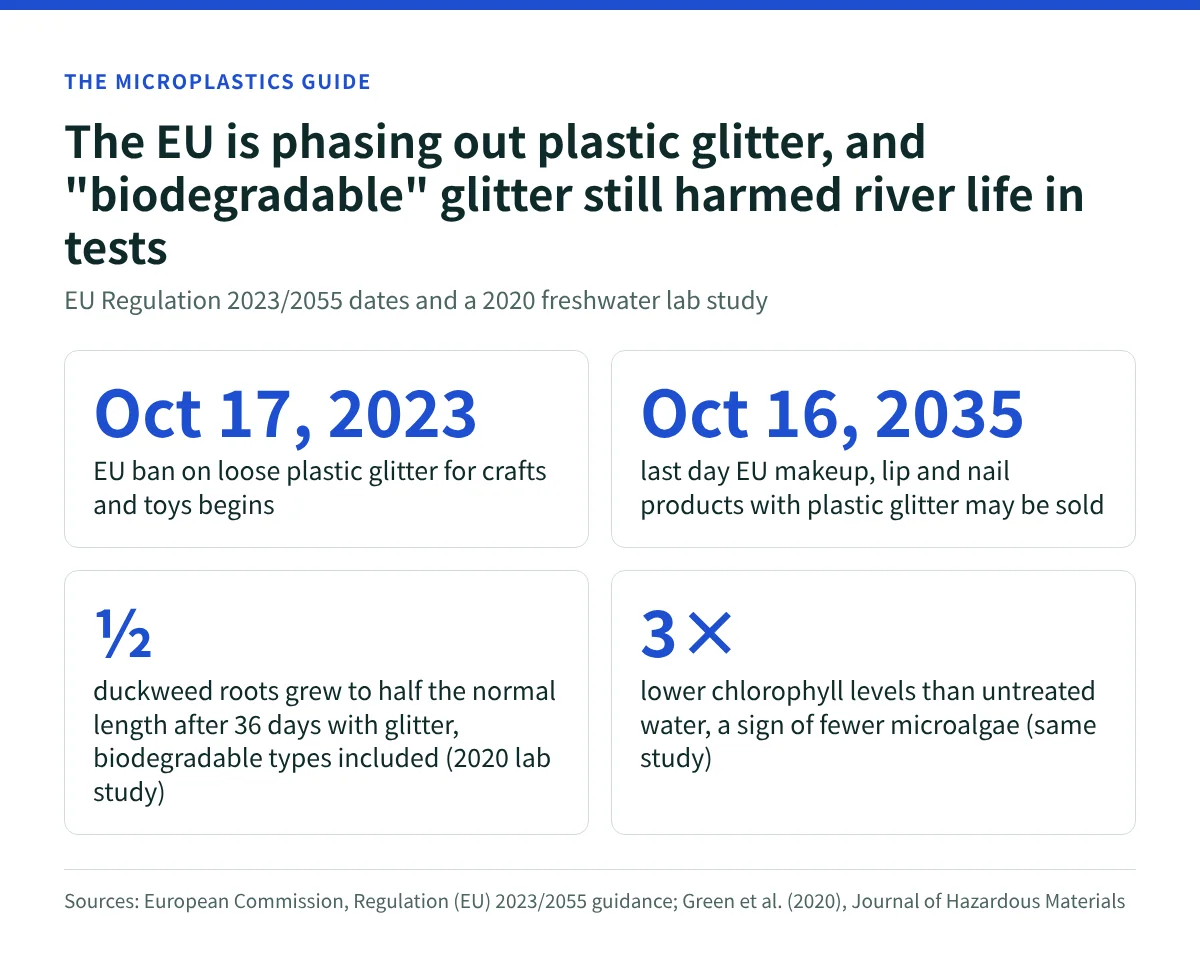
Most glitter is plastic, and the EU has banned loose plastic glitter since October 17, 2023. The US has no federal glitter rule, and a 2020 lab study found "biodegradable" glitter harmed river life about as much as plastic glitter. Our cosmetics and personal care guide covers other plastic ingredients in beauty products.
Is glitter a microplastic?
Usually, yes. Classic glitter is a polyester (PET) film coated with aluminum and topped with a thin plastic layer. It is cut into tiny shapes before sale.
The EU defines microplastics as synthetic polymer particles below five millimeters that are organic, insoluble and resist degradation. Plastic glitter fits that description. That makes it a "primary" microplastic, made small on purpose, as our guide to what microplastics are explains.
Is glitter banned in the EU?
Loose plastic glitter is. EU Regulation 2023/2055 restricts microplastics that are sold on their own or added to products on purpose. The European Commission said the rule should prevent the release of about half a million tonnes of microplastics.
It is not a ban on all sparkle. According to the Commission's guidance, shops may sell stock already on the market until it runs out. Several glitter uses are also outside the rule or have more time.
| Product | Status under EU rules |
|---|---|
| Loose plastic glitter for crafts and toys | Banned from October 17, 2023 |
| Rinse-off cosmetics (e.g. shower gel) | May be sold until October 16, 2027 |
| Leave-on cosmetics (e.g. body lotion) | May be sold until October 16, 2029 |
| Makeup, lip and nail products | May be sold until October 16, 2035; must carry a microplastics label from October 17, 2031 |
| Glitter fixed on an item (e.g. a printed T-shirt) | Outside the restriction |
| Glitter set in glue, paint or ink | Exempt as "permanently incorporated in a solid matrix" |
| Glass, metal, natural, soluble or biodegradable glitter | Not counted as microplastics |
The exemption for glitter set in a solid matrix is getting narrower. A 2026 amendment, Regulation (EU) 2026/1168, was published on June 2, 2026. From June 22, 2028, the exemption only covers end uses that last at least one year. The Toy Association warned in May 2026 that this could affect toys and craft products with glitter. EU guidance on which products are affected is still expected.
The same EU rule covers sports pitches, as our article on the artificial turf rubber infill ban explains. There is still no global equivalent: the UN plastics treaty talks resume in March 2027.
Is glitter banned in the US?
No. The federal Microbead-Free Waters Act covers solid plastic particles of 5 millimeters or less that exfoliate or cleanse. It applies only to rinse-off cosmetics, including toothpaste. Decorative glitter is not part of it.
Some states have tried to go further. California's AB 823 would have banned personal care products with plastic glitter from January 1, 2029. Governor Newsom vetoed it on October 11, 2025. Illinois bill HB 4175, introduced on October 21, 2025, would ban sales of personal care products with nonbiodegradable plastic glitter after December 31, 2029. As of February 2026, it had not passed.
Is biodegradable glitter better?
Not clearly. Researchers at Anglia Ruskin University in the UK tested three glitters in freshwater test systems. They compared PET glitter, glitter with a plant-based cellulose core, and mica glitter. The study appeared in the Journal of Hazardous Materials in 2020.
After 36 days, all three types halved the root length of duckweed, a common water plant. Chlorophyll levels, a sign of tiny algae, were three times lower than in untreated water. The cellulose glitter also doubled the number of an invasive snail.
One reason may be the coating. The cellulose glitter was still coated in aluminum and a plastic layer. The researchers suspect chemicals leaching from such coatings, but this has not been confirmed.
How strong is the evidence?
Strong on the rules. The EU dates come from the regulation and Commission guidance. The US position comes from FDA and the state bill records.
Emerging on environmental harm. The freshwater study is one small experiment on freshwater plants and algae. It does not show what happens in the sea or over many years.
Contested, or simply unknown, on human health. No study we found measures health effects from glitter in people. Glitter adds to the microplastics in the environment, but its direct risk to the wearer is not established.
How can you use less plastic glitter?
You do not need to throw away what you have. Small changes cut the amount that ends up in drains and soil:
- Choose mineral or glass shimmer in makeup. Under EU rules these are not microplastics.
- Treat "bio" or "eco" glitter with care. Some, like the type tested in 2020, still have a plastic coating. Look for a named biodegradation standard.
- Skip loose craft glitter for kids' projects. Glitter glue or paint keeps the glitter fixed in place.
- Wipe glitter off with a cloth and put it in the trash instead of washing it down the sink.
- Pick cards and wrapping paper without glitter during the holidays.
For more on "compostable" claims, see our check on biodegradable plastic and microplastics. Our look at microplastics in tampons and pads covers another personal care category, and our check on contact lens microplastics explains why used lenses belong in the trash, not the drain.
Frequently asked questions
Where is glitter banned?
In the European Union. The European Commission says loose plastic glitter for uses without a transition period, such as crafts and toys, has been banned since October 17, 2023, unless it is biodegradable, soluble or otherwise exempt. The US has no federal glitter ban.
Is glitter illegal?
No. The Commission states that glitter is not completely banned: only certain types and uses are covered. Biodegradable, soluble, natural or inorganic glitter can still be sold in the EU, and products already in shops could be sold until stocks run out.
Is cosmetic glitter banned in the EU?
Not yet in most products. Loose plastic glitter has been banned since October 17, 2023. Makeup, lip and nail products with plastic glitter may be sold until October 16, 2035, with a microplastics label from 2031.
Is mica glitter plastic-free?
Mica is a mineral, so EU rules do not treat it as a microplastic. In the 2020 freshwater study, mica glitter had effects similar to PET glitter on duckweed and algae.
Can glitter be recycled?
Loose glitter is too small to sort out for recycling at home. Wipe it up with a damp cloth and put it in the trash rather than rinsing it down the drain. Check local rules for glittery paper and cards.
Keep reading
Sources
- European Commission: Commission Regulation (EU) 2023/2055, restriction of microplastics intentionally added to products (guidance and Q&A)
- European Commission press release IP/23/4581 (2023): Commission adopts measures to restrict intentionally added microplastics
- European Commission news (2023): Commission protects environment and health by restricting intentionally added microplastics
- SGS (2026): EU updates microplastics rules under REACH, Regulation (EU) 2026/1168
- Canadian Toy Association (2026): Toy Association advocates for key changes to EU glitter and microplastics proposed amendment
- US FDA: Microbead-Free Waters Act FAQs
- Jenner & Block Environmental Blog (2026): Beyond microbeads, states target plastic glitter in personal care products
- Anglia Ruskin University (2020): Glitter litter could be damaging rivers, study
- Green et al. (2020), Journal of Hazardous Materials, DOI 10.1016/j.jhazmat.2020.124070
- EurekAlert (2020): news release on the Anglia Ruskin glitter study