
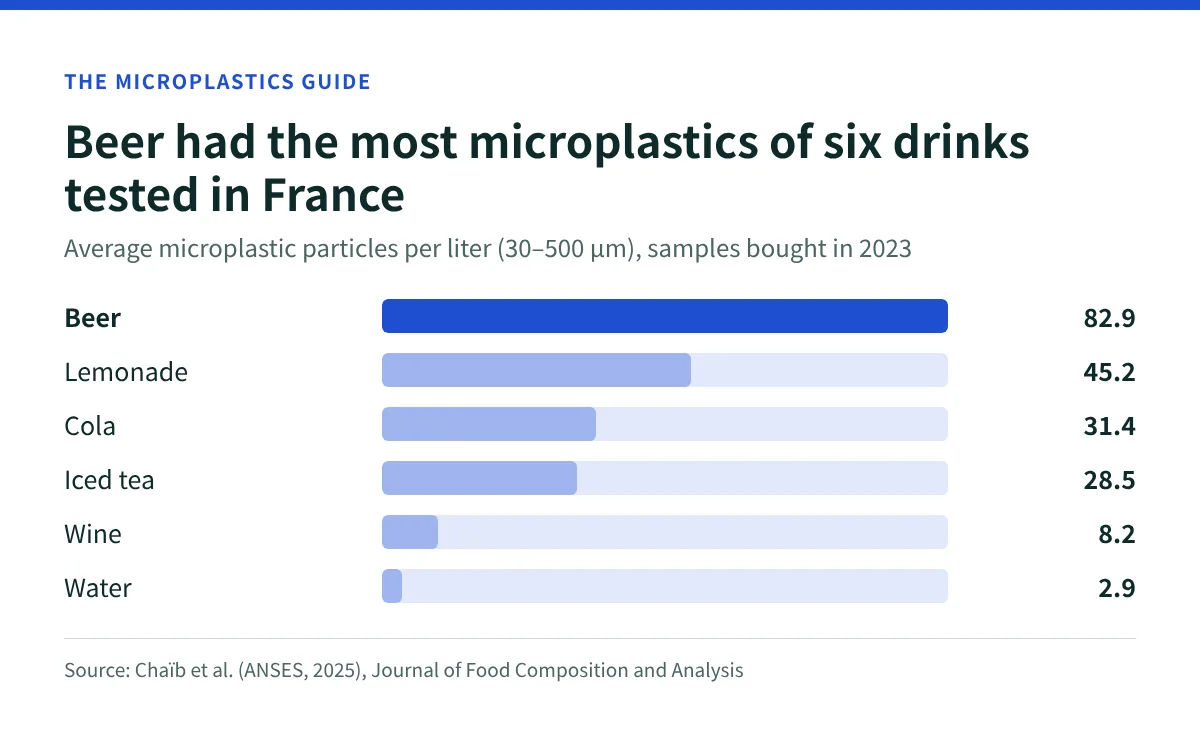
Beer contains microplastics, and often more than other drinks. A 2025 study by France's food safety agency ANSES found an average of 82.9 particles per liter in beer, compared with 2.9 in bottled water. Glass bottles closed with painted metal caps carried the most. For how this compares with tap and bottled water, see our drinking water guide.
How many microplastics are in beer?
Counts depend on the study, the country and the lab method. Three studies give a useful range:
| Study | Drinks tested | What it found |
|---|---|---|
| Kosuth et al., 2018, PLOS ONE | 12 US Great Lakes beer brands | 4.05 particles per liter on average (range 0 to 14.3) |
| Shruti et al., 2020, Science of the Total Environment | 57 samples of soft drinks, energy drinks, cold teas and beer from 27 brands in Mexico | Particles in 48 of 57 samples; up to about 28 per liter |
| Chaïb et al. (ANSES), 2025, Journal of Food Composition and Analysis | Water, cola, tea, lemonade, beer and wine bought in France | Beer highest at 82.9 per liter on average |
The 2018 US study by Kosuth and colleagues also tested tap water, which averaged 5.45 particles per liter. So beer in that study averaged slightly less than the tap water samples.
The 2020 Mexican study found polyamide, PET and ABS plastics among the particles. Its highest sample had about 28 particles per liter.
Do wine and soft drinks contain microplastics too?
Yes, but usually fewer than beer. In the French study, the agency bought six samples of each drink in June 2023. Average counts per liter were:
- Beer: 82.9
- Lemonade: 45.2
- Cola: 31.4
- Iced tea: 28.5
- Wine: 8.2
- Water: 2.9
The method counted particles from 30 to 500 micrometers. Smaller particles, including nanoplastics, were not measured. Our article on nanoplastics vs microplastics explains why that matters.
Why do glass bottles have more microplastics?
The main suspect is the cap, not the glass. ANSES found that glass bottles of soft drinks, lemonade, iced tea and beer held about 100 particles per liter. That was 5 to 50 times more than the other containers surveyed. Glass bottles of water and wine averaged 4.5 particles per liter, versus 1.6 in plastic bottles and cartons.
The caps showed scratches on the outside, and paint was found on the inside of the lid. The authors concluded that the particles came from the exterior paint of the caps.
In a lab test, untreated caps gave 287 particles per liter. Blowing the caps with air cut this to 106. Blowing and rinsing them with filtered water and alcohol cut it to 87, about a 70% drop.
Are cans or plastic bottles better than glass?
Not reliably. In the French data, cans and glass had the highest overall counts, and many of the particles in cans were of unidentified polymer type. Plastic bottles scored lower here, but a 2024 US study found about 240,000 tiny particles per liter of plastic-bottled water, mostly nanoplastics that the French method could not see.
The packaging effect also varies by brand. The cap paint finding in glass came mainly from one soft drink brand. So no container type is a guaranteed fix.
How strong is the evidence?
Strong that beer, wine and soft drinks contain some microplastic particles. Studies in the US, Mexico and France agree on this.
Emerging that painted caps drive higher counts in glass bottles. It is one agency's study, and the cap link rests mostly on one brand. Independent studies are needed to confirm it.
Contested on exact numbers. Labs use different size limits and methods, and some count all man-made particles, not only plastics. Results from different studies should not be compared directly.
Health effects from drinking these particles are unknown. None of these studies measured health outcomes. See our health effects guide for what research shows so far.
What can you do?
The harms of heavy drinking and sugary soda are well established; the effects of particles in drinks are not. Practical steps:
- Drink less alcohol and soda overall. This has clear health benefits and lowers particle intake whatever the container.
- Choose water most of the time. In the French study, water had the lowest count of any drink.
- Do not switch containers just for microplastics. Glass, cans and plastic each had problems in the studies above.
- Cut bigger sources first, such as heating food in plastic. Our ranked list of changes shows where effort pays off.
Drinks are one source among many. Salt and gum add small amounts too; see sea salt vs rock salt and how much plastic chewing gum releases. There is no proven way to remove microplastics from the body.
Frequently asked questions
Is canned beer better than bottled beer for microplastics?
Not clearly. In the 2025 French study, glass bottles with painted metal caps had the most particles, but cans also had high overall counts. The best-supported step is to drink less, not to change the container.
How many microplastics do you get from drinking beer?
In the 2018 US study, the authors estimated nearly 520 particles a year for someone drinking one 12-ounce (355 mL) beer a day. Beer in the 2025 French study had about 20 times more particles per liter, so estimates differ widely by study.
Does wine contain microplastics?
Yes, but less than beer or soft drinks. The French study found an average of 8.2 particles per liter in wine. Glass-bottled water and wine together averaged 4.5 particles per liter.
Keep reading
Sources
- Chaïb et al. (2025), Microplastics in packaged beverages, Journal of Food Composition and Analysis (Food Packaging Forum summary)
- Chaïb et al. (2025), journal article on ScienceDirect
- Packaging Gateway (2025): Glass bottles found to contain more microplastics than other containers
- American Ceramic Society (2025): Glass bottle caps, an unexpected microplastic source
- Kosuth, Mason and Wattenberg (2018), Anthropogenic contamination of tap water, beer, and sea salt, PLOS ONE
- Qian et al. (2024), nanoplastics in bottled water, PNAS (NIH Research Matters summary)
- Shruti et al. (2020), First study of its kind on the microplastic contamination of soft drinks, cold tea and energy drinks, Science of the Total Environment