
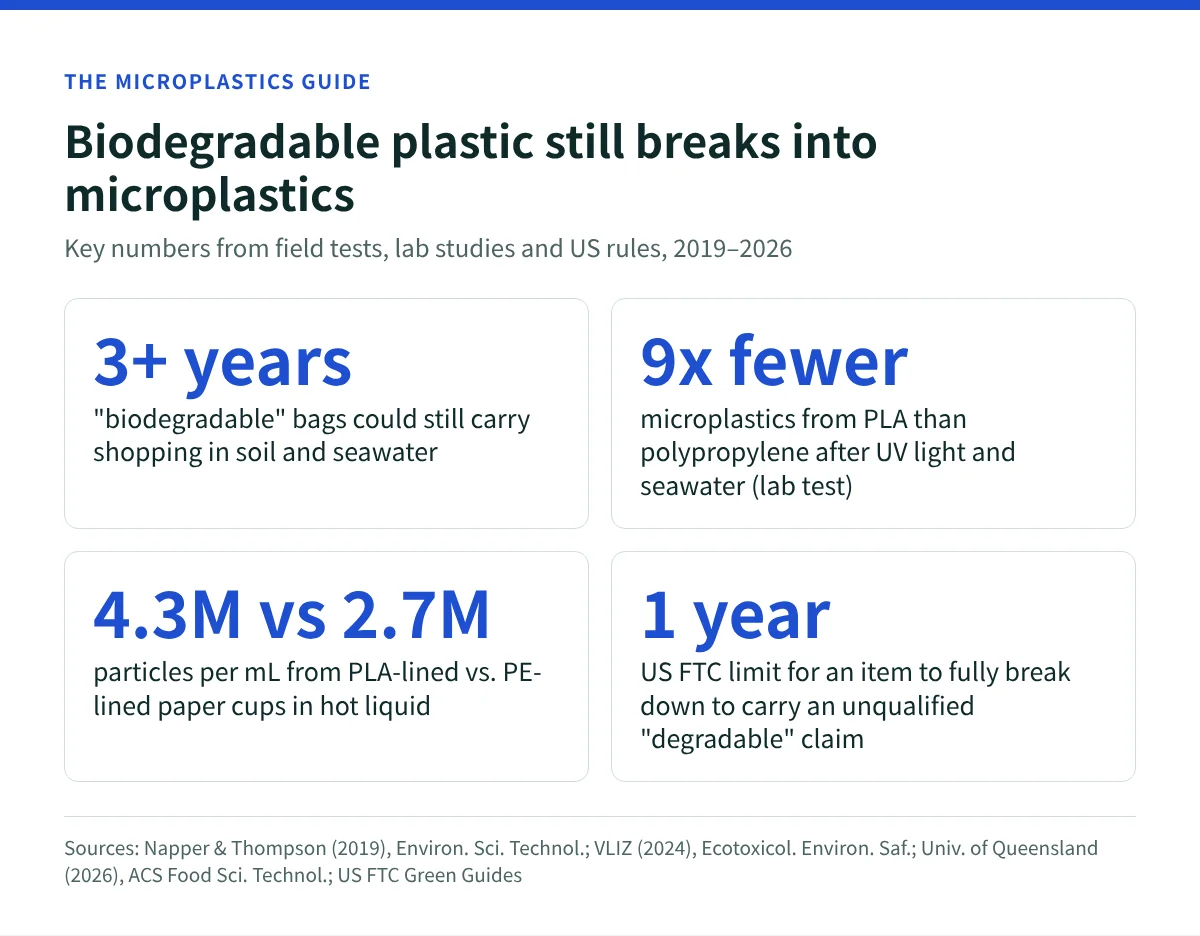
Biodegradable plastic still breaks into microplastics, and most types only fully break down in industrial composting. In a 2019 University of Plymouth study, "biodegradable" carrier bags could still hold shopping after more than 3 years in soil and seawater. For safer everyday swaps, see our buyer's guide to products that help.
What is the difference between biodegradable, compostable and bio-based plastic?
These three words mean different things. The European Commission says bio-based plastic is made fully or partly from plants or other biological sources. It is not necessarily biodegradable.
"Biodegradable" plastic breaks down in certain conditions at the end of its life. It can be made from plants or from fossil fuels. "Compostable" plastic is a subset that typically breaks down in industrial composting plants, where heat and moisture are controlled.
A widely used example is polylactic acid (PLA). It is made from plant-based feedstocks and is used in clear "compostable" cups, cutlery and cup linings. The Commission also notes there is no general standard for marine biodegradation.
| Label | What it means | Where it breaks down |
|---|---|---|
| Bio-based | Made partly or fully from plants | Not necessarily anywhere |
| Biodegradable | Breaks down under some conditions | Depends on heat, moisture, microbes and time |
| Industrially compostable | Certified to a standard such as EN 13432 | Industrial composting plants |
| Home compostable | Meant for a garden compost bin | Varies; not covered by the 2022 EU framework |
Do biodegradable plastics break down in nature?
Often not quickly. Imogen Napper and Richard Thompson tested five types of carrier bags in open air, soil and the sea. Their study appeared in Environmental Science & Technology in 2019.
After nine months in open air, all the materials had broken into fragments. That means they were turning into smaller pieces, not vanishing. In soil and seawater, the biodegradable, oxo-biodegradable and conventional bags could still carry shopping after more than 3 years.
The compostable bag did better at sea. It disappeared from the marine test rig within three months. In soil, though, it was still present after 27 months.
Do biodegradable plastics shed more microplastics?
It depends on the product and the test. Two studies point in opposite directions.
A 2024 study led by the Flanders Marine Institute, in Ecotoxicology and Environmental Safety, exposed PLA and polypropylene to UV light and seawater. The 76-day test matched about 24 months of sun in central Europe. PLA released about nine times fewer microplastics than polypropylene, but it still released some.
A 2026 University of Queensland study found the reverse for hot drinks. Paper cups lined with PLA released about 4.3 million nanoparticles per milliliter, versus 2.7 million for cups lined with polyethylene. By mass, PLA linings released about 12 times more plastic. The lead author said this does not mean PLA is inherently unsafe.
How strong is the evidence?
Strong that "biodegradable" does not mean a product disappears in soil or the sea. The 3-year field study and EU guidance agree on this.
Emerging on whether biodegradable plastics shed more or fewer particles in daily use. Results so far come from a handful of lab tests with different materials and conditions.
Contested on health effects. No study shows that particles from biodegradable plastic are safer or more harmful in people. The UQ researchers said the health impact of these particles is unclear. There is also no proven way to remove microplastics from the body.
What do the rules say about "biodegradable" labels?
In the US, the Federal Trade Commission sets rules in its Green Guides. An unqualified degradable claim is deceptive unless the item fully breaks down within one year after customary disposal. The FTC says landfills do not offer those conditions.
California's AB 1201 tightens "compostable" labels from January 1, 2026. A 2025 CalRecycle letter delayed one part of it until June 30, 2027, for products containing synthetic substances.
The EU set out its view in a 2022 policy framework. It says biodegradable plastics "should by no means provide a licence to litter." Labels should state the conditions and time needed to biodegrade. Under the EU packaging regulation, permeable tea bags, coffee pods and produce stickers must be compostable from February 12, 2028.
The EU's 2023 microplastics restriction also excludes polymers proven degradable under its test rules. Our article on the EU artificial turf infill ban explains how that restriction works. The same rule ended EU sales of loose plastic glitter, as our guide to glitter microplastics and biodegradable glitter explains.
Should you buy biodegradable or compostable products?
They can help when they go to an industrial composting plant. They are not a microplastics fix on their own. Use them like this:
- Reuse first. A steel, glass or ceramic cup or container avoids the question entirely.
- Skip hot drinks in plastic-lined cups when you can. This applies to PLA and regular plastic linings alike.
- Read the label closely. Look for a named standard such as EN 13432, and where the item should go.
- Do not litter "biodegradable" items. Field tests show they can last years outdoors.
- Watch for plant-based look-alikes. Many "bamboo" plates are melamine resin, as our melamine and bamboo plates check explains.
For how microplastics form in the first place, read what microplastics are.
Frequently asked questions
Is PLA plastic safe?
PLA is widely used in cups, cutlery and cup linings. A 2026 lab study found PLA cup linings released more particles into hot liquid than polyethylene linings. The authors said this does not show PLA is unsafe, and health effects are unclear.
Can I put compostable plastic in my home compost?
Only if it is labeled home compostable. Most compostable plastic is certified for industrial composting, which is not the same as a backyard bin. In the 2019 study, a compostable bag was still present in soil after 27 months.
Are oxo-degradable plastics better?
No evidence shows they are. In the 2019 study, oxo-biodegradable bags could still carry shopping after 3 years in soil and sea. Like other plastics, they broke into fragments in open air.
Keep reading
Sources
- Napper and Thompson (2019), Environmental Deterioration of Biodegradable, Oxo-biodegradable, Compostable, and Conventional Plastic Carrier Bags in the Sea, Soil, and Open-Air Over a 3-Year Period, Environmental Science & Technology
- University of Plymouth repository record for Napper and Thompson (2019)
- ScienceDaily (2019): news release on the University of Plymouth carrier bag study
- Flanders Marine Institute et al. (2024), Accelerated fragmentation of two thermoplastics (polylactic acid and polypropylene) into microplastics after UV radiation and seawater immersion, Ecotoxicology and Environmental Safety, via EurekAlert
- University of Queensland (2026): Takeaway cups release microplastics into your coffee, ACS Food Science & Technology
- European Commission: Biobased, biodegradable and compostable plastics
- BeverageDaily (2022): European Commission releases framework for bio-based, biodegradable plastic
- US Federal Trade Commission Green Guides, 16 CFR 260.8 Degradable claims
- Keller and Heckman, PackagingLaw.com: California's compostable labeling requirement delayed
- PPWR Connect: PPWR Article 9, which packaging must be compostable
- SGS (2023): EU regulates microplastics under REACH, Regulation (EU) 2023/2055