Microplastics mostly cannot get through healthy, intact skin, based on lab studies so far. A 2024 study on human skin samples found the outer layer kept most 100-nanometer particles on the surface after 48 hours. The open questions involve damaged skin, hair follicles and the chemicals that leach out of plastics. Our cosmetics and personal care guide covers where plastics show up in the products you put on your skin.
Can microplastics get through your skin?
Your skin's outer layer, the stratum corneum, is a tight wall of dead cells and fats. Most microplastics are far too large to slip through it. The question is mainly about nanoplastics, which are smaller than 1 micrometer, as our explainer on nanoplastics vs. microplastics shows.
In the 2024 study, Texas researchers placed 100 nm fluorescent plastic particles on human skin for 48 hours. They wrote that the outer layer "sufficiently kept the 100 nm NPs from skin penetration." Most of the signal stayed on top of the skin.
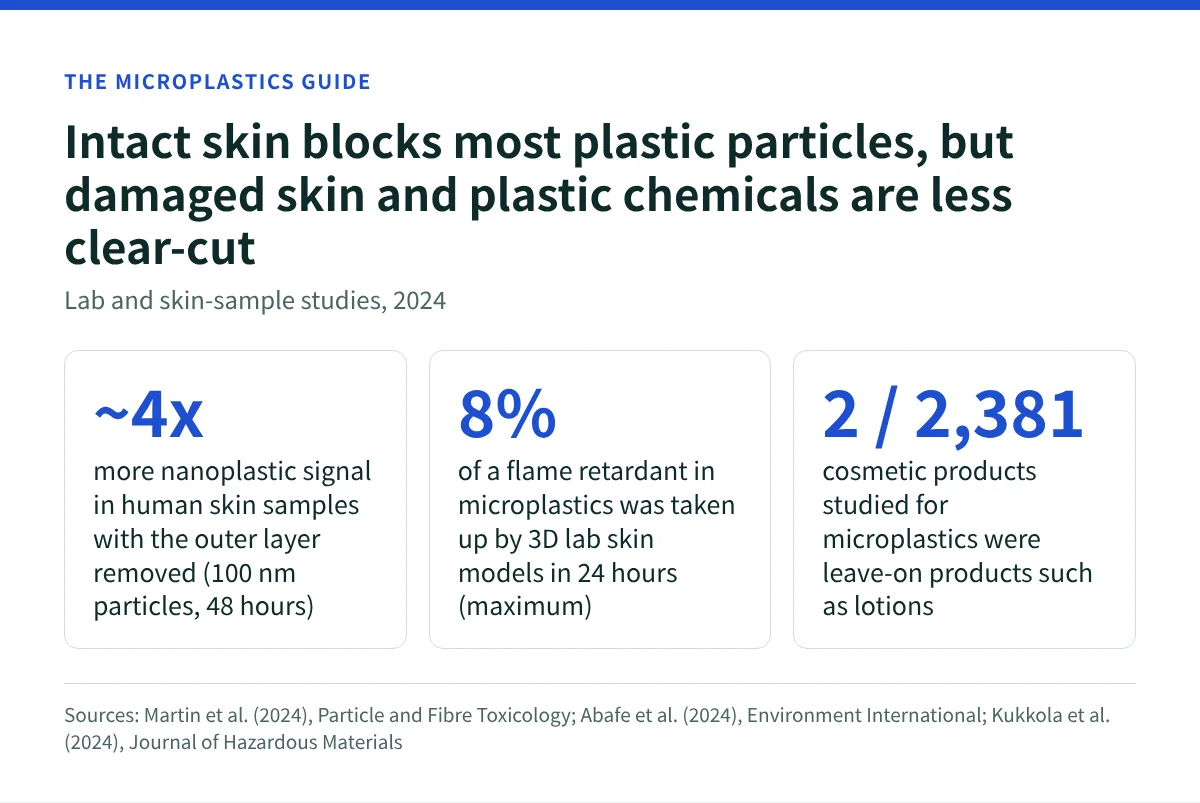
When the outer layer was stripped off, the picture changed. The epidermis held 38.87 pixels of particle signal per cell, versus 9.23 with the layer intact, roughly 4 times more (2024). Particles reached all epidermal layers, but very few went deeper into the dermis.
Can hair follicles or damaged skin let plastics in?
Possibly, in small amounts. A 2026 review in the American Journal of Clinical Dermatology gathered lab, skin-sample and modeling studies. It found that particles can stick to the skin and collect in hair follicles.
In human skin samples treated to open the follicles, 40 nm particles reached immune cells in the skin, the review summary reports. Larger particles stayed near the surface. The authors also stressed that particles in follicles "have not necessarily entered living skin tissue or the bloodstream" (2026).
The same review noted that babies' outer skin layer is 20 to 30% thinner than adults'. That is a reason for more research, not proof of harm. Our babies and kids guide covers the main exposure routes for young children.
Can chemicals from microplastics be absorbed through skin?
Yes, in lab models. Plastics carry additives such as flame retardants, and these can move out of the particle. A 2024 University of Birmingham study exposed 3D human skin models to polyethylene and polypropylene microplastics containing flame retardants.
Up to 8% of the chemical was taken up by the skin over 24 hours (2024). More hydrated, "sweatier" skin absorbed more. The team said more research is needed, and the work did not measure blood levels in people.
How strong is the evidence?
| Question | What studies found | Rating |
|---|---|---|
| Do particles cross intact skin? | Most 100 nm particles stayed on the surface of human skin samples (2024) | Emerging |
| Does damaged skin let more in? | About 4 times more signal without the outer layer, mostly in the epidermis (2024) | Emerging |
| Do follicles act as an entry route? | Small particles collect in follicles in lab samples (2026 review) | Emerging |
| Do plastic additives pass through skin? | Up to 8% of a flame retardant in lab skin models (2024) | Emerging |
| Does skin contact harm health? | No human evidence; cell effects seen at doses that may exceed real life (2026 review) | Contested |
Emerging. All of this comes from cells, donated skin samples and lab models, not living people. The 2024 skin study used smooth, labeled lab beads, and the authors said these cannot fully simulate particles in the environment. The 2026 review found nanoplastics caused stress and inflammation in skin cells, but at doses that may exceed everyday exposure.
Skin also gets less attention than food and air. The World Health Organization's main review covered dietary and inhalation exposure (2022). A 2024 review of cosmetics research found that of 2,381 products studied, only two were leave-on products like lotions or makeup. It found no studies that measured skin exposure from them.
What does this mean for you?
Swallowing and breathing remain the main known routes into the body. Skin is a strong barrier, so there is no need to fear touching plastic. There is also no proven way to remove microplastics from the body once they are inside, so skip any "detox" product.
Easy, low-cost steps:
- Check ingredient lists of leave-on products for polymer names such as polyethylene, nylon-12 or acrylates copolymer, as listed in our personal care guide.
- Glitter in body products is often plastic; our glitter article explains the EU rules.
- For products worn against sensitive skin for hours, see what tests found in tampons and pads.
- Treat cracked or broken skin as your clinician advises; this also keeps the skin barrier working.
Frequently asked questions
Can nanoplastics enter the bloodstream through skin?
No study has shown this in living people. In a 2024 lab study, very few 100 nm particles reached the deeper skin layer, even after the outer layer was removed. Particles found in hair follicles have not necessarily entered living tissue.
Do skincare products contain microplastics?
Some do, especially as film formers, thickeners or glitter. The EU is phasing out intentionally added microplastics, with leave-on products due in 2029, according to a 2024 Birmingham release. Ingredient lists show the polymer names.
Is it safe to wear polyester clothing next to your skin?
There is no evidence that fibers from clothing pass through intact skin. Clothing matters more because it sheds fibers into air and water. Our guide to clothing and laundry explains how to cut shedding.
Keep reading
Sources
- Martin et al. (2024), Cellular response of keratinocytes to the entry and accumulation of nanoplastic particles, Particle and Fibre Toxicology
- News-Medical (2026), Can microplastics get under your skin? Summary of Tan et al., American Journal of Clinical Dermatology
- University of Birmingham (2024), Toxic chemicals from microplastics can be absorbed through skin (Abafe et al., Environment International)
- University of Birmingham (2024), Scientists warn of gaps in our understanding of leave-on personal care and cosmetic products (Kukkola et al., Journal of Hazardous Materials)
- World Health Organization (2022), Dietary and inhalation exposure to nano- and microplastic particles and potential implications for human health