
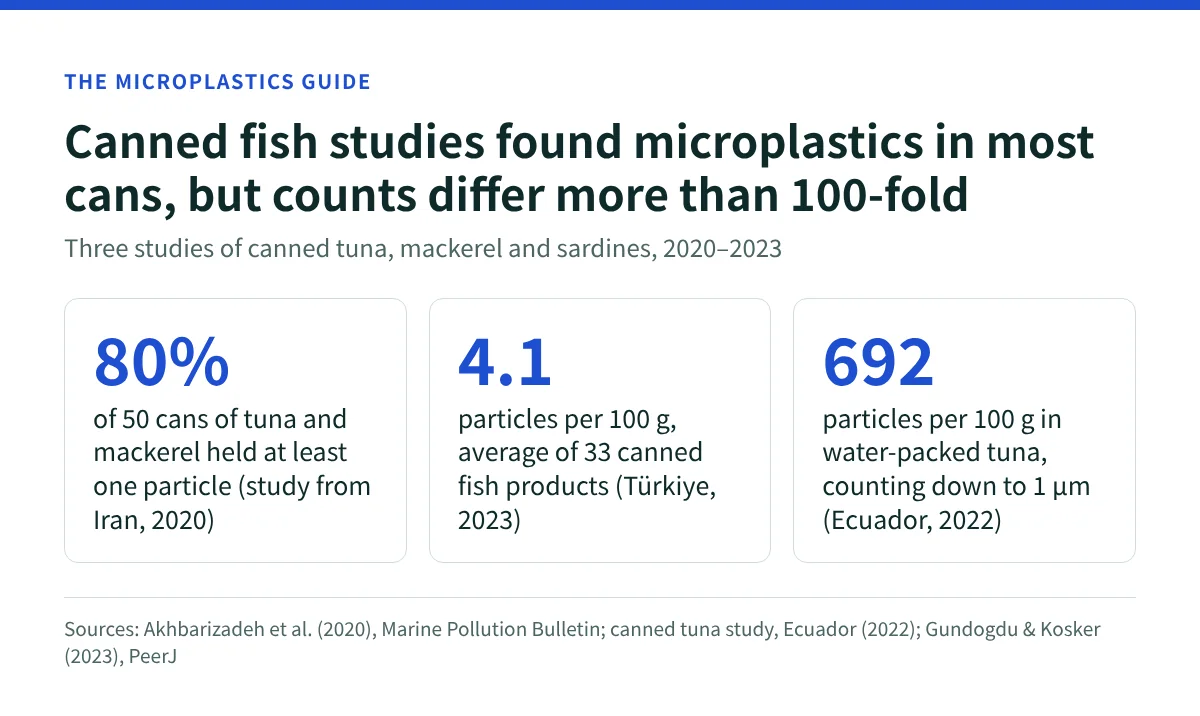
Most canned food tested for microplastics so far contains some. A 2020 study of 50 cans of tuna and mackerel found plastic particles in 80% of them. Later studies reported between 4 and 692 particles per 100 g. Almost all of this research covers canned fish, and no study has yet proven that the can itself is the source. For the wider picture of food and packaging, see our food and kitchen guide.
Do canned foods contain microplastics?
Yes, at least canned fish does. Three studies from three countries looked inside commercial cans:
| Study | What was tested | Main result |
|---|---|---|
| Iran, 2020 (Marine Pollution Bulletin) | 50 cans of tuna and mackerel, 7 brands | Particles in 80% of samples; PET the most common plastic |
| Ecuador, 2022 | 4 tuna brands, in water and in oil | 692 per 100 g (water) and 442 per 100 g (oil) |
| Türkiye, 2023 (PeerJ) | 33 canned fish products | Every sample positive; average 4.1 per 100 g |
In the Iranian study, cans that contained particles held roughly 5 to 22 each. The authors estimated that eating canned fish once a week could add up to 572 particles a year.
The Ecuador team found PET, polystyrene and nylon most often. They also found about 5 to 6 particles per milliliter in the packing liquid.
The Turkish study found fragments made up 57% of particles and fibers 43%. Brand averages ranged from 0.81 to 13.5 particles per 100 g.
Why do the numbers differ so much?
Mostly because labs count different things. The Ecuador study counted particles down to 1 micrometer, and about 90% of its particles were 1 to 50 micrometers. The Turkish study counted much larger pieces, starting at about 0.06 mm.
Quality checks also vary. The Turkish team confirmed 64 of 79 tested particles (81%) as plastic with a laser method and subtracted lab contamination. Many food studies skip such steps.
A 2025 review of 103 studies on food packaging and microplastics rated only seven as well designed and of suitable quality. It called for standard test methods.
Does the can lining shed microplastics?
It is possible, but unproven. Many food and drink cans have a thin polymer coating inside. The US Food and Drug Administration (FDA) says these liners form a barrier between the food and the metal.
The Turkish authors called the can the main likely source of the particles they found. They noted the industry shift from epoxy to acrylic, polyester and polyolefin coatings. But they did not test any coatings directly. Cans labeled "BPA free" had the highest average, 8.91 particles per 100 g, though the difference was not statistically significant.
Other sources are just as plausible. The Iranian team pointed to the fish itself, additives and equipment used during cleaning and canning. Cans with more salt held more particles, which fits with microplastics found in salt. Wild fish also carry particles before they are caught; see which seafood has the most.
Is BPA in can linings the same problem?
No. BPA (bisphenol A) is a chemical used to make some can coatings, not a plastic particle. It is regulated separately.
The European Union banned BPA in food contact materials under Regulation (EU) 2024/3190, in force since January 20, 2025. Most products had until July 20, 2026, to comply. Cans for fruit, vegetables and processed fish have until July 20, 2028.
In the US, the FDA says the available information continues to support the safety of BPA for its approved uses. Switching to BPA-free cans does not, on current evidence, mean fewer microplastics.
How strong is the evidence?
Emerging that canned fish commonly contains microplastics. The finding is consistent, but it rests on a few small studies from three countries.
Contested on amounts. Counts differ more than 100-fold between studies because of size limits and lab methods.
Emerging on the can lining as a source. It is a reasonable hypothesis that no study has tested directly.
No study has shown that microplastics from canned food harm people. There is also no proven way to remove microplastics already in the body.
What does this mean for you?
Canned fish, beans and vegetables are affordable, nutritious foods. Current evidence is no reason to drop them. If you want to trim exposure anyway:
- Mix your sources. Rotate canned foods with dried beans, frozen vegetables and fresh fish.
- Drain packing liquid you do not need. It held particles in the Ecuador study, though draining has not been tested as a way to lower intake.
- Move leftovers out of the can into a glass or steel container rather than plastic.
- Do not overpay for claims. "BPA free" describes one chemical, not microplastics.
- Start with bigger sources. Our ranked list of changes shows where effort pays off most. Drinks matter too; see microplastics in beer, wine and soft drinks.
Frequently asked questions
Are BPA-free cans free of microplastics?
Not necessarily. BPA-free cans still use a polymer lining, often acrylic, polyester or polyolefin. In the 2023 Turkish study, BPA-free cans did not have fewer particles than other cans.
Is canned tuna high in microplastics?
Canned tuna has been tested more than any other canned food, and most samples contained particles. Reported amounts range from a few to several hundred per 100 g, depending on the lab method. No study has shown a health effect from these amounts.
Are glass jars better than cans for microplastics?
We found no study that compares the same food in glass jars and in cans. For now, varying your foods is a better bet than switching containers.
Keep reading
Sources
- Akhbarizadeh et al. (2020), Abundance, composition, and potential intake of microplastics in canned fish, Marine Pollution Bulletin 160:111633
- Oceanbites: Microplastics, canned fish, and you, summary of Akhbarizadeh et al.
- Presence of microplastics in commercial canned tuna (2022), PubMed record
- Gundogdu and Kosker (2023), Microplastic contamination in canned fish sold in Türkiye, PeerJ 11:e14627
- Food Packaging Forum (2025): Food contact articles are a source of micro- and nanoplastics in food, on Zimmermann et al., npj Science of Food
- US Food and Drug Administration: Questions and answers on bisphenol A (BPA) use in food contact applications
- European Commission, Access2Markets (2025): EU prohibition on the use and trade of bisphenol A from 20 January 2025