
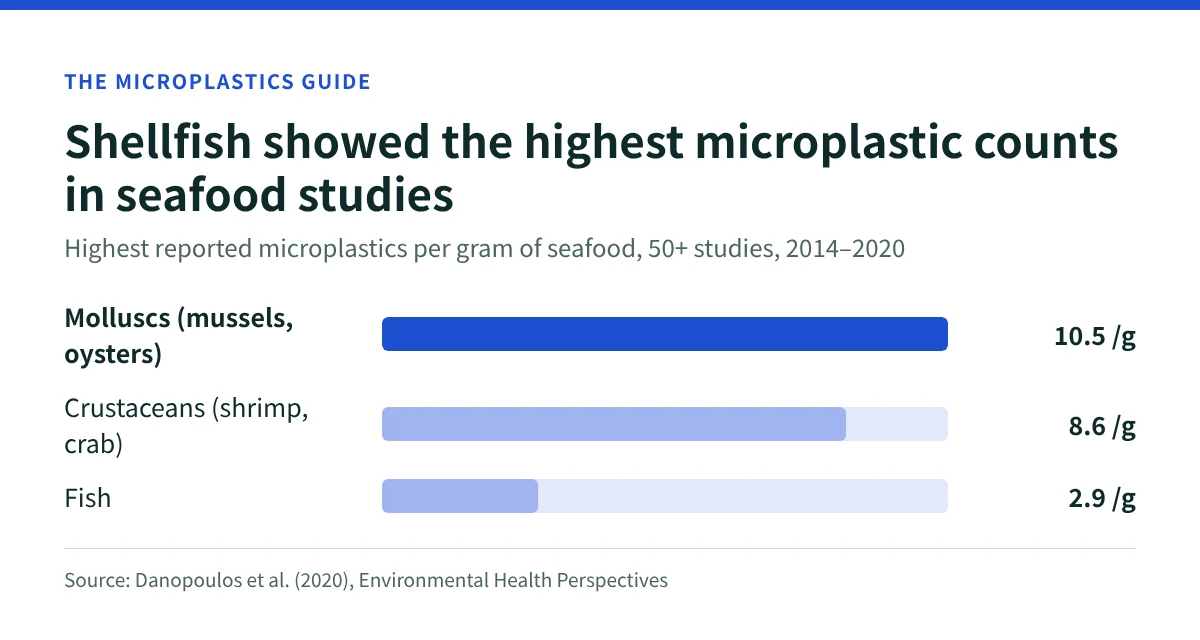
Shellfish usually contain the most microplastics of any seafood. A 2020 review of more than 50 studies found up to 10.5 particles per gram in molluscs such as mussels and oysters, 8.6 in crustaceans and 2.9 in fish. The main reason is simple: we eat shellfish whole, gut and all. For the wider picture of food sources, see our food and kitchen guide.
Which seafood has the most microplastics?
The largest summary comes from a team led by Evangelos Danopoulos. They pooled studies published from 2014 to 2020. Their meta-analysis appeared in Environmental Health Perspectives in December 2020.
Counts per gram ranged widely within each group:
| Seafood group | Examples | Reported range (particles per gram) |
|---|---|---|
| Molluscs | Mussels, oysters, scallops | 0 to 10.5 |
| Crustaceans | Shrimp, crab | 0.1 to 8.6 |
| Fish | Finfish | 0 to 2.9 |
The review found that molluscs collected off Asian coasts were the most contaminated. The authors linked this to heavier plastic pollution in those waters. They also called for standard methods, because labs count particles in different ways.
Why do shellfish have more microplastics than fish?
It comes down to what we eat. Most microplastics in fish sit in the stomach and intestines. The European Food Safety Authority (EFSA) notes that these organs are usually removed before fish is eaten.
Mussels, oysters and clams are filter feeders. They pump seawater through their bodies and trap tiny particles. We then eat the whole animal, digestive tract included. Small shrimp and small fish eaten whole, such as sardines or anchovies, fall into the same group.
What did the newest US study find in fish and shrimp?
A Portland State University team tested six seafood species from Oregon. They examined 182 samples and found suspected human-made particles in 180 of them. The study was published in Frontiers in Toxicology in December 2024.
Pink shrimp, which filter-feed near the surface, had the most. Vessel-caught shrimp held about 10.68 particles per gram, and store-bought shrimp about 7.63. Chinook salmon had the least, at about 0.028 per gram.
Fibers made up about 82% of the particles the team checked by spectroscopy. Not every particle was plastic, though. The study counted "anthropogenic particles," which also include treated natural fibers such as cotton. Store-bought seafood was not consistently dirtier than seafood taken straight from fishing boats.
How much plastic do you actually eat from seafood?
Less than the headlines suggest, by weight. In 2016, EFSA estimated that a 225 g (8 oz) portion of mussels could hold about 7 micrograms of plastic. EFSA called this a worst-case figure based on limited data.
A 2017 report from the UN Food and Agriculture Organization (FAO) used the same mussel example. It found the plastic would add less than 0.1% to total dietary intake of certain pollutants and plastic additives. The FAO noted that harm in animals has mostly been seen in lab tests at much higher doses than in nature.
Seafood is also only one route. Bottled water, salt and household dust add particles too; see whether sea salt has more microplastics than rock salt and why nanoplastics in bottled water matter.
How strong is the evidence?
Strong that seafood, especially shellfish, commonly contains microplastic particles. Dozens of studies on several continents agree.
Contested on exact amounts. Methods differ, and many studies cannot be compared directly. Some counts include natural fibers or particles from lab air.
Emerging on health effects. No study has shown that microplastics from seafood harm people. EFSA found insufficient data on toxicity and on what happens to these particles in the body for a full risk assessment.
Should you stop eating seafood because of microplastics?
No. Fish provides protein and omega-3 fats, and the health risk from its microplastics is unproven. If you want to trim exposure anyway:
- Vary your seafood. Do not rely on one type, such as mussels, every week.
- Favor gutted fish and fillets when you want lower counts, since the gut is where most particles sit.
- Rinse fillets and shrimp under cold water before cooking. The Portland State team said this may remove some surface particles.
- Store and reheat seafood in glass or steel, not plastic.
- Look at bigger sources first. Our ranked list of changes shows where effort pays off most.
There is no proven way to remove microplastics already in the body. Be wary of products that claim to "detox" them.
Frequently asked questions
Do farmed fish have more microplastics than wild fish?
The studies above do not answer this clearly. Contamination depends more on the water, the species and what is eaten than on farmed versus wild. In the Oregon study, store-bought seafood was not consistently higher than vessel-caught seafood.
Does cleaning mussels or oysters remove microplastics?
Scrubbing the shells removes dirt on the outside, not particles inside the animal. Because the whole body is eaten, shellfish remain a direct route. Eating them less often is the only reliable way to lower that exposure.
Is canned tuna or salmon high in microplastics?
Fish fillets, including those used for canned fish, are generally lower than shellfish because the gut is removed. Small fish canned whole, like sardines, include the gut. The studies above did not test canned seafood. For what tests of canned tuna and mackerel found, see canned food microplastics.
Keep reading
Sources
- Danopoulos et al. (2020), Microplastic Contamination of Seafood Intended for Human Consumption: A Systematic Review and Meta-Analysis, Environmental Health Perspectives, news release
- ScienceDaily (2020): Highest levels of microplastics found in molluscs, new study says
- Traylor et al. (2024), From the ocean to our kitchen table: anthropogenic particles in the edible tissue of U.S. West Coast seafood species, Frontiers in Toxicology, news release
- News-Medical (2025): Study reveals widespread microplastic contamination in U.S. West Coast fish and shellfish
- European Food Safety Authority (2016): Microplastics and nanoplastics in food, an emerging issue
- Lusher, Hollman and Mendoza-Hill (2017), Microplastics in fisheries and aquaculture, FAO Fisheries and Aquaculture Technical Paper 615, summary