Clear aligners do shed microplastics, at least in the lab. A 2026 study in the Korean Journal of Orthodontics found that all 10 aligner brands tested released particles in artificial saliva, and more after 14 days than after 7. No study has yet measured particles from aligners inside real mouths or linked them to health effects. Our cosmetics and personal care guide covers other plastics we put on or in our bodies.
What are clear aligners made of?
Clear aligners are thin plastic trays that move teeth step by step. Most are heat-formed from plastic sheets over a model of the teeth. Newer ones are 3D-printed directly from liquid resin.
The 2026 study listed the polymers behind 10 brands. They included PET and PET glycol (PETG), polyurethane, and methacrylate resins for 3D printing. Some brands used blends of polyester and polyurethane.
Patients wear aligners for long stretches. The University of Rochester notes that people wear them nearly 22 hours a day for about two years (2026). University at Buffalo researchers cite an estimate of about 3 million clear aligners in use every day worldwide (2026).
Do clear aligners release microplastics?
Yes, in lab tests. Italian researchers placed 10 aligner brands in artificial saliva at 98.6°F (37°C). They stirred them five hours a day for 7 or 14 days to mimic friction, then counted particles with microscopes and spectroscopy (2026).
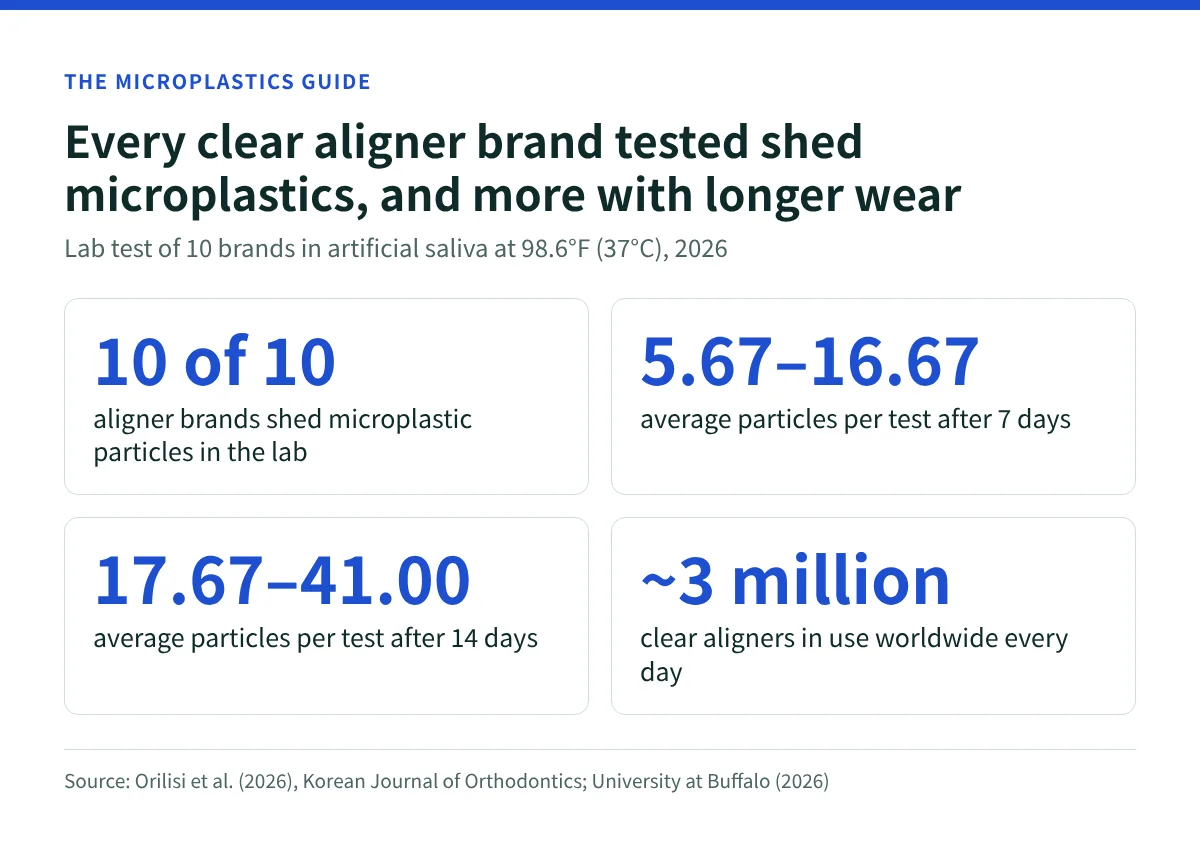
Every brand shed microplastics. Average counts per test ranged from 5.67 to 16.67 particles after 7 days. After 14 days they ranged from 17.67 to 41.00, and the rise was significant for every brand.
Most particles measured 5 to 20 micrometers. By day 14, particles smaller than 5 micrometers became the most common size. Smaller particles matter because they are harder to detect, as our guide to nanoplastics vs. microplastics explains.
The counts are small next to other everyday sources. But they are hard to compare, because each lab uses different methods. Our article on how microplastics are measured explains why numbers vary so much.
Which aligner materials shed the most?
In the 2026 study, release depended on material, not on how the tray was made. Here are the 14-day average counts by material group:
| Material group (brands tested) | How it is made | Average particles after 14 days |
|---|---|---|
| PET or PETG (3) | Heat-formed | 36.33–41.00 |
| Polyurethane (2) | Heat-formed | 20.67–24.67 |
| Polyester and polyurethane blends (2) | Heat-formed | 21.33–23.33 |
| Methacrylate resin (3) | 3D-printed | 17.67–36.00 |
Other studies point the other way on 3D printing. A 2025 study in the European Journal of Orthodontics put printed and heat-formed samples through 120 friction cycles under a 1 kg load. Particles from the printed resin covered 32.34% of the viewed area, against 1.07% for the heat-formed plastic.
A 2026 study in Progress in Orthodontics tested six devices, including aligners, retainers and sleep appliances. The three 3D-printed devices shed more particles than the three heat-formed ones. Immune cells called macrophages readily took up the particles in the lab.
How strong is the evidence?
Emerging that aligners shed microplastics. Three independent lab studies found particles from every material tested. But none were done in real mouths, where saliva enzymes, chewing and temperature change all the time.
Contested on which type sheds most. One 2026 study found material mattered more than printing. Two others found printed devices shed more. The tests used different forces, times and liquids, so they are hard to compare.
No evidence yet on health effects. A 2025 review of 11 studies found only lab data and called for better safety research. The authors also warned that lab models probably underestimate real release. The Buffalo team said its own findings are preliminary and need well-designed clinical studies.
New work is under way. In 2026 the University of Rochester received an American Association of Orthodontists Foundation grant to simulate saliva, temperature and chewing forces in the lab.
What does this mean for you?
You do not need to stop treatment. The Rochester study lead said patients need not change anything, noting that released particles are not necessarily absorbed by the body. Plastic trays have real benefits, and there is no proven way to remove microplastics from the body.
- Follow your replacement schedule. The 2026 authors suggested that swapping trays after 7 days may help limit release, but this has not been tested in patients.
- Ask about the material. Your orthodontist can tell you whether trays are heat-formed or 3D-printed, and which plastic they use.
- Clean trays the way your provider advises. Avoid improvised cleaning methods your provider has not recommended.
- Consider retainers too. Night-time retainers and sleep appliances are made from similar plastics.
Contact lenses raise a similar question for the eyes, as our article on contact lens microplastics explains.
Frequently asked questions
Do clear aligners put plastic in your body?
Lab tests show aligners shed small plastic particles into artificial saliva. Some could be swallowed, but no study has measured how many enter the body. Health effects have not been studied in patients.
Are 3D-printed aligners worse for microplastics?
The evidence is mixed. Two studies from 2025 and 2026 found printed devices shed more particles, while another 2026 study linked release to the plastic type rather than the printing method.
Do retainers shed microplastics too?
Probably, since they are made from similar plastics. A 2026 lab study that included retainers and sleep appliances found that all six devices shed measurable particles in artificial saliva.
Keep reading
Sources
- Orilisi G. et al. (2026), Can wear time, material composition, and manufacturing processes affect microplastic release from clear orthodontic aligners? A multidisciplinary in vitro study, Korean Journal of Orthodontics
- Zecca P.A. et al. (2025), Comparative microscopic analysis of plastic dispersion from 3D-printed and thermoformed orthodontic aligners, European Journal of Orthodontics
- Shariff K.U. et al. (2025), Microplastics and nanoplastics in clinical dentistry and orthodontics: a narrative review, Progress in Orthodontics
- University at Buffalo (2026), UB orthodontics researchers evaluate microplastics' effect on immune system
- University of Rochester Medical Center (2026), Eastman Institute for Oral Health to investigate microplastics