Contact lenses can shed microplastics, but so far only in the lab. In a 2023 study, six lens types released no particles until exposed to simulated sunlight. After that, some could shed more than 90,000 particles a year. Whether this happens in real eyes, and whether it matters for health, is not known. Our cosmetics and personal care guide covers other everyday products made with plastic.
What are contact lenses made of?
Soft contact lenses are made of plastic polymers. Researchers at Arizona State University examined 13 lens brands made from nine different polymer types in 2018. Common materials include hydrogels and silicone hydrogels, which hold water to keep the lens soft.
Lenses are small, thin and used in large numbers. The CDC estimated in 2019 that about 45 million people in the US wear contact lenses. Many types are replaced daily, every two weeks or monthly.
Do contact lenses shed microplastics in your eyes?
The best evidence is one lab study. A team led by Bing Wu published it in Environmental Science & Technology in June 2023. They tested six types of lenses from different brands, with different wear lifespans.
The lenses were exposed to the equivalent of 30 or 90 days of sunlight. They were rinsed with water three times every 10 hours. An automated imaging system then counted the particles.
Here is what they reported:
- Without simulated sunlight, no microplastics were detected.
- After the 90-day sunlight equivalent, particle numbers rose.
- Lenses with shorter wear lifespans shed the most.
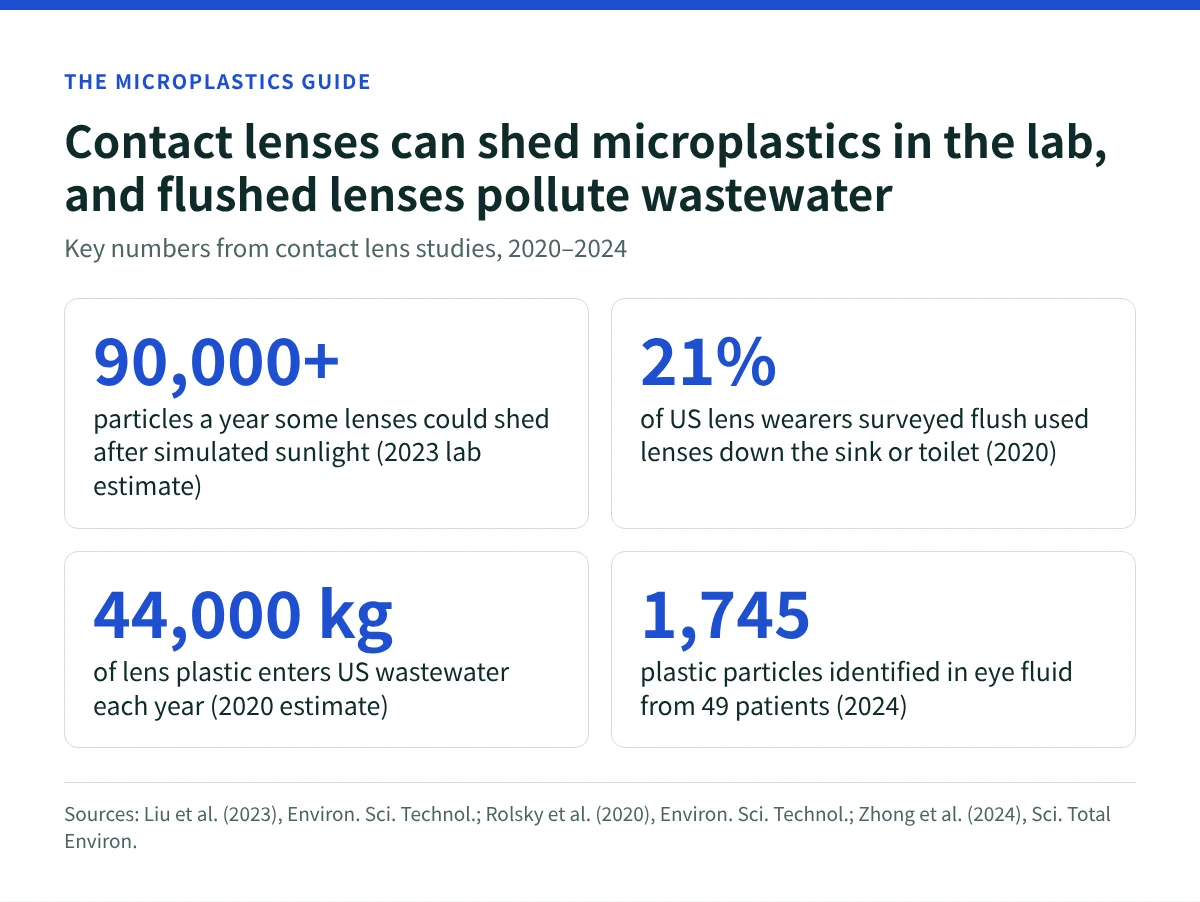
- Some lenses could shed more than 90,000 particles a year if worn 10 hours a day. This is an extrapolation from lab conditions.
The authors called it a small pilot study. They said the health impact of direct microplastic exposure to the eyes is not currently known.
Have microplastics been found in human eyes?
Yes, in a few small studies, but none links them to lens wear. A 2024 study in Science of the Total Environment tested fluid from inside the eye (the vitreous humor). It used samples from 49 patients with four eye diseases at two medical centers.
Of 8,543 particles scanned, 1,745 were identified as plastic, mostly smaller than 50 micrometers. Nylon was the most common type, followed by PVC and polystyrene. Higher levels went along with higher eye pressure, but that is an association, not proof of cause.
Eye drops are another possible source. A 2024 preprint found microplastics in all nine over-the-counter lubricant eye drops it tested. Counts ranged from 5 to 308 particles per milliliter with infrared analysis. The authors suggest the plastic vials may be one source. A preprint has not yet been peer reviewed.
For more on why particle counts vary so widely, see how microplastics are measured.
What happens when you flush contact lenses?
This is the better-documented problem. In a 2020 study in Environmental Science & Technology, the Arizona State team surveyed 416 lens users. About 21% said they flush used lenses down the sink or toilet.
The team estimated that this sends about 44,000 kg (97,000 lb) of lens plastic, by dry weight, into US wastewater each year. Treatment did not measurably break the lenses down. Instead, about 24,000 kg a year ends up as microplastics in sewage sludge spread on farmland.
Only about 0.04% of contact lens waste was recycled, the study estimated. America's water utility association, AWWA, advises people to put used lenses in the garbage, not the drain.
| Question | What the research shows | Evidence |
|---|---|---|
| Do lenses shed particles in the lab? | Yes, after simulated sunlight (2023) | Emerging |
| Do lenses shed particles in real eyes? | Not yet measured | Unknown |
| Are there plastic particles inside human eyes? | Yes, in 49 patients with eye disease (2024) | Emerging |
| Does lens wear cause eye harm through microplastics? | No study shows this | Not established |
| Do flushed lenses add plastic to wastewater? | Yes, about 44,000 kg a year in the US (2020) | Strong |
How strong is the evidence?
Emerging on shedding in the eye. One small lab study used artificial sunlight and water rinses, not real tears and blinking. It has not been repeated by another team that we could find.
Emerging on microplastics in eyes. The 2024 study had only 49 patients, all with eye disease, and no healthy comparison group. Like the tiny nanoplastics that current methods often miss, the smallest particles were not counted.
Strong on wastewater. The flushing estimate comes from a peer-reviewed survey and lab tests, and US water utilities repeat the advice not to flush.
What does this mean for you?
There is no reason to stop wearing contact lenses because of microplastics. The eye health benefits of correct lens care are well established. The microplastic risk is still a research question.
Simple steps that also follow good lens hygiene:
- Wear and replace lenses as your eye-care provider advises. Do not stretch the wear time.
- Store lenses in their case and solution, not in water, as the CDC advises.
- Put used lenses and blister packs in the trash. Never rinse them down the sink or flush them.
- Ask your eye-care provider about lens recycling if a take-back option exists where you live.
- Wear glasses some days if that suits you. It is a personal choice, not a health requirement.
Glitter is another personal care product that often ends up in drains, as our article on glitter microplastics and the EU ban explains. Plastic dental devices raise a similar question, covered in our article on clear aligners and microplastics.
Frequently asked questions
Are daily contact lenses worse for microplastics?
In the 2023 lab study, lenses with shorter lifespans shed the most particles after simulated sunlight. That has not been shown in real eyes. Daily lenses do create more waste, so disposing of them in the trash matters more.
Can microplastics from contact lenses damage your eyes?
No study has shown this. The 2023 authors said the health impact of microplastics on the eye is not known. There is also no proven way to remove microplastics from the body.
Is it okay to flush contact lenses down the toilet?
No. A 2020 study found treatment plants do not break lenses down, and they end up as microplastics in sewage sludge. Put them in the household trash.
Keep reading
Sources
- Liu et al. (2023), High-Content Screening Discovers Microplastics Released by Contact Lenses under Sunlight, Environmental Science & Technology (PubMed)
- EurekAlert / American Chemical Society (2023): Contact lenses shed microplastics, news release
- Technology Networks (2023): Microplastics shed by contact lenses
- Rolsky, Kelkar and Halden (2020), Nationwide Mass Inventory and Degradation Assessment of Plastic Contact Lenses in US Wastewater, Environmental Science & Technology
- Arizona State University (2018): Don't throw those contact lenses down the drain
- Zhong et al. (2024), Revealing new insights: Two-center evidence of microplastics in human vitreous humor, Science of the Total Environment (PubMed)
- NZ Optics (2024): Microplastics found in human vitreous
- Jaeger et al. (2024), Microplastics Identified in Commercial Over-the-counter Lubricant Eyedrops, medRxiv preprint
- CDC MMWR (2019): Healthy Contact Lens Behaviors Communicated by Eye Care Providers and Recalled by Patients, United States, 2018
- AWWA DrinkTap: Don't flush contact lenses