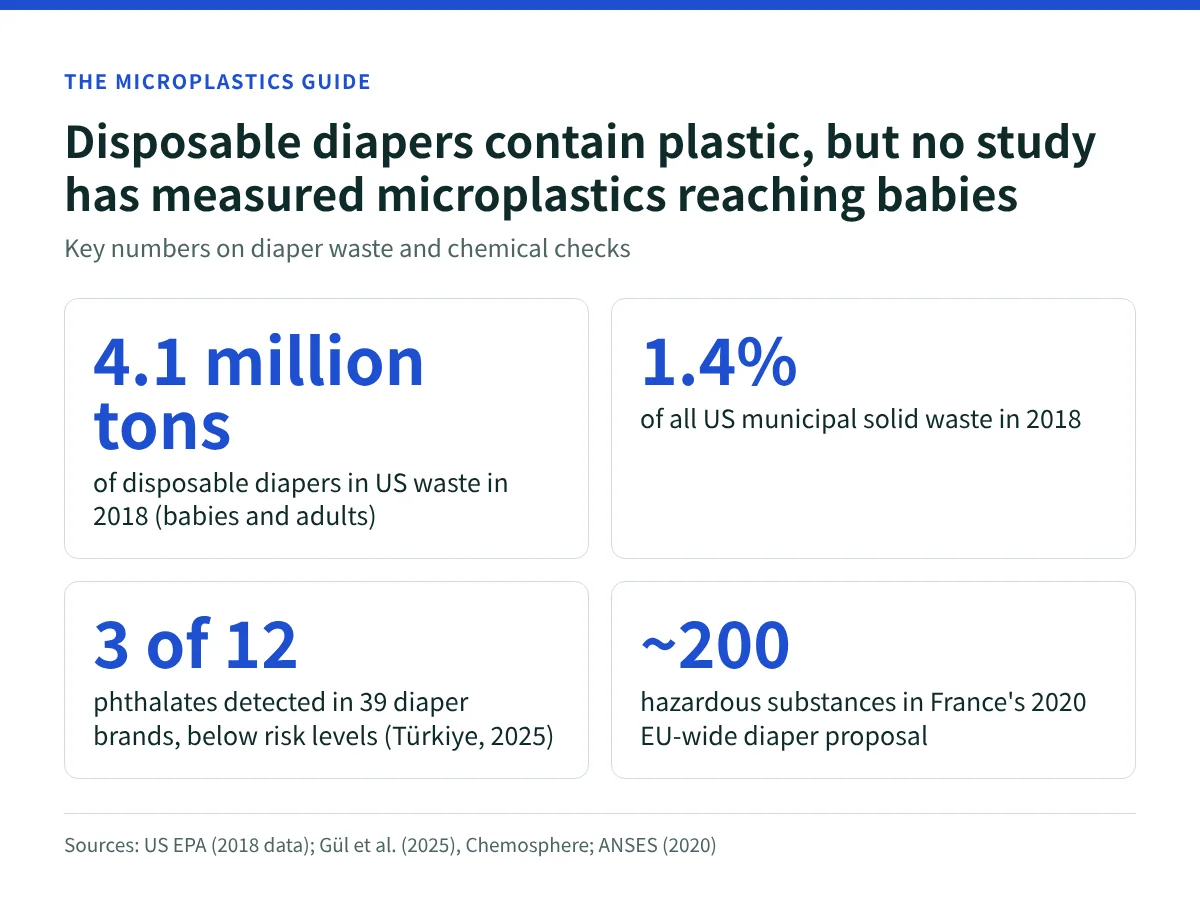
Yes, disposable diapers contain plastic. The US Environmental Protection Agency says their materials include wood pulp, plastics and super-absorbent materials, and Americans threw out 4.1 million tons of them in 2018. Whether diapers expose babies to microplastics has not been measured. For the wider picture, see our babies and kids guide.
What are disposable diapers made of?
The EPA lists three main material groups. Diapers contain wood pulp, plastics and tissue paper, and the plastics include the super-absorbent materials now found in most diapers.
The plastics named in diaper research are polypropylene, polyethylene and a superabsorbent polymer, or SAP. A 2025 study in Chemosphere describes diapers as made with polypropylene, polyethylene and SAP. SAP is the gel-forming material that holds liquid in the core.
The EPA's figures cover both baby diapers and adult incontinence products. In 2018, diapers made up 1.4% of all US municipal solid waste.
Is the gel in diapers a microplastic?
Under EU rules, yes. The European nonwovens industry group EDANA wrote in June 2025 that SAP are microplastics under the REACH definition. That definition comes from the EU's 2023 restriction on intentionally added microplastics.
Diapers are not banned, though. EDANA says diapers and pads with SAP are exempt when the gel is contained by technical means, so it is not released to the environment. In other words, the rule targets loose particles, not a sealed diaper core.
This tells you what the material is. It does not tell you whether particles reach a baby's skin.
Do diapers release microplastics onto a baby's skin?
Nobody knows yet. A 2026 review for the Plastic Soup Foundation gathered about 350 studies on everyday microplastic exposure. It mentions diapers only in a list of baby products and reports no diaper measurements.
The same review calls microplastic release from wet wipes plausible but still a data gap for human exposure. Diapers are in a similar place. Researchers studying microplastics in baby stool even flag diapers as a possible source of sample contamination, which makes the question harder to study.
What chemicals have been found in diapers?
Chemicals are a separate issue from plastic particles, but parents often ask about both. Two official or peer-reviewed checks stand out.
- France, 2020. The food and health safety agency ANSES proposed an EU-wide limit on almost 200 hazardous substances in disposable diapers. These include PAHs, dioxins, furans, PCBs and formaldehyde, which likely come from raw materials and manufacturing.
- Türkiye, 2025. Researchers tested 39 diaper brands for 12 phthalates and detected three: BBP, DEP and DnBP. Their risk assessment found the levels did not pose a risk to babies.
ANSES said its proposal aims to protect the 90% of European children under three who wear disposable diapers. Its page does not give a final EU decision.
How strong is the evidence?
| Claim | Rating | Why |
|---|---|---|
| Disposable diapers contain plastic | Strong | EPA material data and industry statements agree |
| The diaper gel counts as a microplastic in the EU | Strong | Follows the EU definition, as the industry itself states |
| Diapers shed microplastics onto babies' skin | Unknown | No measurement study found |
| Trace chemicals in diapers harm babies | Emerging | Regulators found contaminants; one 2025 study found phthalates below risk levels |
The phthalate study covered one country's market. The ANSES work is a regulatory proposal, not proof of harm. No study has linked diaper use to health effects from microplastics.
What can parents do?
Diapers are a necessity, and any type can be a good choice. If you want to reduce plastic where it is easy:
- Change diapers often. This is good for skin health, whatever the diaper is made of.
- Never flush diapers or wipes. Bag them and put them in the trash.
- Read the label. Some diapers list their materials; look for which layers use plastic.
- Cloth diapers have trade-offs. Some use synthetic fabrics such as polyester, which can shed fibers in the wash like other clothing. Our clothing and laundry guide explains how to wash with less shedding.
- Focus on bigger sources too. How you heat bottles and food matters, as our article on breast milk storage bags shows.
Pads use similar plastic layers, as our check of microplastics in tampons and pads explains. There is no proven way to remove microplastics from the body, and no test or "detox" is recommended for babies.
Frequently asked questions
Are cloth diapers plastic-free?
Not always. Some cloth diapers and covers use polyester or other synthetic materials. Natural-fiber inserts such as cotton or hemp avoid synthetic fibers, so check the label for each layer.
Is the gel from a burst diaper dangerous?
The gel is a superabsorbent polymer that the EU classes as a microplastic. If a baby's skin or mouth contacts gel from a torn diaper, wipe it off. Call your doctor or poison control if you are worried.
Do diapers cause microplastics in baby poop?
No study has shown that. Researchers who measure plastics in baby stool treat diapers as a possible source of contamination in the sample, so they take steps to avoid it. That is a lab-method issue, not proof of exposure.
Keep reading
Sources
- US EPA (data for 2018): Nondurable Goods: Product-Specific Data, Disposable Diapers
- EDANA (June 2025): Position on REACH restriction on intentionally added microplastics
- Leslie, H.A. (2026), Exploring Everyday Microplastic Exposures, Plastic Soup Foundation
- Gül et al. (2025), Phthalates in diapers: Assessment of dermal exposure of babies and environmental phthalate release, Chemosphere 376:144283
- ANSES (December 2020): ANSES proposes an EU-wide restriction of hazardous chemicals in disposable diapers