Plastic pipes can release microplastics into drinking water. A 2026 lab study found new PVC and polyethylene pipes shed up to about 100 particles per liter, but release dropped sharply by the third test round. For the bigger picture on tap water, see our drinking water guide.
Do plastic water pipes release microplastics?
Yes, at least in the lab. A research team tested six materials that touch drinking water, from pipe plastics to a cement lining. Their study was published in Molecules in 2026. They filled samples with water for 72 hours at 73 °F (23 °C), three times in a row.
An oriented PVC (PVC-O) pipe released about 56 particles per liter in chlorinated water in the first round. That fell to about 36 in the second round and was not detectable in the third.
A high-density polyethylene (HDPE) pipe released about 48, then 100, then about 8 particles per liter. A second polyethylene pipe peaked at about 112 particles per liter in unchlorinated water in the first round.
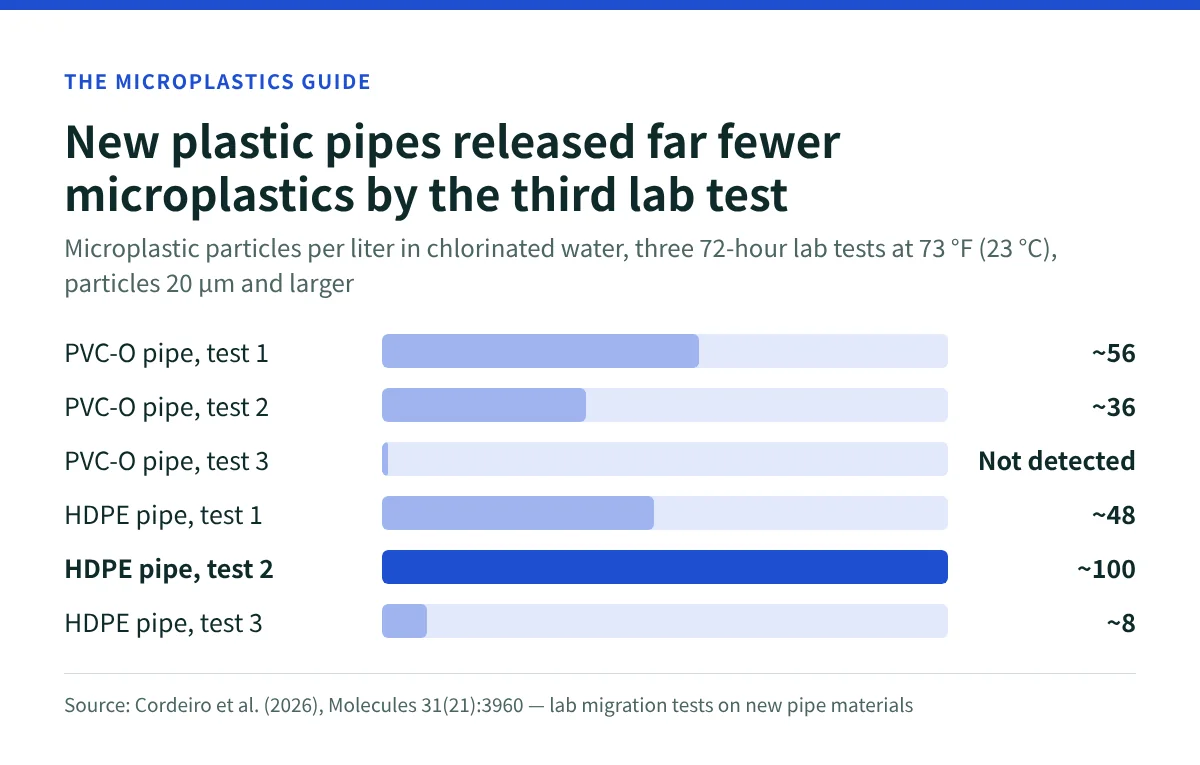
The study counted only particles 20 micrometers (µm) and larger. Most were 20 to 100 µm. Smaller particles and nanoplastics were not measured, so real totals may be higher.
Which pipe materials shed the most?
In that study, the polyester resins used in glass-reinforced plastic pipes and the PVC-O pipe were the biggest contributors. One polyethylene pipe and the cement mortar lining were the most stable. The authors said material composition was "the primary factor" behind release.
| Material tested (2026 study) | What it is used for | Result |
|---|---|---|
| Polyester resins (GRP) | Large composite water pipes | Among the highest release |
| PVC-O | Water transmission pipes | Among the highest; not detected by round 3 |
| HDPE PE100 | Pressure pipes | Peak of about 100 particles per liter |
| PE pipe (EN 12201) | Distribution pipelines | Among the most stable |
| Cement mortar lining | Inside ductile-iron pipes | Most stable; no polymer of its own |
Note what was not tested. These are mostly utility pipes, not home plumbing. PEX and PPR, two plastics often used for pipes inside homes, were not in this study.
Does hot water or chlorine make it worse?
Chlorine did not make a clear overall difference in the 2026 study. The gap between chlorinated and unchlorinated water was not statistically significant (p = 0.090). Effects varied by material.
Heat may matter more for home pipes. A 2024 study in the Journal of Hazardous Materials tested PPR pipes. Chlorination, heating and freeze-thaw cycles all sped up microplastic formation and chemical leaching. The leachate also shifted lab bacteria toward more disease-linked types.
Pipes can also release chemicals, not just particles. A 2025 study in Environmental Science & Technology soaked PVC, PPR and PE pipes for 30 days at about 77 °F (25 °C). It found additives such as bisphenols and organophosphate esters, with peaks of 700 nanograms per liter for one flame retardant.
How strong is the evidence?
Emerging. Lab tests show new plastic pipe materials can shed particles, and release falls as they are rinsed. But these were short tests on new samples, not years-old pipes in real homes.
A 2022 review of 92 studies found tap water from polymer pipes had the highest average levels of the contaminants reviewed. It also linked older pipes with more microplastics. That is an association, not proof that pipes caused it.
No study has yet measured how much your home's plumbing adds to the microplastics in your glass. Measurement methods also differ a lot between labs; see why microplastics numbers vary.
What does this mean for you?
There is no reason to rip out plastic plumbing. The particle counts in these tests were modest, and they fell as the pipes were rinsed.
- Drink and cook with cold water. Heat sped up release from PPR pipes in the lab.
- Flush new pipes well. Release fell sharply after the first rounds of contact in the 2026 study.
- Choose certified pipe when you renovate. NSF/ANSI/CAN 61 sets health limits for chemicals that pipes and fittings add to water. It does not cover microplastics.
- Filter at the tap. A filter with an NSF/ANSI 401 microplastics claim must cut 0.5 to 1 µm particles by at least 85%. It sits after your pipes, so it catches what they shed.
If your water comes from a private well, read what studies found about well water microplastics.
Regulators are starting to pay attention too. Read what the EPA drinking water watch list means for your tap.
Frequently asked questions
Is PEX pipe safe for drinking water?
No study we found has measured microplastic release from PEX. If you install it, choose pipe certified to NSF/ANSI/CAN 61, which covers chemicals. Using cold water for drinking is a simple precaution.
Are copper pipes better than plastic for microplastics?
Metal pipes have no plastic of their own to shed. But pipes are only one possible source of microplastics in tap water, so switching pipes will not remove them all. A certified filter at the tap is more practical.
Does running the tap reduce microplastics from pipes?
No study has tested this directly. Lab results show new pipe materials release fewer particles after repeated rinsing. For a measurable reduction, use a certified filter.
Keep reading
Sources
- Cordeiro, Penetra, Carneiro, Cardoso & Almeida (2026), Microplastic Release from Drinking Water Contact Materials: Material-Specific Responses to Chlorination and Implications for Consumer Exposure, Molecules 31(21):3960 (preprint page)
- Yang et al. (2024), Microplastics and chemical leachates from plastic pipes are associated with increased virulence and antimicrobial resistance potential of drinking water microbial communities, Journal of Hazardous Materials 463:132900
- Fan et al. (2025), Unveiling Chemical-Microbial Cascade Risk Factors from Plastic Pipe Leaching in Drinking Water, Environmental Science & Technology 59(42)
- Food Packaging Forum (2022): Contaminants migrate from pipes into drinking water worldwide (on Mohammadi et al., Environmental Science and Pollution Research)
- NSF: NSF/ANSI/CAN 61 Drinking Water System Components – Health Effects
- Tap Water Data: Filters for microplastics and NSF/ANSI 401